

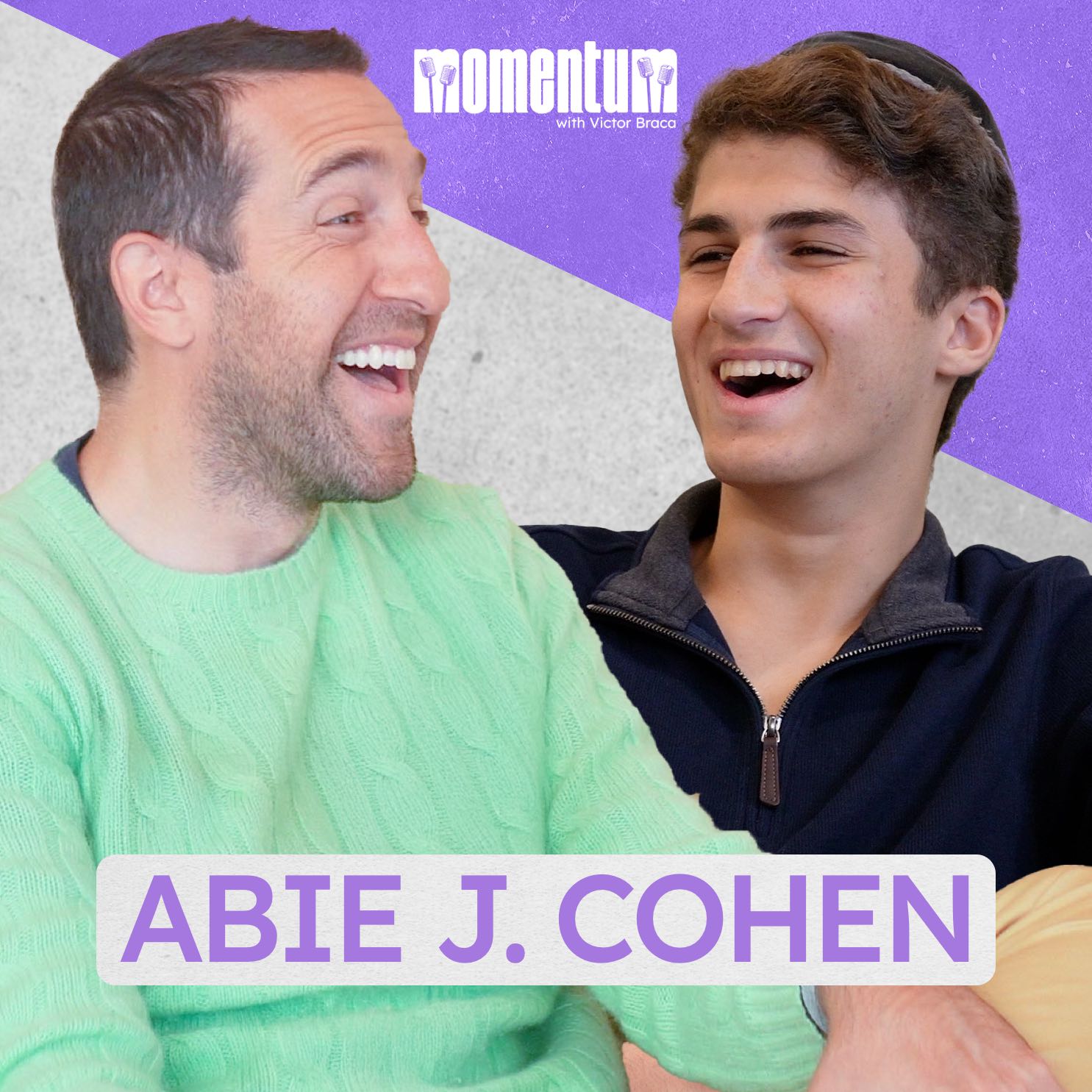


Abie J. Cohen is the founder and managing partner of Centre Street Partners, an NYC–based venture capital firm that’s backed dozens of startups with their latest fund.
In this episode, Abie breaks down how venture capital really works, why he bets on people over ideas, and what thousands of startup pitches have taught him about success.
Enjoy!
Sponsor
Transcript
Abie Cohen: First fund was a $16 million fund.
Victor M. Braca: So you were at UBS for 13 years.
Abie Cohen: Yeah, 13 years. Every three months I had a different manager. I got to get exposure to the CEOs, to the low-level employees, and everyone in between. When I ultimately left UBS, I had spoken to thousands of people across venture capital and private equity.
Victor M. Braca: You were at a position where you’re like, “Wait, I can leverage that to potentially start something in the private investing side.” Is that right?
Abie Cohen: The most important component of a company’s success is—
Victor M. Braca: My guest today is Abie Cohen, founder and managing partner at Center Street Partners, a New York-based venture capital firm. This episode leans a little bit more into the technical side of finance and venture capital, but in a way that’s super eye-opening. We talked about what it really means to bet on the jockey, not the horse, how Abie raised his first $16 million fund with the founder of WhatsApp, and why most of the 5,000 pitches he’s heard never turn into investments.
We also got into how Center Street’s new $60 million fund is shaking up the model by buying majority stakes in cash-generating businesses and layering in AI. I’m Victor Braca. Momentum is where we dive deep into the stories behind business success. Guys, if you want to learn about how top investors really think about people, money, and risk, you’ll want to stick around until the end of this one. It was a really solid episode. Enjoy. Big thanks to Kosher Media for sponsoring this episode. More on them later.
Abie Cohen, welcome to Momentum.
Abie Cohen: Thanks for having me, Victor.
Victor M. Braca: You meet a lot of people. You interact with so many founders and executives and people who have founded startups, which I think is very interesting. We’ll get to that and your entire career history. If I had to ask you in your own words, how do you explain what you do in the most impactful way possible? What would you say?
Abie Cohen: I invest in people. I seek out talent. It doesn’t even necessarily need to be business talent, but I seek them out, see potential in them, and try to find a way to buy into what they’re building. It ultimately or usually culminates in investing dollars out of a fund into an individual and their business endeavors with their startup in some instances, but I invest in people. That’s how I describe it.
Victor M. Braca: What does it mean that you invest in people? Because most people would think you invest in companies.
Abie Cohen: Yeah. At the early stage of company building, especially in venture-backed companies, the most important component of—or the determinant of—a company’s success is the individual behind it. Not the idea.
Victor M. Braca: Not the idea.
Abie Cohen: Absolutely not. People like to use that analogy of betting on the jockey versus the horse or the track. We bet on jockeys. Most venture early-stage investors bet on jockeys, and they’ll tell you that companies that they thought were going to be great or ideas that they thought were going to be great end up turning out the opposite. It all is determinant of who the individual is, how much grit they have, how much earned insight they have into being able to build in the category that they’re building in, how they’ve been able to face obstacles, be resilient, and overcome obstacles to just get to the next step and get the momentum that they need to grow a company. So, it absolutely comes down to the individuals.
Victor M. Braca: We’ll get to your story very shortly—we usually cover that in the beginning of the episode—but I want to ask you, just to build off of this conversation, how do you feel out an individual?
Abie Cohen: That’s a great question. We just try to spend as much time with them in person as possible, whether it’s Zoom or actually one-on-one. That’s really it. I mean, we do a bunch of reference checks. We try to get a sense of how they think around all sorts of different elements of both business and non-business and try to get to the crux in short order of whether or not we feel like we can back them. Where they’re high integrity, honest, and have good values, of course, which is probably the hardest thing to get to. But we try to align on that level and get to the bottom of whether or not we feel like with their initiative and the momentum that they’re putting on the idea on paper, whether or not they can get to at least the next stage of funding.
Victor M. Braca: Interesting, betting on people, not companies. So take me back to your earlier days. Were you always entrepreneurial?
Abie Cohen: No, I would not classify myself as entrepreneurial. Nor do I now classify myself as entrepreneurial, even though it’s all relative, right? I’m amongst dozens and dozens of entrepreneurs on a day-in, day-out basis. I really don’t call myself a founder by any means. The founders are the guys like you, the founders of businesses that are putting their neck out there and leaving money on the table from a corporate job to go start something, sacrificing family and the like.
Victor M. Braca: So, you did do that though. You did do that in some respect.
Abie Cohen: In hindsight, but again, it’s all relative. I never thought of myself as entrepreneurial. Went straight into corporate America right out of undergrad. I went to NYU Stern and then I went to UBS for 13 years. So, I mean, I was a company man moving up the ladder, looking for promotions.
I went lateral a couple of times within the organization into different roles which were, I would say, out of the box in terms of what those lateral moves were. I moved from a training program into an equity derivative sales and trading program which was very markets-oriented where you watch the markets and sit behind eight screens for 12 hours a day. And then I moved over into an extremely client-facing role—the complete opposite. Something where I’d be out and about and try to have as many conversations, coffees, lunches, and dinners with as many people as possible and try to build a network.
So in that regard, there was definitely some gumption for me to think, “Okay, how do I need to build the next set of skills for me to ultimately continue to learn and continue to succeed in business?” And I think maybe I’m entrepreneurial-open-minded to taking on new risks and doing different things.
Victor M. Braca: Okay. So take me into when you first started college. NYU Stern—I’m actually starting there in two days. Take me into that. Did you know that you wanted to pursue a certain track?
Abie Cohen: Yeah, I definitely went down the finance track from the onset. I applied to undergrad business school—which we could talk about the positives and negatives of—and wanted to stay local in New York mostly as a function of wanting to intern right out of the gate, and that facilitated that really easily.
But yeah, finance was the track. I graduated in 2007, entered class in 2003. The stock market was very popular at that point. It was a bull market. My dad also ran a hedge fund for a very long time. He came from the public markets. So we just sort of grew up with the Wall Street Journal on the kitchen table and that’s what I was definitely attracted to. I never considered non-business as a pursuit. It was always the finance track as opposed to marketing or management or anything that comes with Stern these days, which I hear is a lot more diversified than it used to be.
Victor M. Braca: Right. I mean, I guess you can be a computer science major in Stern, you can do anything. Obviously, AI is changing the game too with respect to how business is taught and learned. But you were going down the pretty traditional sales and trading route?
Abie Cohen: Not even investment banking. Sales and trading.
Victor M. Braca: Got it. A lot of people are focused on investment banking. What is sales and trading? What did that look like however many years ago? Was it what it looked like in the Wolf of Wall Street, where you’re sitting at a desk taking calls and stockbroking? What was sales and trading in 2005, 2007?
Abie Cohen: It’s not too dissimilar except I would like to say it’s a lot quieter on a trading floor than what it was in Wolf of Wall Street. It’s a big, huge trading floor, all sorts of different individuals, a lot of screens. It wasn’t only sales or traders on the trading floor. There were lawyers on the trading floor, there were managers on the trading floor. It brought the whole organization in a hierarchical way to this open floor plan which I think could be studied for whatever it’s worth.
We were predominantly creating financial products—they call them structured products—for clients of ours, clients of UBS, to be able to buy. These were derivative products. These wasn’t necessarily stocks or bonds, but they would offer the client a return based on the performance of a stock or bond, but not directly. You didn’t actually go out and put a stock or a bond into the product. You had an option or some sort of derivative that would return or yield based on the performance of that. An option is a derivative of a stock performance.
Victor M. Braca: An option is a derivative.
Abie Cohen: Yes, because it’s not the direct actual product. It’s affected by it, but anyone can create it and anyone can buy and sell it and create a market for it. You don’t have to be listed on the exchange. It’s almost sort of like a bookie in gambling, right? They create this book of bets based on what the football outcome is, but they’re not determinant of what that football outcome is. They just have a book that can hopefully yield a positive return irrespective of what that outcome is. So you’re creating what’s called financial products for clients of the company, let’s say like clients of wealth managers at UBS, for example, to invest in.
Victor M. Braca: So when you first joined UBS, what did it look like? What was your job when you were a junior? Like a junior banker gets kicked around and bullied—was that your case?
Abie Cohen: Yeah. I did some internships that were grunt work for lack of a better word, but I thought that was a good opportunity to just knock it out of the park in terms of what they would expect of you and make myself invaluable for wanting to be hired by them ultimately.
I entered a training program which was a two-year rotational program, a very formal group of 20 or so college undergrads. It was the cream of the crop from all sorts of different colleges. They gave us three or four months of technical training—Excel, Series 7, Series 63—and then we were just parachuted into different parts of the organization as a jack-of-all-trades help. They held us in high regard there, so they gave us a lot of leeway and opportunity to forge our own path within a particular team, and we would rotate every three months.
So I got to see the whole organization. I got exposure to the CEOs, to the low-level employees, and everyone in between. At the end of two years, you sort of looked in the mirror and said, “What did I like? What didn’t I like about those eight or so rotations?” You try to see if you can get a job permanently in one of those roles. They would call that “placing out” into one of those roles.
Victor M. Braca: Do you know if that program is still around?
Abie Cohen: Yes. It’s called the graduate training program at UBS Wealth Management. UBS has multi-trillion dollars of assets around the globe and it’s a pretty prominent wealth management program. It wasn’t investment banking where we were Excel and PowerPoint junkies for two years working on big M&A or IPO transactions. It was much more management-oriented or organizational-oriented around wealth management as a business, not even necessarily managing client assets one-on-one. You learned A to Z of what that organization looks like and then you get to be full-time in one part of that organization. I chose that derivatives sales and trading role after.
Victor M. Braca: So you ended up choosing that. What are some of the other things that you saw as you cycled through the different parts of the organization?
Abie Cohen: Well, the most interesting and valuable thing for me was that every three months I had a different manager. You have to adjust on the fly to different personalities, different skill sets, and different technical hurdles that you’d have to get up to speed on quickly. That to me was a very interesting learning experience. As I got through the program—9 months, 12 months, 15 months—it became much easier to adjust to an individual quickly and then ramp up for the next three months working with them.
Second thing was I very quickly got to see a Fortune 500 organization and all the divisions and workflows that it entails—from the office of the CEO to the marketing department, technology department, client-facing roles, compliance, and operations. We just got to see all that and understand it. Now, in terms of how I think about investing in startups and helping founders build companies, I have a good sense of how they need to prioritize building the elements of the organization as responsibly as possible. I have a good sense of what a Series C stage company needs, what a Series A stage company needs, what B, C, and D need, and then ultimately can even envision taking a company from a seed to IPO and how an organization would need to be built.
Victor M. Braca: Right. So you were at UBS for 13 years, from when you were 22 to 35 approximately? That was most of your life at that point. Did you get married in that time? Did you have kids in that time?
Abie Cohen: Yeah. I met my wife actually before I started at UBS. When I was a senior at NYU, we met, we dated a bit, broke up, and got back together when I was 25 or 26, right in the meat of that job. We were married at 27.
I remember the night before the wedding, I actually went out with our co-workers. We would go to a movie every quarter or so as a team-building exercise. I saw the movie Prometheus, which was amazing, the night before we got married, and then the next day was the wedding, which was just such a difference of scenery.
Then our honeymoon and such. I moved over to the next role at UBS when I was about 31 or 32, which was much more entrepreneurial as a financial advisor trying to build my own book of business—your own team at the company. It had a “kill what you eat” compensation model, which is different than my salary and bonus was. I could go weeks without making any money or go weeks with making a lot of money, but it was not predictable. We had twin girls in the middle of that, straight into COVID.
The other nuance is my wife, Leandra, is an entrepreneur. I married an entrepreneur and I knew she was one from the onset. I was attracted to that. So we both, before kids especially, were working our tails off during the day and even at night. She did a lot of travel and I traveled with her for work, which was cool. We both had a two-worker household from the onset.
Victor M. Braca: So you were at UBS and before you switched into the wealth management role where you started building your own team, you were in the sales and trading role for about five years. Why did you switch?
Abie Cohen: Two years of training, five years of sales and trading, and then about five or six years of wealth management. I had done five years of sales and trading and I was one of the younger ones on the desk. Ultimately my conclusion was, “Do I want to be—can I envision myself being my boss in 20 or 30 years? Would I want the outcome that he has?” And that was the ultimate decision to make: “No, I do not want to become that person or have that lifestyle.”
Victor M. Braca: That’s a good way to think about it.
Abie Cohen: Yeah. So I said, “Okay, I’m going to transition sooner rather than later.” Even though I put in one or two years extra than I probably should have, no regrets. I looked across the street at the industry and I actually entertained maybe taking an operating role or working in a real operating business somewhere. I really thought hard about what I would need to continue to build my skill set and grow as a business person.
Ultimately I said, “Wait, my clients are financial advisors and clients of UBS—really wealthy individuals.” I saw that skill set they had interpersonally to be able to win the confidence and the money of their clients was really special. The concept of being able to influence individuals—I don’t want to say manipulate, but have people buy into what you’re doing—is invaluable across anything you’re doing, like sales.
So I said I’ll step out of my comfort zone and go into the role of financial advisor, which technically speaking I could do in my sleep. I knew what these guys did and I was familiar with the firm at UBS, so I could plug into the organization really easily and take advantage of that and try to start building my client list from scratch.
That was a blur at this point but challenging—literally putting names on paper. The Syrian community is great because we just know a lot of people. Everyone at a wedding—maybe they’re not your friends but they’re acquaintances and you know someone that knows someone that can get to someone. So I started building a list of individuals and reaching out. Breakfast, lunch, dinner, coffee conversations, email, text—just going down the list and over the course of the first couple of years trying to convert those individuals into clients of mine and UBS.
Victor M. Braca: So the sales and trading role was creating products that the wealth managers were going to invest their clients’ money into. The wealth manager role is just sales, pretty much? I don’t want to boil it down to nothing or understate it, but is that really the crux of the job?
Abie Cohen: The firm wants to make it just sales for the advisor. They want to make it easy for the advisor to pick a stock, a bond, a mutual fund, or do a financial plan, estate planning, and the like. They house all the technical nature of that in the home office. They want the advisor out there bringing in business.
The better advisors are technical and good at sales. Then you have advisors that are massively successful that, if you followed them on a day-to-day basis, were never behind a screen and were just really, really good with people. Networking junkies, I don’t know what you want to call it, but if you had to grade who was really good in terms of the money they made, they will chalk it up to their sales skills.
If you were a good trader or stock picker, you’d be doing that as a specialty in a different organization. If you’re an amazing trader, you’re doing it at a hedge fund where you can get 20% of returns and 2% management fees, not the model at UBS. If you’re a great estate lawyer, you’re doing it in private practice at a white-shoe law firm. As a financial advisor, you had to be a jack-of-all-trades, but ultimately it was contingent on the network you were able to build and your ability to onboard clients and attract their money.
Victor M. Braca: So around 30 years old is when you switched into the wealth management role. Switching internally within the UBS ecosystem—was that something you took very deeply and really thought a lot about? Was it a life milestone decision?
Abie Cohen: I was hesitant to stay at UBS. I was looking at different roles at different banks and different operating companies altogether. But ultimately I did a good job climbing the ladder and winning favor across a whole host of people at the firm. I saw my value or skill was that I’m likable and I had been able to build a lot of credit within the organization. How could I throw that down the drain and not leverage that when taking the next step? I wanted it to compound.
I very well could have been a lifer there if things worked out great within the wealth management role or if COVID didn’t hit. I very well could still be there and very happy. UBS has only grown. They bought Credit Suisse and they’re really known as the premier high-net-worth or ultra-high-net-worth private wealth management shop now.
Victor M. Braca: Did you join a team or start your own team?
Abie Cohen: I started my own practice alongside a mentor of mine that had a big practice at that point, just for tips and guidance. I’d work near his office and leverage his team a little bit. But ultimately they were my relationships, my clients, and my way of investing.
That was probably the first real entrepreneurial endeavor I took. It was a completely solo effort where, if I didn’t want to show up to the office five days a week, I didn’t have to. I had no boss. Again, what you kill you make. You only make as much money as you’re able to produce, not a salary and bonus.
Victor M. Braca: That’s cool. So right in line with the entrepreneurial journey. How does the partnership or structure work between you and UBS? Are they paying you? Are you paying them a licensing fee for their name?
Abie Cohen: You’re an employee of UBS, so W2, not 1099. UBS takes a percentage of revenue that you generate—somewhere around 50%. But you’re an employee where you’re getting a base salary, though it’s minimal, and what’s extracted from that are benefits, health insurance, 401k, etc. They provide you with an office, computers, and technology systems, and for that you pay them 50% of the revenue you generate. And for the brand, of course, which is important. It’s a pretty baked-in model across all these firms for wealth management. There are 50,000 advisors under a platform like this—from Goldman Sachs to UBS to Morgan Stanley to Merrill Lynch. Historically it was predominantly stock picking and selling, and now it’s predominantly financial planning and holistic wealth management advice.
Victor M. Braca: You were in this wealth management role at UBS for five years. Did you grow a team or were you solo?
Abie Cohen: I was solo. I had an assistant and continued to hack out a way of bringing on as many clients as I could as a solo practitioner. I wasn’t at the point where I was able to consider partnering with another advisor yet. Then COVID hit, and it sort of just changed the whole trajectory of what a solo practitioner financial advisor business is.
Victor M. Braca: What did COVID really do to you?
Abie Cohen: I determined that my business wasn’t at scale yet. A lot of these advisor practices are on autopilot in some respect. They invest their client’s assets into a fee-generating product where every month a fee is taken out from the client’s account and paid to the advisor. It’s predictable recurring revenue. My business wasn’t at a big enough number for it to be a career. I was still hacking away trying to get commissions and doing all sorts of different things.
When COVID hit in March and April 2020, clients were extremely scared of what the markets were going to do. Ultimately the business dried up. I had the same amount of clients and the same dollar value of assets, but they weren’t being charged the way they could be in a more stable market. New client development stalled. You couldn’t do any meetings. No one wanted to change advisors in the middle of this craziness.
I was working out of my bedroom downtown with my wife. She was in the bathroom, I was in the bedroom—we moved the desk in there. We had 18-month-old twin girls running around the apartment. We were expected to be working all day, 9 to 5, essentially having the same conversation with the same client day after day to try to walk them off the ledge of the nerves and anxiety. It was a lot of therapying individuals and not getting the opportunity to actually generate dollars.
My wife, too, was running a business of 20 employees that went fully remote. Advertisers pulled their dollars instantaneously. We had to lay off some people and were doing that all from the bedroom in April and May of 2020, which was crazy. At the same time, I had started doing a bunch of angel investing over the prior five years in conjunction with being a financial advisor.
What was unique was that I was expected to be out there courting individuals, but I found myself courting predominantly New York City-based entrepreneurs and startup founders. That was a really burgeoning scene that became very impressive. I was attracted to that group. I tried onboarding them as clients at UBS because these were all people in my age cohort. Socially I saw a lot of them because my wife was an entrepreneur in the media space. They were building real businesses that were starting to become venture-backed—like Harry’s, Glossier, and Warby Parker.
I ultimately tried courting them to become clients of mine and realized I found more fulfillment in learning about their businesses and potentially investing personal dollars. I did that once or twice into an apparel business and a skincare business. Very quickly there was success, whether it was the next round of funding or monetization events where they sold to bigger companies. I started investing even more personal dollars. Leandra would help them with promotion and marketing and I’d help them with general advice and trying to find other sources of funding. Over the course of five years at UBS, I was also building this private investment practice on the side, nights and weekends.
Victor M. Braca: As a venture capitalist with a fund, you have the leeway to go into a business and learn everything you need to know. As an angel investor, do you have that same respect in terms of “tell me everything and all your numbers”?
Abie Cohen: That’s a great question. No. These are also super early businesses. There’s usually an institutional investor that’s done a lot of the diligence. But we’d write a check for $10,000 or $15,000 into a founder after having a coffee meeting with them and just being bought in. They were running a proper fundraising process and we were a brick in their wall on their way to $2 million.
A good component of what we would do was there was a positive association with Leandra as an investor because of the platform she built. There was always an opportunity for her and her employees to market that business in a disclosed way. For context, she ran digital media that evolved from a blog into a proper content site focused on fashion and female content from 2010 to 2020. Man Repeller closed in 2020 during COVID.
Victor M. Braca: Interesting. I should interview her too.
Abie Cohen: Oh yeah, she’s been on hundreds of podcasts. She has since started a Substack. 2020 was a pivotal time for both of us.
Victor M. Braca: At what point did you say enough with the wealth management, I’m going all into the investing?
Abie Cohen: What COVID really did was no one moved. Everyone was on Zoom. As a concept, having a full schedule did not exist in my opinion until COVID because there was no travel time. Every half hour I would have a conversation with someone—a client at UBS, a founder pitching a company, or a fellow investor.
In December 2020, when I ultimately left UBS, I had spoken to thousands of people across venture capital, private equity, and consumer investing. I was at a position where I was like, “Wait, I can leverage this network to potentially start something in the private investing side.” I left UBS not sure what to do completely. There was no job on January 1st of 2021, no salary. I wanted to figure out how to start investing full-time, whether that was a fund or running SPVs. Over the course of 2021, I figured out the fund structure, Center Street Partners, and investing in early-stage venture capital was what I was going to do.
Victor M. Braca: From January to October, there was a lot of uncertainty. What were you doing during that time?
Abie Cohen: Behind the desk at home, continuing to work the network and searching for deals. It was a very hot market—probably the worst investments made at any point were made in 2021. It was private investing, the who’s who of consumer and technology companies. This was the zero interest rate era.
Whatever it was, it gave me the confidence to go out and fundraise. Fundraising wasn’t impossible during that time. Markets were up and sentiment was high. I got very good reception to raise a venture fund based on what I had learned in the early-stage consumer practice and the access we had.
Victor M. Braca: When you’re investing in a business, how much money are you investing per business?
Abie Cohen: The strategy for venture capital is to invest in a lot of companies. Every company should have the potential to outsize the entire fund with their returns. They call it the power law. A typical venture capital fund will have 25 to 30 companies. Pre-seed and seed stage companies raise between $500,000 and $4 million for the first money into the company. We were investing $500,000 checks into 25 businesses.
The expectation is that in a portfolio of 25 businesses, 70% to 80% of those companies will not return any dollars. The balance of those companies will return the bulk of the fund and hopefully a multiple. We’re targeting five times over the course of 10 years. We need one or two winners to have grand-slam outcomes, but the expectation is most of those companies will fail.
Victor M. Braca: How do you remove the emotion from putting half a million dollars into a company that fails?
Abie Cohen: We know that the power law and the law of large numbers is what the data has been showing for a bunch of years. Mind you, my strategy has shifted over the last couple years to be much more control-oriented—owning a majority of businesses, specifically cash-generative services businesses where we feel the real value of AI will compound.
But coming from venture, the goal is to chat with as many founders as possible and build that portfolio of 25 to 30 companies to diversify from a category and founder style perspective.
Victor M. Braca: At this point, how many funds have you guys run?
Abie Cohen: We’re on our second fund now. The first fund was a $16 million fund anchored by Jan Koum, the founder of WhatsApp, who’s been a fantastic supporter of ours. We invested in 25 companies and it’s doing exceptionally well—from AI and software to defense and national security, fintech, and healthcare.
Now we are starting to invest out of our second fund, which is a $60 million fund focused on making considerably fewer investments—12 investments in the portfolio. Three of those businesses being majority-owned cash-generative services businesses. These are not typical technology startups. These are businesses that have already existed, sometimes for decades, being run by operators looking to move on. We then impart talent from a venture network and software and AI that we’ve been exposed to.
Victor M. Braca: It’s a little bit more private equity oriented?
Abie Cohen: Sort of a hybrid of venture capital, private equity, and the search fund. A search fund is when usually an MBA student will raise capital with the intention of buying a company, but not knowing what company or what industry yet. He’ll raise capital from his network to back him to go out and buy an operating business and run it in a more private equity type manner. It’s just betting on one individual—like “here, go fish.”
Victor M. Braca: Where did you get the money from? Was it all a network of previous wealth advisory clients?
Abie Cohen: Predominantly. Everything built up on itself. I moved from derivatives, which was not client-facing, to wealth management, which was building that client-facing nature from scratch, to venture capital, which was purely fundraising. I had a whole rolodex of individuals to court for the fund.
Venture capital as an asset class is considerably more institutional than it ever has been. There’s a whole host of fund of funds, pensions, and endowments. It started with Yale and Harvard—the endowment models that are a good majority private equity or venture capital versus public markets.
Victor M. Braca: Take me into the timeline. Does the fund close before you make the first investment?
Abie Cohen: You’re building the plane as you’re flying it, always. The goal is to get to a “first close.” Once you do that, you have the money to start investing. The typical fund life is usually 10 years. In the beginning couple of years, you’re usually fundraising and investing in unison. You could actually raise capital over the course of two years. I could take your dollars and someone else’s dollars six months apart, and it’s investing into the same fund and same assets.
Victor M. Braca: Let’s say you’re raising money for a fund. You invest a million dollars for 10% of Company X at a $10 million valuation. Six months later, I want to invest in your fund. Company X just raised money at a $20 million valuation. Am I retroactively part of that investment since it’s in the same fund?
Abie Cohen: The short answer is yes. The long answer is there are ways that enable the fund managers to compensate earlier investors for a later investor getting access to an earlier price. Usually, the later investor will pay interest to the earlier investor. In some instances, you can split the fund into two and have an asset here worth X and an asset here worth Y, but generally there’s an interest charge.
The goal is to get all the investors up front day one. We can’t just raise an infinite amount of money. We’re hard-capped at $60 million because we know we can make three investments over three years based on the work adjusted constraints we need to implement. We see value in this $1 to $5 million EBITDA range for a company. If we were to raise a billion dollars, we couldn’t buy $1 to $5 million EBITDA businesses; we’d have to put more money to work. EBITDA—you’ll learn that next week—it’s profit. So we limit ourselves to a certain fund size to execute the strategy as best as we can.
Victor M. Braca: You said it’s all in the individual. If you had to break down a percentage, what percentage is the individual, what percentage is the idea, and what percentage is the execution?
Abie Cohen: They’re not mutually exclusive. It’s the individual first and foremost. The founder comes with an idea. We assess their capability to execute on that idea based on past performance. We only know their actual execution ability once they’re in the business. There’s always room for error. On paper, the founder had an amazing resume and perceived ability, but they’re not a good hirer or a good leader. But the individual is the base layer of the pyramid.
What’s interesting about our strategy now is we’re buying cash-generative services businesses from founders and not expecting them to continue building those businesses. We’re sourcing talent through our network and placing them into these businesses.
Victor M. Braca: At what point do you start calling yourself private equity versus venture capital?
Abie Cohen: Venture capital is just a subset of private equity. It is a private business. Jonathan and I are creating a whole new asset class—a hybrid. People ask, “What box do we fit you in? You’re not VC, you’re not PE.” Steve Schwarzman at Blackstone was doing something different in 1988 when he was building Blackstone. We think we’re forging a path to create a whole new category.
Victor M. Braca: Take me into starting Center Street Partners. How did you find your partners and what was it like in the beginning?
Abie Cohen: I’ll start with the name. Leandra and I lived on Centre Street for five years towards the tail end of it. It’s right in between Chinatown, Nolita, and Soho—a very New York block. Centre Street is famous for being one of the original streets of New York City; the courthouses and marriage house are there. It’s spelled the English way, C-E-N-T-R-E. I stood up that name as a holdco back in 2017 when we started angel investing as a brand for founders to know us as something more institutional.
I had known my partner, Jonathan Kerstein, for three or four years prior. Jonathan has a very interesting career. He grew up in the Five Towns. He went to Baruch College—super smart. Then he made his way over to a firm called Insight Partners out of Baruch, which is very rare. That’s like not going to college and getting a job at Goldman Sachs. Jonathan got into Insight, which is an $80 billion venture capital and private equity firm. They have a buyout practice where they buy public companies and take them private, which is a good foundation for our strategy right now.
We had been getting to know each other through COVID, doing a bunch of deal sharing and co-investing as angels. I started Center Street alone as a solo practitioner with the intention of finding a partner. In January 2022, the whole market turned upside down. There was a major vibe shift and venture was a hard asset class to be in. Jonathan and I were catching up over coffee; it turned into a three-hour lunch and we saw eye-to-eye on what a potential partnership would look like. We spent the next six months deliberating—him leaving Insight, what strategy we would implement, raising additional capital. We finalized that in August 2022. We raised our last dollars in May 2023. We’re partners or practically brothers, and it’s been great.
Victor M. Braca: If you had to estimate, how many startups have pitched you?
Abie Cohen: 5,000.
Victor M. Braca: And how many investments have you made?
Abie Cohen: Between personal and fund, probably about 100. Very low hit rate. I’ve seen 5,000 companies; I’ve probably been formally pitched two or three thousand times. I’ve seen businesses from ideas on a napkin through later stage, a ton of pre-IPO stuff right now, and everything in between—AI, software, fintech, internet, healthcare, media, crypto, hardware, defense. The market to be an entrepreneur right now is really healthy, particularly in America.
Victor M. Braca: What does the landscape look like? Are startups chasing VC money, or are VCs trying to get into a few startups?
Abie Cohen: It’s both. Pre-2022, there were a lot less VCs and they were trying to get competitively into fast-growing startups in a way that bid up the price. In 2022, things shifted. Money was taken out of the system. VCs now had the power back to name a price and pass on startups they felt didn’t reach their bar of quality.
Then ChatGPT and the AI race started. Getting into better companies is harder because there’s a lot more power in the hands of the founders for the high-quality, technical ones. Then there’s a whole subset of other companies that are struggling, whether venture capital is not interested or a sector like consumer is out of favor. It’s all healthy and part of the capitalistic nature of the system.
Victor M. Braca: If we had to pinpoint a couple of hard skills that founders can acquire to make them more desirable, what would those be?
Abie Cohen: Especially at the early stage, a prototype of a product is integral. Very few people are just investing on ideas or decks without a tangible product. Ideally, that founder would have built that product themselves. They either know how to code or they can “vibe code”—work with the AI tools that enable the average person to be extremely more efficient and technical. Showing that you went from zero to something in short order in a self-starting way is extremely important.
People ask me, “What can I do to get a better job?” I’m like, “You got to create something from nothing. Create your own website, tell people you built it yourself.” There’s got to be some foundation for why you deserve to be building that end product.
Victor M. Braca: Right now, how much do you consider the school that a founder went to?
Abie Cohen: Very little. I could stereotype each school and the founder profile. I have 12 schools and I’ll get the same answer from each individual. There’s a Stanford profile, there’s a Princeton profile, and there’s always a Harvard profile. You come out saying the same exact things.
In 2010, Peter Thiel started a grant-making organization called the Thiel Fellowship where he would pay a college student $100,000 to leave college and start a business. Those are college dropouts that have started more unicorns than Y Combinator has. Palmer Luckey from Anduril is a Thiel Fellow. Y Combinator is an incubator that takes hundreds of founders—some dropouts, some graduates—and they check the box on a particular founder profile. Thiel is more about the sacrifice of leaving college and standing out from the crowd. We do not hold the typical profile as that important.
But we do back founders that have insane resumes. Our first investment in Fund Two is into founders who were West Point grads and Army Rangers. One went to Harvard MBA, one to Wharton MBA, one to Palantir for 10 years. These guys are “resume.” They chose from birth to go to West Point. That is impressive.
Victor M. Braca: For a young person who wants to be in the position that you’re in, what do you recommend they do in college or just out of college?
Abie Cohen: I’m definitely an advocate of college generally. You need a diversity of experiences—living somewhere that’s not New York, taking a whole range of classes to find your interest. GPA is still very important in terms of opening doors. In the same regard, if you know your life’s purpose is to start a company in a certain category, I appreciate that too.
Take your academics seriously. There are no pass years; freshman year counts just as much as senior year. Multitasking is the way I’d sum that up—study, work, have fun. I love to see people that are able to take on a lot of tasks at the same time.
Victor M. Braca: What do you think about the piece of advice “follow your passion”?
Abie Cohen: I’m generally supportive of that. If you know what your passion is from elementary school, lucky you. Even if it doesn’t make much money, I support pursuing it. You want to have a diversity of experiences and have it come up in a story where you’re being interviewed. Everything comes down to storytelling. If you’ve done 50 different jobs over three years, it’s not going to be a good story unless you can spin it into something really interesting.
Victor M. Braca: We like to dedicate a part of every episode to giving back. What fulfills you in that way?
Abie Cohen: For a very long time I was searching for a way to give back that wasn’t just donating money. It’s easy to throw money at things. Ultimately, my best approach is doing it on a one-to-one basis. I have about half a dozen people in my life that I just try to support motivationally or psychologically. There’s no financial return; I just do it from a place of intuition that these people need a little bit of me in their lives. The textbook word is mentorship, but it’s so much more. It’s just being a support system for people that need a little bit of help.
Donating time is much more valuable and personal than donating money. Sometimes the people asking for money are the ones who need the money the least and the support the most. Do you just make the problem go away by throwing a $180 check at them, or do you try to get to the crux of what their problem is?
Victor M. Braca: “Ask for advice, get money. Ask for money, get advice.” Is that true?
Abie Cohen: “Ask for advice, get money twice.” Pitbull sings that song. I’m going to listen to it on the way home.
Victor M. Braca: If you had to leave young people with one thing they can do or a skill they can develop, what would that be?
Abie Cohen: Start meditating. If one person asked me for advice on something they could start tomorrow: pick up a guided meditation and try it.
Victor M. Braca: How long do you meditate for?
Abie Cohen: I do 20 minutes twice a day and have been for a very long time. Life is very different pre-meditation and post-meditation. Pick up an app—Waking up by Sam Harris is where I’d start. Transcendental Meditation is also great. I wouldn’t expect anyone to knock it out of the park with their first one, but if you’re willing to sit for 20 minutes with your eyes closed, that’s a big point of validation in my book.
Victor M. Braca: It’s difficult to do nothing for 20 minutes. I’m like everyone else—whenever I have a free moment, I’m reaching for my phone. Have you found that your compulsion to reach for your phone has decreased?
Abie Cohen: Overall, yes, but it’s hard to measure. You’re one with your thoughts and your body, which very few people get to experience. You’re one with your feelings. Also, the wildest ideas come up sometimes where I have to stop and jot it down. You’ll realize that Hashem and the universe are working in different ways.
Victor M. Braca: Abie, I want to ask you for your “Momentum Moment”—the moment where you gained momentum.
Abie Cohen: It was way back in 2010. Leandra and I were broken up at the point, but we had gotten together for lunch. She essentially gave me an ultimatum: we could get back together or we cannot talk to each other ever again. Whatever was happening, I got pushed or influenced by some other power to say yes. I promise you my head was shaking “no,” but my mouth was saying “yes.” That was my momentum moment. It changed the trajectory of my life.
Victor M. Braca: Thank you for coming and for sharing your story. I think for the right viewer, this is going to be very helpful.
Abie Cohen: I’m happy to answer any other specific questions. Feel free to share my info with your viewers because I’m excited about who comes my way for both professional and personal reasons.
Victor M. Braca: Awesome. Thank you so much for listening until the end of this episode with Abie Cohen. Guys, as always, here are my top three key takeaways.
First, bet on people. Whether you’re choosing a co-founder, a partner, or who to hire, the individuals matter more than the idea. Surround yourself with people who have integrity and the ability to execute.
Second, volume matters. Abie has looked at thousands of companies to make just a handful of investments. The same lesson applies outside of VC. The more shots you take—outreach, interviews, ideas—the more likely you’ll find the one that changes everything.
And third, learn to build something from nothing. Abie said today investors want to see founders who can create a prototype on their own. Even if you’re not starting a company, showing you can take initiative and teach yourself new skills will set you apart.
If you enjoy this episode, you’re going to love my conversation with Ezra Dweck. He’s the co-founder of IceCap Group. In that episode, he shares the story of how he lacked direction in his mid-30s with a wife and kids and how that led him to start a huge lending business. Check that out by searching “Momentum Ezra Dweck.”
Please make sure to subscribe and follow us on YouTube, Spotify, and Apple Podcasts. Our metrics show a large portion of our viewers are not subscribed. I want to see you around. And with that, I will see you in the next one.



Leave a Reply