

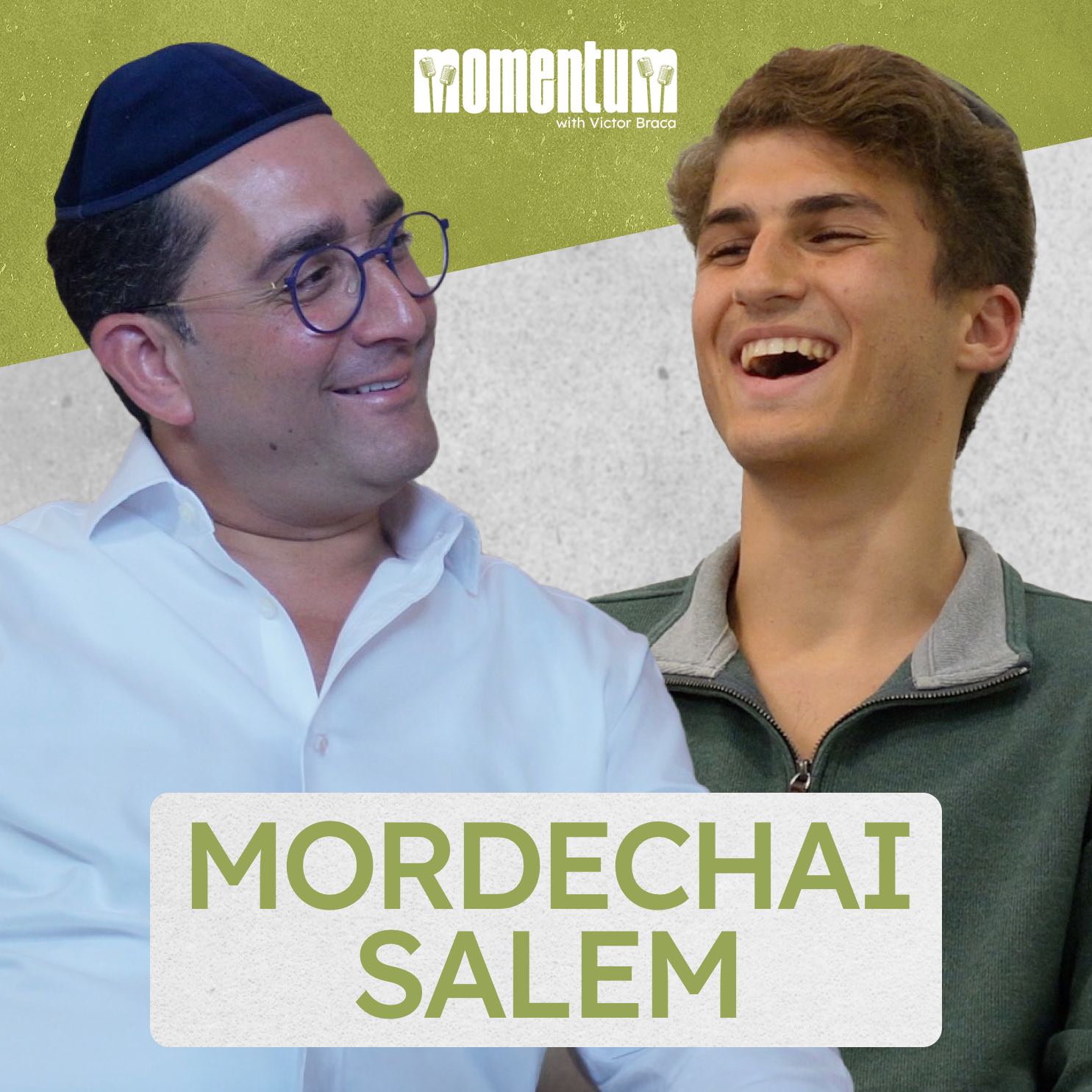


Mordechai Salem is a hazzan (cantor) and wedding singer who’s led prayers in synagogues and performed at weddings and events around the world, from Brooklyn to Cabo to the south of France.
In this episode, he shares his journey from a 14-year-old hazzan in Israel to becoming the premier voice of our community, balancing family, faith, and a career that rarely leaves a free night.
Sponsors
- Yazdi Entertainment, New York’s premiere event production company.
yazdientertainment@gmail.com or (646) 765-5643 - Kosher Media: the #1 advertising network across Jewish communities worldwide. Visit koshermedia.com
Transcript
Mordechai Salem: And there was literally 20,000 people. That was my biggest performance.
Victor M. Braca: How many times a year do you eat dinner at home as opposed to at a wedding?
Mordechai Salem: I could probably count on my finger how many dinners I eat at home. I believe you. It’s really not a joke. That was probably the most amazing moment of my life. At 14 years old being a Hazzan in front of 2,000 people. If I have a bride that calls me up and tells me, “I want you to sing at my wedding, but I can’t afford it,” I’m going to be there. It doesn’t matter. That’s what we do for this community.
Victor M. Braca: Do you listen to your own music? I got to know.
I remember I got a call one day that you know the President Donald Trump was coming to Deal and they want you to sing for him.
Victor M. Braca: My guest today has one of the most recognizable voices in our community and far beyond it. Mordechai Salem is a Hazzan and wedding singer whose music has been played worldwide. He’s performed for President Trump, sung in front of a crowd of 20,000 people, and brought his voice to weddings everywhere from the south of France to Cabo San Lucas to Panama to Brooklyn. In this episode, we talk about how at 14 years old, Mordechai led prayers in front of 2,000 people. How a no-show wedding singer launched his entire career. And—and this is my favorite part—how Mordechai built his schedule in a way that’s so packed that he can count on one hand the number of dinners he eats home every year. Think about that for a second.
I’m Victor Braca, and Momentum is where I dive deep into the stories behind business success. Guys, before we start, I want to define a couple of terms that Mordechai and I use throughout this episode. In case you’re not familiar with the context, when we refer to “community,” we’re talking about our community, the Syrian community of Brooklyn, New York. And it’s a very tight-knit community. You’ll understand when you watch it. And we also talk about “sebit,” which if you’re not familiar, they’re sort of like a Sephardic Syrian equivalent of a Shabbat Chatan. And you’ll understand that in the episode. They happen on Shabbat, obviously. And I just wanted you guys to have that context before we get into it. All right, with that said, let’s get into the episode. Quick thanks to the sponsor of this episode, Yazdi Entertainment. More on them later.
Mordechai Salem, welcome to Momentum.
Mordechai Salem: Thank you so much for having me.
Victor M. Braca: Thank you for being here. You—you are the voice behind thousands of events in our community, weddings all over the world from south of France to Cabo San Lucas, Mexico to our home in Brooklyn, New York, and so many more. You’ve not only weddings but you know hundreds of events per year and you really like… I—it’s hard to find a free time with you. We’re filming this right now during the three weeks in the summer and this is probably the only time of the year that I was able to grab you. You know, the three weeks. Am I right?
Mordechai Salem: Yep. Absolutely. It’s tough. It’s tough to nail you down but we got you.
Victor M. Braca: I want to ask, like, were you always interested in Hazzanut?
Mordechai Salem: So I really was born and raised in Israel, but my parents are from the community. Got it. Both my father and mother. My father grew up in the community. My mother grew up in the community.
Victor M. Braca: So in Brooklyn?
Mordechai Salem: Yes. They got married. They went for a honeymoon to Israel and they stayed there for 56 years.
Victor M. Braca: Oh, they never came back.
Mordechai Salem: They never came back.
Victor M. Braca: Wow. And even when you moved to America, did they follow you?
Mordechai Salem: Then after that, I moved. Even some of my siblings moved, but they still in Israel. They don’t want to leave.
Victor M. Braca: Oh, wow. Okay. They love it. Would you ever move to Israel?
Mordechai Salem: You never know. Never know. You can’t say never.
Victor M. Braca: Right. So, tell me a little bit about—about growing up for you in Israel. I mean, what was life like over there? Because I think it’s hard for me, an 18-year-old in New York, to imagine what life is like, you know, in your time in Israel.
Mordechai Salem: So, you grow up regular Israeli—Israeli culture, nothing to do with America, and you really follow what you do over there. So, it’s regular school and it’s something that I always loved was singing. Since I’m a kid, since I remember myself, I always used to sing. Wherever I was, I was always singing. And that’s really how I got to it. I never thought I’m going to become a Hazzan. I just love to sing. And again, Shabbat came, I would be in shul. But would I ever think I’m going to be a Hazzan and a whole thing? I never thought that in my life.
Victor M. Braca: So, if I had to ask you looking back at your childhood or maybe even your whole life, what’s one of your proudest moments of just your life in general?
Mordechai Salem: There’s a very interesting story. So Shabbat before Pesach, it’s called Shabbat HaGadol. And the Hacham would come to the shul right next to my house and he would speak over there. The rabbi walks in and they pray and the rabbi would give the speech. They’re looking around; there’s nobody to be Hazzan. I’m 14 years old at the time. I didn’t even think it’s going to happen but the rabbi at the place all of a sudden looked at me. He knew that I’m a Hazzan—I used to pray in that shul sometimes—and he gave me a look and I remember myself freezing. I remember I froze and I said, “No, he’s not going to really call me.”
Sure enough, he looked at me and says, “Come be the Hazzan.” And that was probably the most amazing moment of my life. At 14 years old being a Hazzan in front of 2,000 people. And he knew. He knew. So you make sure you can’t mess anything up. So that’s probably one of the best moments of my life that I remember; I’ll never forget.
Victor M. Braca: So interesting because like you’re nervous but you need to perform. So you have to lose the nervousness, you know?
Mordechai Salem: 100%. It’s one thing that I said to myself. I said, “Listen, if I make a mistake, I’m 14 years old. It’s okay to make mistakes when you’re 14.” And I remember that’s how I calmed myself down. And that’s really what happened.
Victor M. Braca: And how good you must have been at 14 years old. How well known you must have been in order to get that request from the chief rabbi.
Mordechai Salem: So it wasn’t the chief rabbi, it was the rabbi of the shul where we prayed. He would come to that shul. So the rabbi of that—I used to pray there on high holidays and Shabbat. That was my shul. So he knew that I know how to sing. Even when I was 10 and 11 and 12 in the high holidays, I used to always get parts over there. So the rabbis knew I knew how to pray. But again, not when the chief rabbi is there with 2,000 people. But when there was no one and the rabbi looked at me, I guess it really happened.
Victor M. Braca: Yeah. To do it, right? And so tell me a little bit about growing up in Israel for you. Um, you were in yeshiva for your entire youth life, right?
Mordechai Salem: Yes. So, I grew up very religious in Israel. Um, I grew up, if you know Israel, Jerusalem, Mea Shearim, which I’m sure everyone knows; it’s the most religious place probably in the world. And that’s where I grew up. So, I grew up very religious. I used to always study. I used to take my learning very serious and I learned and it was, you know, always always learning. I did always have a desire to come to the community because again it’s something that I heard from my parents and again cousins, uncles, people that used to come visit us in Israel. They used to always talk about the community but I never knew what it was. Um, but that came in later.
Victor M. Braca: Interesting. And so tell me like—what—what went into the decision of moving to America at age 21? Your parents didn’t go with you. So you’re sort of like this young adult, you know, new fresh adult that is moving to a whole new country, whole new lifestyle.
Mordechai Salem: So I knew so many people again—all uncles, my grandparents, everyone lived over here in America in the community. Yes. Everybody was here because my parents’ parents, right? So my parents moved to Israel, we were all there. But again, every cousin, every uncle, grandparents, everyone was here. So I always wanted to come. It was always a dream. I came when I was 21. And I was even studying over here and then in Shabbats people started calling me, you know, “you want to be the Hazzan here” and this, and I used to start being Hazzan and everything. I remember one Shabbat I got somebody called me and said, “Would you like to do Friday night in Kol Israel on Bedford Avenue?” and I said sure and I went to be the Hazzan and the rest is history. I became the Hazzan.
Victor M. Braca: Wow. Like did you ever envision Hazzanut becoming your—you know, your trade, your career?
Mordechai Salem: No, that’s what I said. I loved Hazzanut and I would always sing, but I never thought that would be my trade.
Victor M. Braca: Interesting. And so like you—somebody asked you to be the Hazzan at Kol Israel one random Friday night. How old were you? 21. You were 21. So just when you moved to America, I guess you already had the reputation built up a little bit, right?
Mordechai Salem: Yes. Cuz people heard me in a few different shuls. I used to always… the few people that knew that I know how to Hazzan and I did that. And then I went to Kol Israel. They loved me. I went there second Shabbat and then they started talking to me about becoming the permanent Hazzan.
Victor M. Braca: So you were—you were Hazzan at Kol Israel one night and was that like a one-off gig? Did they hire you for the year? Did you have a contract?
Mordechai Salem: So there was a Hazzan over there. He was from Mexico and he would come back and forth. So he wasn’t always in New York. So that’s why they needed me that Friday night because he wasn’t around. And then when I went there and they said, “Would you become the Hazzan?” and I said yes. And I was still single. I wasn’t even married and I became the Hazzan over there. I was there for nine years.
Victor M. Braca: And as a 21-year-old who’s single and you know who’s single and obviously you know in the market, on the market in that sense… was it ever a concern for you that you wouldn’t be able to create a career in the community or you know make a living in the community in—in the art of Hazzanut? Right? Meaning it’s—it’s an artsy, creative business that most people will pursue real estate or wholesale, you know, or a professional career as a doctor or lawyer, and yet you’re going into Hazzanut which some might see as very risky. You know, did you ever feel like that?
Mordechai Salem: I never thought about it. It was something I love to do. I love Hazzaning. I love praying and I just used to do it.
Victor M. Braca: I guess what I kind of want to zoom into is how you went from the—you know, the up-and-coming Hazzan at one or two shuls to singing all around the world at destination weddings, being recognized by people in America and Israel and Panama, Mexico, all like all over the world and being the premier Hazzan of our community. So like, to just go into that, you know, like we went from A to Z so to speak. To go into that rest of the of the journey. How did you heighten your brand image so to speak as a Hazzan?
Mordechai Salem: So something very interesting happened that I realized as I was doing—as I was Hazzaning Shabbats. I would sing, obviously, our custom is Arabic music and that’s what we know and that’s what we… every tune that we sing today in Shabbat, the original song is an Arabic song, right? And that’s what I would do every single Shabbat everywhere I was. And then all of a sudden I realized, like… I didn’t even know English songs, again, I grew up in Israel, I didn’t know that. But again, it’s a song that I heard here or there and I knew it and I would put it into the prayer. All of a sudden I found people love that tune. People would say, “Oh my gosh, that tune!” and I said there was so many tunes, but it’s funny to find that that’s what they caught. It’s like the one English tune that you use for a Kaddish or a Kedusha or whatever it is. And that’s the thing that they caught. And then it brought it to my attention. I said, “Oh my gosh, that’s what they like.”
And again, I started learning more and more. And I realized that that’s what our community likes. The people, at least in the shuls that I work, that’s what they like. And that made you different because nobody was doing it. Today, like going from a lot of Arabic to really a lot of English songs that I put into the Tefila, which I feel that’s what people connect to. You know, people come to shul, people want to feel a connection and many times it’s songs that they don’t—they never heard of, they don’t even know what it is, and when they all of a sudden it’s a song that they know and they feel like it’s something that they grew up with, it’s a very different meaning for them.
Victor M. Braca: Interesting. Interesting. You know, I personally love hearing like English songs as the tune, you know? It just—like you’re right, it connects with you more, you know?
Mordechai Salem: And that’s what happened. So, again, it moved to weddings, it moved to… and Friday night in shul, every Friday night almost is an English Kaddish. Maybe is really a lot, but not—again I have Arabic, I do Shabbat morning and I’ll do it Saturday night, but Friday night is something that people feel connected. That’s something that I started. People love it—to really have an English Kaddish every Friday night almost.
Victor M. Braca: It’s interesting. You’re very calculated with it. I mean, I—I guess you have to be, you know? This is your job.
Mordechai Salem: Again, that’s what they know. That’s what they like and that’s what they connect to. And I remember coming to shul Friday when I first started, there were 50 people in shul. Today we have over 300 people that come to shul. And I can’t say that’s the reason, but maybe that is the reason. They love the Kaddish and people say, “I wonder what you’re going to do this week.” It’s something that people connect to and that’s really what you have to do for the people.
Victor M. Braca: I have to say at one time, you know, must have been three, four years ago, I was like 14, 15 years old and I heard you for the first time as Hazzan on Friday night and I didn’t—I don’t know who you were, you know, whatever. I was like, “Who is this guy? Unbelievable.” You know, like it was a Friday night. It was great. But like what I want to kind of go into with your story is how you’ve been at many shuls across your career. I think most Hazzanim stay at one shul for their entire life. But how many shuls have you been in so far? Like four, five, six?
Mordechai Salem: So in Brooklyn, I—I’m on my fourth shul right now. And it’s funny, everyone had a different very unique, special thing to it that I loved. I never left because of any specific reasons. Just different offers that came and a better opportunity for me.
Victor M. Braca: And that’s when I [saw] opportunity to expand your reach and expand your—your your audience.
Mordechai Salem: Yes. And that’s something that I feel is very different about me than other Hazzanim, that I have very different communities. Especially in the summer also, if I could recall, I’m probably in six or seven shuls that I—that I did in the summer. Wow. Which is very different and again I touch so many different people and get close to so many people and it’s something that I really like. Again, in anything that you do in life, you have to love what you do, right? And that’s the way I feel. Every shul has the unique people, special people and you just get to know more and more of the people of our beautiful community.
Victor M. Braca: What did it look like for you when you’re going from shul to shul over the course of three, four, five, six years? Like, are the shuls begging to have you or are you bringing in crowds? Like tell me about that.
Mordechai Salem: So I did feel like I brought crowds. Um, I did start in Magen David. One of the shuls that I went to was Magen David. When we first started there were 100 people on a Friday night. Um, 150 special Shabbats. We had 200. But I remember when I left after 10 years, if I could recall the last holidays, we had over 600 people.
Victor M. Braca: Wow. Wow. I think people connect with—like the beautiful Hazzan and just like the experience of going to shul, not just in and out, but really sitting there enjoying and taking it in, you know? And connecting to your roots.
Mordechai Salem: Yeah. It’s first of all, again, everyone knows the tunes of the community that we have and again—we connect to it, we know it, and we sing it. But—again, still in each community there’s different tunes and different prayers that they’ll appreciate more. Maybe that’s the word, right.
Victor M. Braca: At what point did you start thinking about the business of… like, meaning, not that you’re—you know, you’re starting a whole multi-billion dollar empire, but at the end of the day, this is like taking up a large portion of your time and—and you have to focus on the parnasa aspect of it, you know?
Mordechai Salem: So again, like I said, when I first started, I thought, “Okay, I’m just going to be Hazzan and it’s a nice thing.” I didn’t even think of salary like… and it just really came from there. Then all of a sudden, I realized that… I don’t want to say the word it’s a market because it’s not the right word, but again, that’s what people want. That’s what people invest to. It’s very different than Israel. Israel, people don’t really pay a Hazzan. I mean, again, you become a Hazzan somewhere; it’s nice. You’ll get a few, you know, dollars and that’s really what it is. Over here, it’s much more… people appreciate it and people come to shul because of a Hazzan, I really believe that.
Victor M. Braca: When did you start getting into the events/wedding business? Because like that’s—it’s totally different than a Hazzan at a shul, right? Because you don’t see every—you don’t see every Hazzan that’s, you know, performing so to speak on Saturday and Friday night going to sing at weddings all over the world.
Mordechai Salem: So, it’s funny. My first wedding happened to me… I was once at a wedding and again I’m going back to Israel. There was never singing at a wedding at a Huppah. We don’t have that. We don’t have Huppah the way we have over here. It’s very, very different. And I came to a wedding over here one time—remember it was in Brooklyn—and there was no Hazzan and somebody tells me the Hazzan never showed up. “Could you become the Hazzan?”
I said, “I never did a wedding before in my life. I don’t know how to do it.”
“What’s the difference? Just do you know any tunes?” And I remember that was the first time I did a wedding and then I did another one and another one and then it became what it is today.
Victor M. Braca: How many times a year do you eat dinner at home as opposed to at a wedding?
Mordechai Salem: I could probably count on my finger how many dinners I eat at home.
Victor M. Braca: I believe you. I believe you. And it’s—it’s—it’s really not a joke.
Mordechai Salem: You know, sometimes it could be a wedding like you said. Sometimes you have a bris the next day and people tell you, “Could you just come for a few minutes for this?” So you do that, and then there’s always school events, there’s shul events, you know, there’s always something that comes up which [makes] you really very, very busy. Sometimes like even my kids will go [to] another wedding there. They see me coming down dressed down and they see me and they go crazy.
Victor M. Braca: Right. Right. It’s very hard. You can’t blame them, you know? I mean, like—like it’s—it’s—it’s a lot. I’m sure it’s a big strain on you too, you know?
Mordechai Salem: Yeah. Again, usually most people, you know, they come home and that’s it. They’re home, you know? And even if they go to a wedding, they stick around for a little bit and then they go later. I leave much earlier to a wedding. I’m ready at… I have to… I always get there an hour, an hour and a half before. You want to settle down, you want to be—you want to know this and do the sound check, right? It’s crazy, right?
Victor M. Braca: So, at what point did things turn from, you know, a wedding here and there to really being busy almost every night of the week?
Mordechai Salem: I don’t know. I can’t pinpoint what had happened but over the years really that’s what it became—that you’re very busy. And again, mashallah, the community grew. Again, mashallah, the community grew and there’s an event every night. I’m sure from people that live in—people that I know in the summer in Deal, people always say, “I have three, four events every night,” and it’s, you know, on a Friday and a Sunday there’s always something going on and this is the community that we are in. There’s always something and you just don’t realize people keep calling you and it’s the most beautiful thing that I could give back to the community.
Victor M. Braca: Let’s talk parties for a second, guys. Let’s be real. We all love partying, but don’t even get me started on planning a party. The pressure is so stressful. From juggling multiple vendors to choosing the right music, lights, games… it could really be a real nightmare. That’s where my good friends at Yazdi Entertainment come in. These guys are the expert one-stop shop for event production. Whether it’s a wedding, engagement, bar or bat mitzvah, corporate event, literally any type of event or party, Yazdi Entertainment is the only call you will need to make. Mark my words on that. I’m talking lighting, sound, male or female DJs, photo booths, games, staging—they do it all. Guys, if you’re planning a party, make the call to Yazdi Entertainment. You can call 646-765-5643 or email YazdiEntertainment@gmail.com.
All right, back to the episode. For you… if you think about like, you know, if your life or your career took a different course, right? I mean, obviously you’re a religious man and you’re rooted in family and community values, but like you have a great voice, you’re a great performer, you’re a good-looking guy, you know? You could have become a celebrity in the sense, you know? Like what went into the decision of staying within the community or just staying within your—your values and your—your balance when you could have made x amount of times more money becoming a—a celebrity or, you know, a musical artist that’s world-renowned and, you know, known in every corner of the earth?
Mordechai Salem: I really believe that value is the first thing that we have and that’s something that I grew up [with] and I think that’s what we teach in schools, that’s what we learn as we grow up. And I think that’s the first thing you have to focus about. Looking right, looking left will never take you nowhere, right? Focus, you stay with God and the rest is in His hands.
Victor M. Braca: What are some of the coolest performances that you’ve done in your mind?
Mordechai Salem: One of the most amazing things was… I was in Israel for one holiday—I think it was Sukkot in Israel—and there was a very big event for the Sephardim in Israel and they called me up. They heard that I’m in Israel, they asked me, “Would you come to perform?” I didn’t understand how big the place was. It was a soccer stadium and there was literally 20,000 people. Wow. And that was my biggest performance. I saw the place; I said I’m walking out, not staying here. But it was really the most beautiful day. So many people. Everybody was dressed in holiday clothes and it was just really one of the most beautiful moments.
Victor M. Braca: 20,000 people you performed in front of. Wow. That’s crazy. That’s—I mean, like—performing in front of what was it, you know, a couple hundred or a couple thousand people when you were 14 years old is more than most people could say for their lifetimes, right? And then you go in front of 20,000 people. Unbelievable. And just—like not even the fact that you did that but the fact that you were recognized enough to be asked to do that is—is amazing, you know?
Mordechai Salem: Yeah, thank God it’s amazing and I’m very privileged to have that.
Victor M. Braca: On that note of things that you’ve done… I mean, you’ve—you’ve done weddings in—in Cabo and south of France and in Israel and in Panama and Miami—like all over the country and all over the world. And your accomplishments in that—in that sense are amazing. Did you ever think that your career or your—your love for Hazzanut would turn into that?
Mordechai Salem: Absolutely not. You had no clue. Never never thought. I keep saying, like, I grew up in Israel and it was a very simple place where we grew up and sometimes, like, I talk to my brothers even, I say, “Who would ever believe that I—I’m going to be at this or this place?” It’s just something that I—I would never think about it. It’s crazy. They always say dream big, but even that I never dreamt that. I never thought it’s going to happen. Like you know that you have one shul and then another shul and then you go to another shul and different people and, like he’s saying, different weddings really around the world. It just—it’s a fun thing. I love it. I love the fun of it. You know, somebody once told me, he says, “I see you, I know there’s a party.” And it’s probably one of the most beautiful things that I heard and I love it.
Victor M. Braca: That’s a great compliment.
Mordechai Salem: I’m there. There’s a… let’s just party, let’s have fun. And that’s really what I love to do.
Victor M. Braca: Can you maybe take me into like what people don’t see about your life, right? So, you’re a Hazzan and at many weddings—at hundreds of weddings per year, if I could even say—and like I mentioned, you travel all over the world, but I’m sure there are, you know, like we said, there are not many nights when you’re home, right? Because you’re at—you’re at weddings and it’s… I—I imagine it’s difficult with your family, with your kids, your wife, you know? Just, you know, being away for that long for—for—for that many days of the year, that many nights of the year. Do you have any stories that maybe illustrate the difficulty with work-life balance that this poses?
Mordechai Salem: Just to give you an example, I used to do a sebit probably every single Shabbat of my life because, again, there’s always a… imagine there’s two, three weddings in that week. Now you’re there—there’s one Shabbat that you could just do Shabbat. So every Shabbat you have a sebit. So in the beginning when I was, you know, going back 25 years, I was fine. I was happy. I was loving it and, you know, having fun. Then you get to a point and you see you’re never home with your kids on Shabbat and something that bothered me a lot and I said, “I can’t keep doing that.”
Victor M. Braca: And usually Shabbat is like the time for people.
Mordechai Salem: Exactly. That’s the time that you’re with your family. So again, Friday night I would never leave. I’m always with the family. But even Shabbat day, it’s still Shabbat. You want to be with your kids. You want to be with the family. To walk in from a sebit—you know, you ate, you drank, you’re in the best mood and all of a sudden you come home and you see your kids and your wife sitting there and it’s just like… you don’t like it, right? And about probably 15 years ago I made a decision: I’m not doing any more sebits.
Victor M. Braca: Wow. I mean, that’s got to be a tough decision to make because you were busy for 52—pretty much like 52 weeks out of the year, you know? 50—and that’s like 52 days of a gig, a job, that you’re giving up. That’s a lot of money, you know? And that’s like it’s a big thing to give up for your business and for your family, you know? And like how did you make that decision?
Mordechai Salem: It’s tough. It’s a very tough decision, but I couldn’t see it any other way. I couldn’t see my kids growing up without their father on Shabbat day. You know, you could go once, you could go twice, and it’s okay, but again to—something they have to sacrifice from you in order to have your kids. I love my kids. There’s nothing like my kids. And I, you know, you want to give them everything and I just want to spend time with them.
Victor M. Braca: Why not just do 10, 20, 30 sebits per year as opposed to doing zero? Like, why’d you set the line so—so defined?
Mordechai Salem: Because once you’re doing one, the other one would say, “Oh, you did that one. Come to me,” and everybody will start, you know, convincing you. And you’ll find yourself again very quickly doing another 52 sebits, right? So it’s just something that I made up my mind. You know, if my family comes to the sebit, you know, if it’s a close friend or relative, so obviously I’ll be there. Um, or very very very close friend I will do it, but otherwise even if I have to go to a sebit, I’ll go for 10-15 minutes, a half hour or something, but I’ll still go home and I have the meal with my family. I think it’s the most important thing.
Victor M. Braca: Do you find that even after ruling out sebits and even after saying I won’t work on any Saturday—any Shabbat—do you find that there’s still a problem with like the work-life balance? I mean like you’re working when your kids are home pretty much, you know? When—like—off-hours is the prime time for you. Um, and if somebody has a wedding over a weekend, for example, a destination wedding, that’s where you are and that’s your whole weekend. So, do you find that it’s still difficult to carve out that time with your family, you know, by nature of what your career is?
Mordechai Salem: So, like I said, destination happens, but again, they understand, “Okay, Dad is going on a trip, you know, he’s going to do a wedding, he’ll be back.” When you’re just down the block and you’re not with us, it’s very different than just going away. “Okay, Dad is away.” And it’s something that happens, but again, not that often.
Victor M. Braca: It’s got to be tough. I don’t know.
Mordechai Salem: You know, it’s very hard. It’s very, very hard. It’s a lot of money sometimes. Like, I want to change my mind on that, but again, I would never do it because of my kids.
Victor M. Braca: Right. You made a decision a while ago to put your music online on Spotify, YouTube, Apple Music. And that’s personally how I found out about you. Not—not necessarily “found out,” but that’s how I get to listen to you in my car and, you know, my AirPods, whatever it is, and thousands of people around the world. What went into that decision? Because most Hazzanim, especially if they’re a community Hazzan, don’t really put their work out there for the entire world because “who would be interested in it?” you know, “I am for the community and that’s it.” So, what went into that decision?
Mordechai Salem: So, it’s very interesting. My son was studying in Israel for the year and his friends kept on saying, “You know, we wanted to listen to your father’s music,” and he said, “Dad, I want to put it on Apple Music.” I said, “You could do whatever you want. I have no clue how to do that.” So, he says, “I’m going to do it,” and he went ahead and he did it. And the truth is it was a beautiful blessing that happened to me because again I want to give out to the community, out to the people, and people really love the music and it really makes me very happy to know that people are listening and listening and it’s the least I could do for this beautiful community.
Victor M. Braca: Have you ever seen that it’s gone outside of the direct Brooklyn, New York Syrian community?
Mordechai Salem: Absolutely. I get so many times that people send me videos from being in totally different places and they’ll hear my music somewhere. And it happened more than once—it happened many times. That’s great. And it’s something that just blows my mind. How is my music playing? It happened in Greece one time; somebody sent me a video in Greece, somebody was listening to it. France it happened as well. Um, a few times. And it’s very funny. Like I said again—like you’re saying—I’m somebody from the community and this is what the music really came out for. And then like I said, all of a sudden you get a phone call from someone from Panama. “Oh my gosh, I love your songs on Spotify. I want you to become the Hazzan for my wedding.” And it’s like, yeah.
Victor M. Braca: So somebody heard your music on Spotify, they came across you and they wanted you for the wedding. Did it end up happening?
Mordechai Salem: Yeah. Really? Yeah. That’s so cool.
Victor M. Braca: Very cool. What have you found is the most popular of your songs?
Mordechai Salem: [Music]
Victor M. Braca: I have to tell you, it’s just as good in—in person as it is on Spotify and at the weddings. Wow. Thank you. You get the private concert. I got the private concert from you and Yaakov Shwekey when we did him last year. So, uh you know, very good. So that again… there’s other songs like “Hallelujah” is also a very powerful song that I almost do at every wedding, but that came out two, three years ago, but is probably out there for 15 years.
Victor M. Braca: The guitar at the beginning is great.
Mordechai Salem: What? Yeah. Yeah. That—that’s like—it’s like a very—it’s like electric start, you know? Yeah. Love it. “Ana Hashem” is—is—it’s got to be up there.
Mordechai Salem: Absolutely. “Ana Hashem” is one of my favorites. [Mordechai sings Ana Hashem]
Victor M. Braca: I’m loving this. This is great. I was going to sing with you for a second and I was like holding myself back. No, no, no, no. They don’t want to hear that.
Mordechai Salem: Of course they do.
Victor M. Braca: Only you. They don’t want to hear me. I get paid for this—for the podcast with sponsorships, you know? But I think that was better than any sponsorship, you know. All worth it. All worth it. Thank you.
Mordechai Salem: Again, singing is something that I love to do. It’s something that’s in your blood. I can compare to any other business. People that work, people that go to work every day—if you don’t like what you do, you’re out. You can’t succeed in what you do.
Victor M. Braca: What would you say to a young adult who’s in that same predicament, who has that same dilemma? Should I go for what I love? Should I go for what’s going to make me the most money? Should I go for in the middle? Like, where do you stand over there?
Mordechai Salem: The first thing is to do something that you love. If somebody’s making a lot of money but he’s not happy what he’s doing, he will never be happy. So, it’s not something that you do—I don’t care how much money you make, right? If you’re happy with what you do, I think that’s key for everything in life. And that’s what I felt. Again, it’s not like I woke up one day at 18 and I said, “I’m going to become Hazzan.” I sang. I loved it. It was only Shabbats. So, I always did it on Shabbat and holidays. And again, you did it and then you went to shul and you became a Hazzan and you sang and you liked it. But it’s not like I sat one day and I wrote like, “What’s your dream? I want to be a Hazzan.” Obviously, it’s something that I loved, but I never thought that that’s going to be my—my whole life.
Victor M. Braca: Right. Right. It’s so interesting. I want to shift a bit towards, like, giving back and just the community in general and getting involved. I mean, for you it’s interesting because usually I have to separate the episode into business and then community, but your job—that’s your job—community. You’re a community servant by nature. So I think it’s very interesting. I mean, like, how has that part of your career, being a community servant, brought you fulfillment over the years?
Mordechai Salem: So the first thing I’m going to say is I’m going back to growing up in Israel. We never had a community and it’s something that’s so important to have.
Victor M. Braca: Wasn’t you saying, like, you didn’t have like a tight-knit circle?
Mordechai Salem: There’s no community in Israel, right? You live with people, you live with the neighbors. So, wherever you live, you go, you don’t necessarily know them. You could say hi to them, but you don’t really know who they are. It’s totally different people. Over here, when you walk into [shul], you know everyone; it’s—it’s one big family. So, that’s the one plus. So, saying this that, you know, growing up in Israel without a community, coming to a community and to finding out what it is, it’s the most beautiful thing in the world. And I know people say it every day—rabbis, community members, everyone says we’re the most beautiful community in the world. I’m telling you it is because, again, growing out of it and you saw both sides of the coin.
Victor M. Braca: Absolutely.
Mordechai Salem: And giving back to the community is the most important thing I could say. And I really believe that everyone gives back to the community. You know, we don’t realize, but if we don’t have the people, we don’t have community. If we don’t have rabbis, we don’t have community. If we don’t have businessmen that give, we don’t have the organizations. Look how many organizations we have in this community and the reason is because people know people will give for every organization that you have. We counting on people and it’s one big circle that this community has; it’s beautiful. Most beautiful thing in the world.
Victor M. Braca: And for you personally, how have you gotten involved in the community, whether it be community initiatives or nonprofits? You know, it could be singing at community events, it could be like serving at your school… tell me about that.
Mordechai Salem: So again, like I said, besides weddings there’s always something that this community has and you know, many many times… especially let’s say after October 7th, how many community members did [this], how many shuls did so many events. And obviously you just go. Even if it’s just singing—don’t [just say] “just singing”—whatever it is, you’re always giving back to the community and singing people just want to have something, you know, they want to feel like they want one song and you go there and you give out of your heart and soul whatever you can to really every single person. I never say no to people. Even if it’s a wedding that a couple, you know, needs—needs some help, I’ll do the wedding. I don’t have a problem. I call up my manager, musician. I tell him, “We’re going to do this tonight,” you know, and we just do it. This is what we here for. We’re here to give back to the community to every single person. If I have a bride that calls me up and tells me, “I want you to sing at my wedding, but I can’t—I can’t—I can’t afford it,” I’m going to be there. It doesn’t matter. That’s what we do for this community.
Victor M. Braca: Wow. So special. It’s beautiful. I want to ask you, like, a fun question. So me, when I’m in the car, I listen to music. When I’m chilling at home, I listen to music and I listen to—I shuffle my Spotify. I listen to your songs oftentimes. You know, I enjoy them. Do you listen to your own music?
Mordechai Salem: I don’t know. Uh, it’s not my first choice, let’s put it that way. But does it happen? Yes, it happens. Every song has a very unique thing to me. If it’s a special wedding that we did it for or whatever it is, and I love listening to it sometimes—it just gives me certain memories of all different songs. It’s weird to say but yeah, sometimes I do listen to myself.
Victor M. Braca: Guys, there’s a very good chance you found out about Momentum through Kosher Media. These guys are the premier advertisers throughout Jewish communities all over the world. Let me just tell you something. Momentum currently has however many thousands of listeners per episode. David and the Kosher Media team have been helping me expand my reach for over a year now. They have dozens of Instagram accounts with hundreds of thousands of followers, tens of thousands of contacts for email and text blasts, WhatsApp chats like there’s no tomorrow. I mean, the list goes on. Whatever it is you’re trying to advertise—a product, a service, a podcast, anything at all—call Kosher Media. It’s an amazing experience working with them and I promise you, you will not regret it. Guys, koshermedia.com. It’s that simple. Tell David I sent you.
And let’s get back to the episode. Does it ever get difficult to be busy a majority of the nights of the week?
Mordechai Salem: Yeah, it’s definitely something that you always busy with and there’s always something, but I’m going back [to] something I said before: if you enjoy what you’re doing, you’re going to have fun. Right now, you’re going up to a wedding, there’s a bride, there’s a groom, it’s always so nice, it’s so—you know, it’s so special and I love what I’m doing. So, again, I’m going and having fun. It’s like, you know, you go out with your friends and have fun and do whatever you do. So interesting, right? That’s what I’m doing. That’s my fun: going up there and singing and, you know, enjoying every moment.
Victor M. Braca: Great. That gets to be your business, you know? Probably have to save your voice for each wedding, you know? Like it’s really—it’s funny because it’s not just a—it’s not just the actual singing, but it’s like the day before, the week before, the week after. You have to make sure that your voice is good. You have to stay hydrated. You have to be in the right temperatures. You have to get enough sleep. Like, tell me about that.
Mordechai Salem: So, it’s a 365 day that you have to watch yourself. Sleeping is the number one rule. You can’t always eat what you want. You can’t always drink what you want. You know, I’m water strictly usually. Um, so again, you have to always be careful what you drink, what you eat. I’m very careful with that. Sleep, like I said, is the number one. And you… it’s always on your mind. You can’t just go to sleep late one night because, you know, tomorrow I’m working. You can’t do that. You just won’t—you won’t perform the same, never. And if we go back to what we spoke [about] before about the sebits, that was one of the thing also that I stopped doing. There’s always a wedding every Sunday and you’re sitting at a sebit with everybody talking and you have to sing on top of them; you strain your voice. You strain your voice, you walk out, you can’t even talk and the next day there’s a big wedding that you can’t NOT sound 100% right.
Victor M. Braca: You pioneered English tunes for the prayers of that lot in our community, essentially. You know, I would say probably around the world, you know? And like, I don’t think that was really a big thing before you. Was that—was that tough for you to… like, what did it look like for you to pioneer a whole new genre?
Mordechai Salem: It was very difficult. Again, I never knew English music. It was a whole new industry, if I could call that. And again, one song at a time. You know, people would tell me, “Oh, you know, try this song, try ‘Imagine,’ try uh, you know, all different songs.” And it’s something that, you know, you sit, you listen, and all of a sudden I find myself learning so many new tunes. But again, something I fell in love with, something that I love and I know that if I do a “My Way” Friday night, the people are going to love it and go crazy, right? But that’s what it is.
Victor M. Braca: They love Frank Sinatra.
Mordechai Salem: Frank Sinatra, and that’s what catches them.
Victor M. Braca: Like to sort of go through a trajectory of your career. You were a Hazzan—you know, obviously that’s a live trade. You’re not recording anything on Shabbat, on—on Friday night, Saturday, whatever it might be. And then you moved into weddings where also still live, you know, you’re singing to the audience in front of you. And then you put your songs on Spotify, Apple, YouTube, whatever it might be. And then you have to go into a studio and record. Was that new to you to—like, to record in a studio?
Mordechai Salem: First of all, studio is a lot of fun. Okay? You go in, first [it’s] exciting. You learn the song, you know, you write new words for every song that you do. So you know, you pick the words, you change the words and then you come in and again your studio is a world of itself and again I started loving it and you could see song after song and it’s something that I just love doing. I have many songs that I didn’t put on Spotify. Many. I probably have another 20 songs I never really [released].
Victor M. Braca: Why? You don’t feel like they’re ready?
Mordechai Salem: No. Yeah, maybe they’re not ready or just I don’t know how to do it. So my son puts it on and I tell every time, “come on let’s go put it on,” till we do it. There’s a lot of songs after you really do it. You know, you have to go to the studio, fix this word, fix that breathing, fix this, fix that, and then you could put it out. But again, you don’t have a minute.
Victor M. Braca: Does anybody ever underestimate the amount of work that you do?
Mordechai Salem: So, it’s funny. I once—I was once at a wedding and someone told me, “We work all day from 9:00 to 5:00 and you work from 5:00 to 9:00. You come an hour before the ceremony. Ceremony is over and you leave. So, we 9 to 5, you 5 to 9,” which I thought was very cute. But I said to him, “I work 9 to 5 because I have a day job, and 5 to 9.” And I said, “When you go home on Friday afternoon and you don’t have to be in work until Monday morning, I go Friday night to shul. I go Shabbat to shul. There’s always a wedding Sunday.” So I get to work very hard. But again, when you love what you’re doing, nothing could stop you.
Victor M. Braca: So like what do you find is the most challenging or rewarding or special time of the year for you? Obviously the high holidays.
Mordechai Salem: High holidays is very special. Rosh Hashanah and Yom Kippur are probably my favorite days, you know? Everybody comes to shul, everybody’s in a good mood, everybody is just… you know, it’s a new year and it’s something that I love most. Um, I do probably most of the [day]. I stand all day. Somebody once told me—what’s so… he says, “Tizku Leshanim Rabot.” Meaning after you get a little weak, you should be blessed. Why should you be blessed? What’s the whole thing? He says because whatever you do, people are never happy. Either you go too slow or you go too fast. So people say you just be blessed whatever you did. I like that. Um, so again, holidays is something… it’s—it’s a beautiful. It’s beautiful days that we have. It’s special. Everyone’s in shul, you know? It’s many many hours of spending together and it just [is] something that’s so powerful, something that we love so much.
Victor M. Braca: And I mean, you’re bringing, you know, hundreds and hundreds of people to shul and it’s very hard to keep people and to keep people sitting down and or standing up and quiet on the day where they’re fasting the whole day, they’re not eating, not drinking, you know? It’s—it’s a lot. And so to be able to uplift people in that manner, inspire people. I think it’s very—it’s a big zechut.
Mordechai Salem: I love the day, but also it’s a very big pressure because I always say to myself, “You know, holidays, imagine you praying for yourself. Okay, I take my Mahzor and I pray for myself. I want to have a beautiful year and everything. But when you’re praying for everyone else…” It’s interesting and it’s always such a scary day for me and I when I think about it, I really get it. It does something to me like I get very nervous. But again, you know, you come, you do what you have to do. You pray and you always wish for the best.
Victor M. Braca: And—if I had to ask you for an event or a performance that you’ve done that’s the most different—that people would never think a Hazzan, a cantor… people would never think that a Hazzan would do that. What would you say that would be?
Mordechai Salem: Um, I remember I got a call one day that you know, the President was coming, Donald Trump was coming to Deal, and they want you to sing for him, do the national anthem, which was very funny for me, but again, it was a beautiful experience.
Victor M. Braca: It’s a huge honor. Absolutely. What’s it like singing for the President? Tell me, like… you have time. Did you prepare? Were you there early?
Mordechai Salem: Obviously, you’re more nervous. You always think about it even though it’s the same song that you sang before and you know how to sing it, but still, you know, you want to make sure that everything comes out clean and everything comes out easy, you know? And it all went smoothly. Thank God, it was beautiful.
Victor M. Braca: Did he like it?
Mordechai Salem: I think so. You can’t ask him. You can’t get a hold of him, like…
Victor M. Braca: Yeah. Just to go through the whole thing, you know, like he’s saying they take your phone away and you know, you go through the whole event and then all of a sudden when he comes out they’re telling you, “Okay, sing right now.” Like you’re the only one singing and it’s just such a beautiful moment. All eyes on you at that point, you know.
Mordechai Salem: It’s so funny. I mean, you were probably the only one besides the big donors and the President who got, you know, all the attention for a certain period of time. It’s pretty cool, you know. Definitely. It’s pretty cool. Yeah.
Victor M. Braca: Nice. From A to Z in your life, from zero to 100, from age eight, 14 years old when you’re Hazzan in front of the chief rabbi to today, weddings all over the world, thousands of people listen to your music worldwide and you—you’re busy almost every night of the week, you know, and for the whole year, which is unbelievable. What has been your Momentum Moment? The moment where it’s—it’s sort of like a moment of internal shift, a realization, an epiphany where everything turned around for you.
Mordechai Salem: No, what I’m trying to think is like when all of a sudden somebody comes to tell you, “You know, we’re going to have a destination wedding and I want you to do, you know, four brand new songs,” and—and you just look at yourself and you say, “Me? Really?” Like, you know, you don’t even think that this is who you are. I don’t, you know, you don’t hold of yourself like that. You just—you look at yourself and you say, “Really?” Maybe a moment when, you know, you just walk around, people keep stopping you, people say, “Oh, I heard this song,” or you put a new song and it could be from a little kid, a two-year-old that’s having a birthday that loves my songs that I actually went to his birthday to make him happy, or to a huge destination wedding where you have to make four brand new songs. Just making people happy and people enjoying your music and people give you great feedback and just—just so thankful to Hashem, you know? That I love that I have that ability to do that and I do that and just… I’m probably the happiest man.
Victor M. Braca: It’s beautiful like just to get to do the thing that you love as—as your thing, as your business, as your life.
Mordechai Salem: And again, and if you can make the whole world—I mean you can make everyone happy from that—that’s key, right? If you can make one person happy from your business, it’s great.
Victor M. Braca: Mordechai, thank you so much for—for coming on. I mean just to see—like to hear… it’s so interesting. It’s such a different business. Like I get people in real estate, in wholesale, and in branding whatever it is but—but you, you’re a Hazzan; it’s totally different from anything I’ve ever heard before so I just—I find it very interesting and—and thank you for coming on and sharing your story.
Mordechai Salem: Thank you so much for having me and only good things—only good things to you as well.
Victor M. Braca: Thank you. Beautiful. All right. Awesome. All right. That’s a wrap on Mordechai Salem. Let’s do our signature three key takeaways from this episode. Actionable tidbits that you can apply to your own life.
First up: find a way to do what you love. Now, notice how I didn’t say to blindly chase your passion no matter what it is. Instead, you should take a nuanced approach and look for an avenue to pursue your passion in a way that can also sustain you financially. Take Mordechai for example. He could have been so many things. He could have been a full-time Hazzan. He could have tried for the big leagues and aimed to become a pop star. He could have gone down countless other paths, but he didn’t. He chose to focus primarily on being a wedding singer because it’s something that he loves and it provides him with a steady sustainable income. The key is finding the sweet spot where passion and practicality meet.
All right. Number two is: don’t try to become the top in an existing category. Create a new category. Mordechai set himself apart by incorporating English tunes into the prayers. It sounds simple and it is, but it doesn’t have to be complicated. Do something nobody has done before. Become “the guy in X category” or whatever it is. Mordechai became the go-to traditional but modern Hazzan. Find a way to be unique and invent a new category.
And last but not least: know when to scale back. To be honest, when Mordechai told me how he stopped doing sebits because he wanted to spend Shabbat with his family, I had a hard time figuring out whether or not I would have been able to make that sort of decision. I mean, we’re talking about tens of thousands of dollars per year that he gave up just like that to be present with his wife and kids. It’s really a tough decision to make. And I genuinely respect Mordechai for making that choice and putting family first.
Guys, if you made it till the end of the episode, comment the word “determined” down below so I know you made it until the end. And with that said, if you enjoyed this episode, check out my conversation with the one, the only, Yaakov Shwekey. He’s a world-renowned singer in the space of Jewish music. I’m sure I don’t even need to introduce him. He’s performed in front of tens of thousands, if not hundreds of thousands of people. And in our conversation, he opened up about his journey of how he became one of the top Jewish singers in the world. Guys, check that out by searching “Momentum Yaakov Shwekey” on any platform or by clicking the link in the show notes. And with that said, guys, that wraps it up. If you enjoyed, share with a friend. If not, don’t. See you next time.



Leave a Reply