

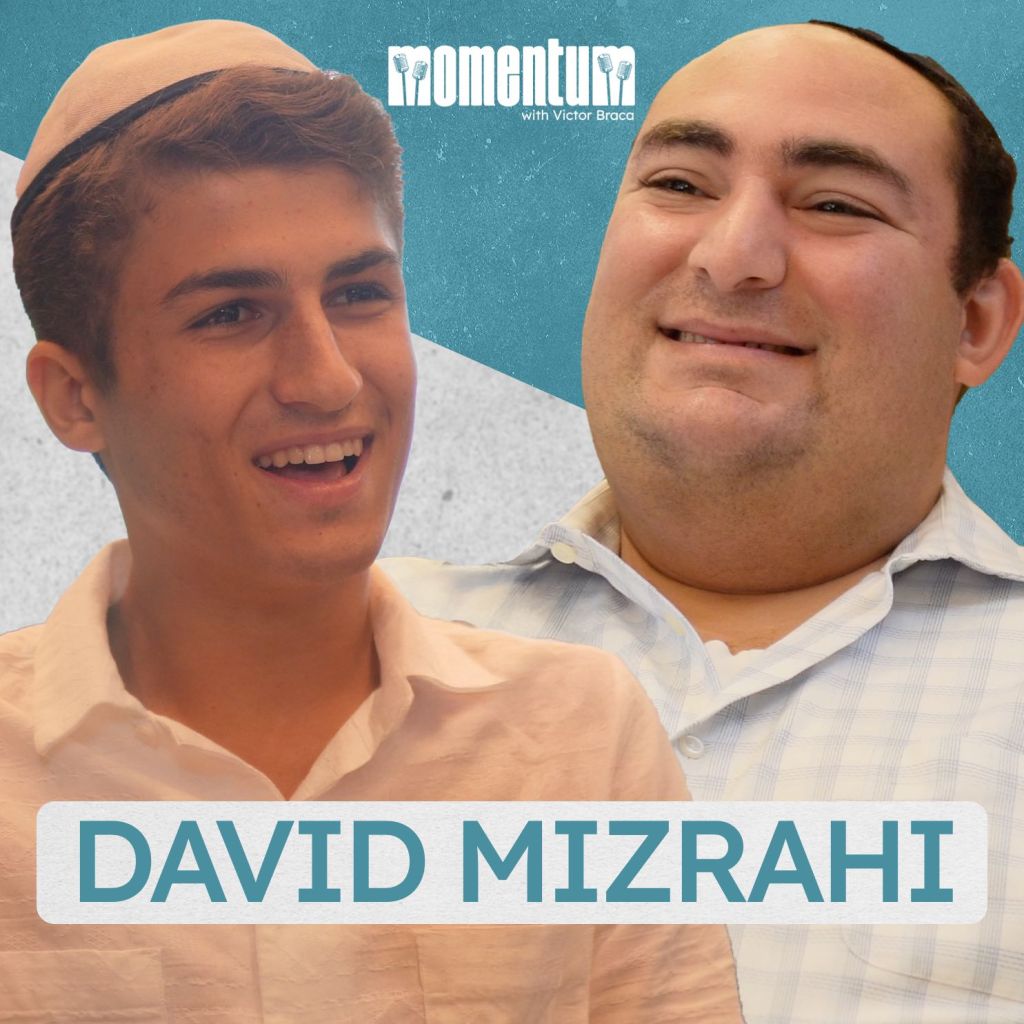




David Mizrahi is the founder of Salt Restaurant Group, the hospitality company behind 5 restaurants on the Jersey Shore in just 5 years – including the world-famous Salt Steakhouse.
David’s story is anything but traditional. He dropped out of high school, made millions in real estate as a teenager, and then shifted into hospitality, where he’s now redefining what a kosher dining experience can look like.
Sponsors
- Yazdi Entertainment, New York’s premiere event production company.
yazdientertainment@gmail.com or (646) 765-5643 - Life Vault Films: Capture the story of your loved one’s life, forever. Inquire today by emailing victor@topnotchvisuals.com
Transcript
Victor M. Braca: In the past 5 years alone, you’ve opened up six restaurants. LBK Grill, Salt Steakhouse, Soya, Pepe Kitchen, Salt Market, and Bubby’s Bagels. Every day you have 500 people coming in and 500 people you need to please every single day. You developed a relationship with Charles Kushner, with the entire company. So far that they’re calling you every year pretty much asking you to open up a new restaurant. How did you do that?
David Mizrahi: We opened Salt. A lot of people were not for it. Steakhouses are for New York City. They’re not for small towns. Something that I learned the hard way, unfortunately, is people fly from all over the world to dine at your restaurants. I was working till 10:00, 11:00 at night, getting home at midnight. I wouldn’t see my wife. I wouldn’t see my kid all summer. We opened the steakhouse. We interviewed a bunch of managers. We settled on this manager that 2 weeks later was gone. He walked out on us. Tens of millions of dollars in sales, tens of thousands of people every year. What’s been your biggest failure?
Victor M. Braca: My guest today has an insane story. He went from making over a hundred grand selling underwear on eBay at 16 years old to running a foreclosure cleanup company that brought in millions a year by the time he was 18 to owning a hospitality empire that draws customers from all over the world. David Mizrahi didn’t go to college. He actually didn’t even finish high school. Yet, he’s the founder of Salt Restaurant Group, the team behind Salt Steakhouse, Bubby’s Bagels, Soya, LBK Grill, Pepe Kitchen, and Salt Market—six thriving spots along the Jersey Shore that attract customers from all over the world.
Here are some of the highlights of this episode. David tells us how he opened a high-end steakhouse during the height of COVID and ended up doubling projections in the first year. He takes us into his relationship with the Kushner family and how that led to partnerships on several restaurants and millions of dollars. He shares the behind-the-scenes chaos of running a high-end steakhouse. Like, for example, the time they ran out of plates in the middle of dinner service. And he opens up about the biggest lessons he’s learned from an incredibly rapid expansion. I’m talking quite literally opening a new restaurant every year for 5 years. It’s unheard of. We talk about carving out time for a family when you’re building a business, how to grow without spreading yourself too thin, and David’s advice for ambitious young people.
Before we start, I’m Victor Braca and Momentum is where I dive deep into the stories behind business success. I know guys, I say this every time, but this was an episode that I really enjoyed and I think you’re going to love it, too. Let’s get into it. Guys, this episode is sponsored by Yazdi Entertainment. More on them later.
David Mizrahi, welcome to Momentum.
David Mizrahi: Welcome to Salt Steakhouse.
Victor M. Braca: It’s great to be here. And I usually say, you know, thank you for coming, but thank you for having me in your restaurant. You’ve built a hospitality empire that seems to be growing every year. In the past 5 years alone, you’ve opened up six restaurants, I should say five restaurants and a market. We’re talking originally with LBK Grill. We have Salt Steakhouse, Soya, Pepe Kitchen, Salt Market, and Bubby’s Bagels. A hospitality empire like I was saying, and I know that you were always entrepreneurial. Can you take me back to when you were 16 years old? You got into a car accident and you turned that into an opportunity for entrepreneurship?
David Mizrahi: So, yeah. So at the age of 16, I got into a really bad car accident. I broke my hip. I was wheelchair bound, crutches bound for a year, on and off, three surgeries, and I was stuck home and I’m doing nothing. And it was just the beginning of e-commerce—2006 actually—and my dad was in the import export business selling wholesale closeouts and stuff like that. And it was the beginning of eBay. I said let me see what I can do. I went on eBay. I asked my dad to bring me home some stuff from his warehouse and I put it on eBay. The first 10 minutes I put it on there was, I think it was underwear—brand new underwear and it was closeouts, but they were expensive underwears. You know, it’s $100 for five pairs and I was selling them for, I think, $30 for five pairs. And I didn’t even know what I was doing. I just put them on. I said, you know, let me price them at 30 bucks. Sold it instantly. I asked my dad what it cost him. Said 10 bucks. I said, “All right, I’ll sell them for 30.” Sold it instantly. I ended up raising the price to $50 as I was selling. I sold out the whole shipment on eBay which was a great feeling, you know, to say, “Hey look, I took something that was wholesale and I retailed it.” You’re going to make a lot more money retailing from a product.
Victor M. Braca: And you were 16 years old. How much money did you make?
David Mizrahi: So we did over like $100,000 in sales in a couple months for a teenager. A lot of money. I mean, I had the cost of goods, I had to split it with my dad, but yeah, we still run a bunch of money.
Victor M. Braca: At this point, you’re 16 years old. You’re smart, you’re capable, you’ve sort of proven to yourself that you can make something of nothing, but instead of starting another business, you actually went to work for pizza shops, falafel shops. Why did you take those jobs?
David Mizrahi: I guess I always enjoyed cooking. I always enjoyed food. I always enjoyed that side of the world, like hospitality. So, I worked as a teenager, 17 years old, at different shawarma places, a pizza shop, for different people. I really enjoyed it.
Victor M. Braca: Most professionals in the hospitality industry receive some sort of formal education, whether it be culinary school, hospitality management, business management, anything like that. But not only did you not go to college, you actually dropped out of high school. Can you tell me a little bit about that?
David Mizrahi: I did. So, I moved to Lakewood when I was young, 12, 11 years old, and I didn’t really fit into the schools there. I struggled in the schools. It was a whole different curriculum that I was used to in New York. I dropped out of high school in 10th grade. I went to work. I worked for an electrician for a couple months. I worked in different restaurants. I was, you know, I was homebound for a little bit because of the car accident. But ultimately I dropped out. And I never went to college.
Victor M. Braca: When you were younger, was that something that people did—dropped out of high school? Were you the only one?
David Mizrahi: No, it was not. Today, it’s a lot more common for youngsters to drop out of school. Going back, looking back, saying, “Hey look, I have my whole life to work,” and I tell this to youngsters all the time: enjoy your younger years. You’re going to go to a workforce, you have the next 50 years of your life to work. God willing you’ll be successful and you’ll do all that, but you can’t take yourself back to when you were a teenager to hang out with your friends, to get that experience and to get that education that you get from school.
Victor M. Braca: And so if you were able to go back in time, would you have dropped out of high school?
David Mizrahi: Probably not. I would not have dropped out. If I would have known what I know today, I would have stayed in school, made it work. But you know, there’s the path that I chose and I made the best of it.
Victor M. Braca: So I’ve heard you speak about your foreclosure business during the 2008 crisis. And if I’m not mistaken, you were 18 years old making millions of dollars per year. Can you tell me about that?
David Mizrahi: So, yeah. 2008, I was 18 years old. I decided to go work for somebody in the mortgage service provider foreclosure business. It was the housing crash in 2008. I worked for this guy for a little bit. Turns out his company wasn’t doing too well. He closed up. He owed me a bunch of money. I ended up getting paid. I decided I’m going to—I know the business, I learned a little bit about it—let me open my own company. I applied to the banks to become a vendor, I got the insurance and a couple days later I had my own company. I had a pickup truck. I went out. I grabbed a couple workers and I went to work. We were cleaning up these houses, boarding them up, fixing them up. Grew that company. We did… I was 18, I did a few million dollars in sales in the sequential years and had 30, 40 employees every day working for me doing this work. Built the office, and I really had to learn on the job. I didn’t really know what I was doing. I didn’t have the right insurances in place. I didn’t have the right management skills to manage it. But somehow, I made it work. I eventually sold the company in 2012 and I got out of it. I didn’t really enjoy it so much. It was more a job for me than a passion.
Victor M. Braca: Crazy how you were 18 years old—the age that people are seniors in high school—and you’re making millions of dollars per year employing 30 to 40 people, which is unbelievable.
I want you to be a part of the Momentum Army. The Momentum Army is our frontline force that holds up this entire podcast. Now, you might be wondering, how do I enlist in this momentum army? Guys, it’s very simple. Share this episode with three people right now. Before you continue watching, don’t skip this. Three people is all I ask. I don’t want any ads for Momentum. And the main way the podcast grows is through word of mouth. So, be sure to enlist in the momentum army by sharing this episode with three friends. Let’s get back to the episode.
A lot of people, most people I would say, would have taken that experience, that success in real estate, and catapulted that into a career in real estate where they could have made tens of millions of dollars. But you decided to go back into hospitality, to go back into the culinary arts. What went into that decision?
David Mizrahi: If you do something you don’t love, you’re just doing it for a job, no matter how much money you’re making. You really don’t feel satisfied at the end of the day when you put in a 12-hour day and at the end of the day, you don’t really have what to show for it other than money. Money comes, money goes. It’s not really a fulfilling thing to make more money. No matter how much money you have, everybody wants more money. Money is something that you’re always going to want more of.
Fulfillment is not something you can [buy]. You want to feel fulfilled. Whether it’s personal life, family, or business with your business operation—fulfillment is a feeling that you get not from money. So yes, I was making a lot of money but I didn’t really feel fulfilled. I wanted to get out of that. I said, “You know, let me try the restaurant business.” I bought a failing restaurant in 2012 after I sold my foreclosure company. Crazy story how I sold my company in 2012. A friend of mine calls me up and says, “My brother-in-law just came back from Israel and he just started a company doing the same thing that you’re doing to foreclosures and he needs some help. He’s struggling.” I said, “Yeah, give him my number.” I sat with him for 2 hours, went through a bunch of things, showed him a bunch of things that I learned from my experience. A few weeks later, he called me up. We ended up becoming friends and he says, “Would you be interested in selling your company?” I said, “Yeah, I would sell it. I don’t really love it.” So, I was thrilled with the idea of selling my company. I was 22. So, I sold the company sitting on a pile of money and just enjoying life at the age of 22.
Victor M. Braca: Do you think people doubted you as somebody—a young kid who was successful in real estate—but decided to use that success to go into the hospitality industry?
David Mizrahi: So I would say definitely people doubted me all along. Even when I was opening Salt, I had people doubting me saying, “You want to flip burgers? You’re in the real estate business and you want to go flip burgers?” Listen, if you enjoy flipping burgers, flip burgers. Whatever you really enjoy to do, follow your passion. Hospitality was always my calling. You really have to follow your passion because otherwise you’re just going to work. You got to enjoy what you do every day.
Victor M. Braca: So, you bought your first restaurant. It was a failing shawarma shop. Is that correct?
David Mizrahi: Yes, I bought it. It was a small restaurant, 20 seats in Lakewood called at the time Pella. It was a shawarma place, very small. I bought it off a friend of mine. It was failing. He had bought it as an investment. I turned it around. Changed the name to Eda B’Pita. I moved it a block away to a larger location and I grew it to a point where it was really, really profitable.
Victor M. Braca: How did you do that? How did you turn it around? You’re buying it from somebody and it’s failing to the point where he had to sell it. How do you turn it around?
David Mizrahi: So really you have to see what’s not working. You have to know what the customers want. You have to know how the employees are operating. If you have employees that don’t really care, your food quality is going to go down. You’re going to be serving people food that’s not fresh. People want just fresh food. They want quality food. They want a good experience. They want to walk in and—today, technology age, everybody’s on their phones. If you walk into the restaurant and everybody’s sitting on their phones and you have to say, “Excuse me,” to the employee behind the counter, “Can I order?” That’s not what the customer wants. The customer wants to be greeted when they walk in. “Hey, how are you? Welcome.” They shouldn’t have to ask you. They’re doing you a favor by coming in.
Victor M. Braca: What else did you do that the previous owner didn’t?
David Mizrahi: Really, a restaurant’s like a child. You have to really love it. And you have to put the passion into it. I think they bought it as an investment, not as a restaurant. And the restaurant business is very different. If you’re in the e-commerce business, you buy a product, you sell the product, and you move on. In the hospitality business, every day you have 100 or 500 customers coming in and 500 people you need to please every single day. So, you really have to be in that business of service in order to be in the hospitality business.
Victor M. Braca: So that’s what you did, the previous owner didn’t. And I guess that turned it from failing to profitable.
David Mizrahi: Yes. Just by adding that level of service that you’re going to give people. If it’s fast food, people want to be in and out. If it’s going to be a steakhouse, they want that experience where they’re going to sit for 3 hours. So you have to give them the experience they’re looking for. Somebody orders takeout, the food’s got to come hot. It’s got to come wrapped properly and it’s got to come with all their special requests. If they’ve requested spicy mayo with their sushi or an extra container of tehina with their falafel, you got to make sure to try to accommodate all those things. As good as the sushi is, that little thing—you have to care about giving the customer that little thing. We don’t always succeed at it, we’re humans, but we really try to take care of that little extra bit.
Victor M. Braca: Let’s talk parties for a second, guys. Let’s be real. We all love partying, but don’t even get me started on planning a party. The pressure is so stressful. From juggling multiple vendors to choosing the right music, lights, games—it could be a real nightmare. That’s where my good friends at Yazdi Entertainment come in. These guys are the expert one-stop shop for event production. Whether it’s a wedding, engagement, bar or bat mitzvah, corporate event—literally any type of event or party—Yazdi Entertainment is the only call you will need to make. Mark my words on that. I’m talking lighting, sound, male or female DJs, photo booths, games, staging—they do it all. Guys, if you’re planning a party, make the call to Yazdi Entertainment. You can call 646-765-5643 or email YazdiEntertainment@gmail.com. All right, back to the episode.
You turned around this failing restaurant. What did that teach you about creating or uncovering hidden value?
David Mizrahi: So, it’s really about maximizing whatever you’re doing. I felt like over there my value was maximizing the restaurant. Added a Friday takeout for Shabbat. Added new menu items. Expedited deliveries. Moved it to a larger location with more seating where we could accommodate more people. Did off-site catering. So there was a lot of things that I added that really brought the value and the profits up.
Victor M. Braca: And over the next decade, you either bought or you launched many different restaurants in different categories in different locations. And they pretty much were all ultimately successful. I think we’ve all heard the stat that 80% of restaurants fail within the first three or five years. And you shattered those expectations repeatedly. What was your playbook to launching a successful restaurant?
David Mizrahi: So, I think launching a successful restaurant is really listening to your customers. I always tell my employees, “The customers are the bosses.” I’m just the middleman. The customers pay me for the food and I pay you for your salary. Without customers, we don’t have a business. We never forget that. Especially in hospitality. In retail, you’re locked in with a lease. Over here, nobody’s locked in. There’s no contract if somebody has to come eat by me. If I don’t give them good service, they don’t leave happy, they don’t return. That’s really what you got to remember. So, you got to live by that.
Victor M. Braca: Do you think that’s enough to turn a restaurant from failing into profitability? Do you think the previous owners just didn’t care about their customers? Was there more to it than that?
David Mizrahi: I don’t know if they didn’t care about their customers or they didn’t really know their customers. So, you really got to get to know your customers. On any given day, you’ll see me in one or multiple restaurants talking to guests: “How’s your experience? How’s your food?” I really [listen], and you know, people will call me and give me both positive and negative feedback. People sometimes are hesitant to give me negative feedback because they feel bad telling me, but it’s not hurtful. It’s very helpful when somebody gives you negative feedback.
One story stands out to me. The week we opened Salt Steakhouse, a friend of mine who’s very close calls me up and says, “Where are you?”
I said, “I’m on the way to work.”
He tells me, “I’ll meet you at the rest area.” Pull into the rest area. I said, “I got to go to work.”
He’s like, “I’ll meet you at the rest area. It’s super important.” He comes in my car and he tells me, “I was there last night and the experience was terrible.” He’s like, “I waited 45 minutes for my food. Nobody was happy. The waiters didn’t know what they were doing. At the end of the day, they gave me a bill, I paid, I’m not happy. But I don’t care. I don’t need the $100 I paid you. I want you to succeed and you have to make sure the customer experience is perfect.”
We weren’t even open yet. We were still doing friends and family. This was a friend of mine. And he goes, “Not everybody who’s coming is your friend and your family and doesn’t really care about your business.”
So that day, I called everybody who was coming and I said, “Hey, I got to cancel your reservation.”
They said, “What do you mean? I’ve planned my whole date night!”
I said, “I got to cancel. I can’t host you tonight.” Which was very hard. And we went from serving 200 people down to 50 people. I said, “Okay, we’re going to go back to 50 people.” And we slowly grew from 50 people, 75 people, 80 people, 100 people, on how many we can service and nail down the food on, and how many we can give that experience they were looking for.
Victor M. Braca: Tell me about a call from somebody at the Wave Hotel and how that sparked the conception of LBK Grill.
David Mizrahi: So, in 2019, pre-COVID, I get a call from one of the people at Kushner companies. He says, “Look, we built this brand new hotel at the Wave Resort in Long Branch and we have a couple of food operations here and we think it’ll be a good idea to make one of them kosher. We don’t know what concept, but we think having a kosher option would bring more kosher clientele to Pier Village. We were referred to you as the right operator.”
I came in, took a look at it. 2019, I came with my wife, I met the Kushners, and that’s where the relationship really started. We looked at the space where LBK is. Ultimately, we decided, “Okay, we’ll open in the spring for 2020.” 2020, COVID happened. It was scary. I mean, nobody’s opening restaurants. 2020, COVID, very hesitant. My wife pushed me to do it. She’s like, “Look, you have the opportunity. Why don’t you take it?”
One of my restaurants in Lakewood, Revolve, was closed. We actually bought a food truck during COVID cuz there was no indoor dining—made a bunch of money on the food truck which I ended up selling after the pandemic. I said, “I have the employees, I have the will, I have the know-how, let’s go for it.” So we opened LBK in May of 2020.
Victor M. Braca: Wow. Right in the heart of the pandemic.
David Mizrahi: Yeah, right in the heart of COVID we opened. And as you can imagine, COVID, we built projections, we built a menu. Week one was crazy. The amount of people that were coming to the shore—there was nowhere else to go. If you were in Brooklyn, the schools were closed, there’s no reason to stay in Brooklyn—”let’s extend the summer, go to Deal.” Everybody came down. There was no traveling; no flights to Mexico, Greece, or France. Everybody was coming to the shore and we had to really change our whole concept that we originally built. We had this little DIY sandwich where you could choose a burger and put toppings on it, and we had to change our menu to streamline it to handle the crowds.
Victor M. Braca: Why didn’t you delay the launch one year? I think the hospitality industry was the space that was most affected during COVID. What went into the decision of keeping the launch date May of 2020?
David Mizrahi: So, I came down to the shore to look at it in the beginning of May and I was hesitant. I was very hesitant to open up another thing. I had a restaurant that was closed and like you said, the hospitality business was failing then. It was a disaster. And I saw the crowds here. I said, “You know what? Look how many people are here. Everybody has to eat. And this is a great opportunity because it’s all outdoors.” And it really worked. Having that during COVID… we doubled our projections year one which was incredible. It was a great feeling seeing lines. I mean, it wasn’t built to handle the volume that we do. We inherited the kitchen. And that can be a struggle sometimes when you take over a restaurant or anything that you’re working with somebody else’s design—how do I incorporate that into my idea to serve the guests?
Victor M. Braca: For context for anybody watching, Kushner Companies owns Pier Village, which houses all of your restaurants. They initially called you up to open LBK Grill and you developed the relationship with Charles Kushner and the entire company so far that they’re calling you every year asking you to open a new restaurant or market. How did you do that?
David Mizrahi: So, I remember year one I was here in LBK. We saw the demand for kosher here, doubling our projections. We had a plan to try to stay open all year doing Uber Eats and deliveries. Ultimately that didn’t work. We pivoted. We made it a seasonal restaurant. But during the summer when we were open, we got inundated with requests: “Do you offer Shabbat meals?”, “Can I make a reservation?”
Victor M. Braca: A reservation at a fast food place?
David Mizrahi: Exactly. People didn’t really know what we were. It’s called LBK Grill—”grill” could be a sit-down restaurant or a fast food place. It doesn’t really tell a story of what it is. At the time they were developing the new retail building where Salt is, and they approached me—I think it was mid-August—to tour the space across the street.
Victor M. Braca: Mid-August of 2020? This is still in the pandemic. I guess they saw what you were doing at LBK and within two or three months they were calling you up to check out a new space.
David Mizrahi: Yeah. They said, “Let’s go check out the new space. Let’s put our full restaurant across the street.” So I looked at it. I reluctantly looked at it. I came up with a plan. We came up with the name. I brought in the designer, brought in a contractor, and we built Salt Steakhouse. We needed a lot of help. I’m very gracious for a lot of people who have helped me along the way. A lot of people were not for it. They said, “You’re opening in a seasonal place. There’s never been any big restaurants in Deal. Steakhouses are for New York City; they’re not for small towns.” It’s a big investment, it’s scary to invest so much money and you don’t know if it’s going to work.
Victor M. Braca: How much money does it cost to open up a high-end steakhouse?
David Mizrahi: It’s in the millions. It’s in the millions today.
Victor M. Braca: That’s a ton of money. So you had backing from the Kushners and from friends and family. Did you feel comfortable taking other people’s money for a project like this or was it nerve-wracking?
David Mizrahi: It is nerve-wracking, borrowing money from people to do something. It’s a big risk.
Victor M. Braca: How’d you deal with that?
David Mizrahi: It’s really just taking it day by day, pushing ahead and saying, “Look, we’re going to get this done.” Seeing the success of LBK and the amount of requests we had, we said, “We’re definitely going to have the summer. It’s going to be crazy here. If the winter’s going to be a little slower, we’re okay.” We started off, we took a smaller space, and we’ve grown—added on the sushi bar and lounge, added on the market in 2024, and this year now we opened Soya because we see the demand for kosher fine dining in Pier Village.
Victor M. Braca: I think this would strike anybody as a very rapid progression. You opened up one restaurant then pretty much every year since then you’ve opened up another restaurant or Salt Market. Did you ever feel like you were expanding too quickly?
David Mizrahi: So, yeah. It is scary to expand at all because you have something that’s working and now you’re going to add another element to it—how’s that going to affect it? We opened Pepe, which is a fast casual Italian eatery. It’s a small place. And we said, “What’s that going to do for LBK?” LBK was the only option for lunch. And we’ve only seen that as you add more options, more people come to the area. You might think you have a total amount of customers and by opening more restaurants you’ll be competing with yourself. In general, that is the case. Over here we are blessed that we are a destination. We’re drawing an audience—kosher and non-kosher—from around the world. We’ve had people here from almost every country. But on a general basis we’re drawing from Lakewood, Brooklyn, White Plains, Teaneck, Baltimore.
Victor M. Braca: And people fly from all over the world to dine at your restaurants. Was there ever a moment where you felt like you were spreading yourself too thin?
David Mizrahi: I do feel like that sometimes. Thank God I have a good team, a big team, and we continue to grow. I continue to add more people to help us grow in a financially stable manner. It has to be responsible growth. There are restaurants unfortunately that have grown super quickly and the sales were not there to support it. If I had taken every investor who came to me and said, “Let’s go open a restaurant in Miami, New York, DC, LA, or Israel,” I could have a restaurant in every town. But is that responsible? You have to really think long and hard about it. You have to research the market—what does the market need? What can the market sustain?
Victor M. Braca: How do you manage five restaurants in one area? Do you have partners for each one?
David Mizrahi: I’m still learning every day how to manage it. Like we spoke about, I never went to college. It is a struggle every day learning how to manage five places and having a manager in each place that’s competent, honest, and that you can rely on. And not always do you find that. Day one we opened the steakhouse, we interviewed a bunch of managers, we settled on this manager that two weeks later was gone. Two weeks after the launch, he walked out on us.
Victor M. Braca: What does that look like—he walked out on you? Scrambling to find a new person?
David Mizrahi: Yeah. It was a couple weeks without a manager and then we hired a new manager who’s still with us today, James. He’s amazing. Consistency in a restaurant is a big thing. So, having the manager and the chef—consistent people working for you. Treating your workers right, throwing holiday parties for them, giveaways, giving them vacation time off, bonuses… just to keep people motivated and happy. Not everybody wants to be their own boss. Some people want to work for somebody, and if you take care of them, they’re happy and have no reason to go elsewhere.
Victor M. Braca: When you opened Salt, I know that you launched with a partner who was one of your close friends and you guys butted heads a little bit. You ended up buying him out. What did that teach you about who you choose as your partner, but also going into a partnership with potential exit strategies from the onset?
David Mizrahi: People call me all the time asking for advice. And something that I learned the hard way, unfortunately, is: make sure you have an exit strategy. It’s not a marriage where you have kids involved; there’s only money and business involved. And even in marriages, people sign prenups because if you can’t come to an agreement today when you are friends on how you’re going to exit if there is a dispute, there’s no way you’re going to work through those things when you’re fighting. So that’s something that really taught me how to operate.
Victor M. Braca: When you’re choosing partners now, are you less inclined to go into business with a close friend?
David Mizrahi: That definitely is a factor. I try not to do business with family and close friends. There’s some people… like the chef is a partner with me. We’ve been friends for 20 years. I got him his previous job where he worked for eight years and now he’s here in Salt for 5 years. So, I know him for close to 20 years. And it’s a struggle. You don’t want to lose your best friend because you’re going to lose your business partner. There are many families that are torn apart by business decisions that can be totally avoided. So, I try not to do business with family. You have to really dot your I’s and cross your T’s and make sure that there’s nothing that could go wrong. And even then, something will go wrong and you have to work through it.
Victor M. Braca: What’s been your biggest failure? You’ve opened multiple restaurants, bringing in tens of millions of dollars in sales. You see 500 customers a night across all of your restaurants. What’s been your biggest failure?
David Mizrahi: I say my biggest failure is really time control. Timing is a big thing, especially seasonality over here. But something that’s taken me many years to learn is a good work-life balance—which I’m still learning every day—is how to spend more quality time with your family. Ultimately we’re working to have a quality of life for not just for us, but for our kids and our families.
Victor M. Braca: I know that when you first opened up one of your restaurants, you were living separately from your family for the week. Can you tell me a little bit about that?
David Mizrahi: So yeah, the first year we opened—well almost two years cuz LBK we opened—I was working almost every day. I was here a couple days a week and I worked until [late]. I lived in Jackson, had a young newborn baby at home. And I was working till 10:00, 11:00 at night, getting home at midnight. I wouldn’t see my wife; I wouldn’t see my kid all summer. 2021 we opened Salt and it was even worse. Throughout the construction process I was here a lot. Then when we ultimately opened, the entire summer I was here every day. I would come in at 10:00 in the morning and I’d leave at midnight. Get home at 1:00 a.m., take a shower and do the same thing the next day. I literally… then I’d get to the weekend and I was bombed. I was dead. I would sleep the weekend. I didn’t see my kid. I didn’t see my wife all week. I made the decision: “What am I doing this for?” I’m doing this for my quality of life. I got an apartment out here and I made the move here for the summer so that I’m local now. I can go home, spend time with my wife and my kids every day or every other day. Just spend quality time with your family because you got to remember: what’s the ultimate prize?
Victor M. Braca: Have you found that your business has suffered because of that?
David Mizrahi: I don’t think so. You can’t always be everywhere. So, it’s all about how you choose to spend your time.
Victor M. Braca: Do you think your success or your business would be where it is today if you didn’t go through that?
David Mizrahi: It’s very possible it wouldn’t have. I don’t know, but it’s very possible I wouldn’t be [here] if I hadn’t put in that work and pushed through and gotten all the bugs worked out—working through those challenges opening a new restaurant, whether it’s staffing or running out of plates. Middle of dinner service, we ran out of plates, I remember. “Crap, we need more plates!” We were washing dishes in the middle of the night, trying to get more plates to serve the guests, and then running to the store the next morning buying plates that don’t match the other ones cuz you got to custom order. All those challenges that come into a growing business when I didn’t really know what I was doing. I didn’t even know how many plates I needed.
When I started Momentum, I did it because I love talking to business people. I wanted to inspire people with real stories—stories of how people built something from nothing. But what I didn’t expect is how much those episodes would mean to the families of my guests. I’ve had people reach out to me and tell me, “Victor, I watched my dad’s episode three times. Thank you for capturing a piece of him forever.” And that’s what led me to start Life Vault Films, guys. It’s a way to professionally capture your parents’ or grandparents’ full life story—from where they were born to how they built their life, their family, their business, their values—all of it on film forever. It’s not a tribute, it’s not a slideshow; it’s them telling their story in their own voice. Imagine you felt like you knew your great-great-grandmother. Wouldn’t it be amazing to see her smile and hear her voice? That’s what Life Vault Films gives you. If you want to capture the essence of your loved ones forever, click the link in the description to learn more. Because stories fade unless we capture them. Let’s get back to the episode.
What goes on behind those two kitchen doors that nobody in the restaurant sees?
David Mizrahi: There are a lot of challenges in the restaurant business. A lot of them stem back to staffing or products. I’ve had it in the middle of the night where we run out of product. Now we got to get product. So, you’re running to the store to buy stuff. The customers don’t know that somebody just ran in the back door with a meat delivery. Staffing: a few weeks ago on a Saturday night, three staff didn’t show up—got in a car accident and was in the hospital. You’re missing three staff members on a Saturday night, you got to jump in.
Something that I’ve learned is I won’t ask my employees to do something I wouldn’t do. I try to know a little bit about every aspect of the business—from the cooking process. I’m not the chef, I don’t make the recipes, but I like to know enough that if somebody’s struggling, I’m going to step in and help them. Showing them the leadership of “I’ll get my hands dirty,” whether I need to wash dishes or clear a table. People don’t see that three people are short in the kitchen or the computer system went down. The computer system is like the heartbeat of the restaurant. Without the computer, the orders don’t get to the kitchen. The power will go out and now the computers are off for 3, 4, 5 minutes, which will delay everything for 5 minutes.
A brown-out will actually shut off the gas to all the cooking appliances. So, not only is it going to restart our computers, now the rabbi has to go around the 20 cooking appliances relighting every single fire, relighting the pilots—it’s a process. So many moving pieces. The lights flickered in the restaurant for a second, which browned out the electric, and now that’s going to cause a 15-minute delay. Instead of your dish coming out right away, it’s now going to delay 15 minutes. There’s a lot of things like that.
Victor M. Braca: It’s so crazy that there are hundreds of moving pieces. I’m sitting here waiting for my food, telling my girlfriend, “What’s going on? They’re late with the food,” and yet so many things could be going on behind the scenes that I have no clue about.
David Mizrahi: Yeah. We’re humans, so you’ll have somebody who… steak takes 20 minutes to cook. The guy forgot the steak on the grill for a little too long and now it’s medium-well instead of medium-rare. I don’t want to serve you a steak that’s overcooked, so now he’s going to make you a new steak. So that’s going to delay you 20 minutes. Now you waited 40 minutes for your steak instead of 20 minutes. Things like that do happen. We try to limit as many issues as we can, but they do happen.
Victor M. Braca: To somebody interested in hospitality, cooking, food, or hosting, do you recommend they get into the restaurant business?
David Mizrahi: So really, the restaurant business is a very rewarding business, but at the same time can be very, very challenging. We have to make sure that going into the restaurant business you know what you’re going to be offering—have a cohesive offering to the guests. We can’t take a fast food place and serve a $100 steak. People are not going to take it. And you can’t take a fancy restaurant and serve chicken tenders. You have to really offer a cohesive and consistent experience. I think those are two of the most important things. People are expecting a certain thing when they come and you got to deliver that.
Obviously you got to know your clientele and the area where you’re opening. And it could be very financially rewarding or fulfilling. I see this very, very often: you could be the best chef in the world, but you got to understand the business side too. It’s a numbers game. You’re ultimately here to make money. There are people that have restaurants as hobbies—generally they’re very wealthy and they don’t care if it loses money. But generally people going into restaurant business want to make money. You have to know your clientele and your demographic and what price point the market will sustain. People have dreams that the kosher market is going to be something that it’s not. The kosher market is a niche market. You have to really offer something that’s going to speak to your clientele. That’s the most important thing.
Victor M. Braca: To somebody who wants to be in your position in 10, 15 years operating a high-end steakhouse: should they follow your playbook of buying failing restaurants and turning them around? Do you think a different first step would work better?
David Mizrahi: So, I don’t know necessarily if the playbook is my playbook or a different playbook. This is what worked for me. God has sent me the opportunities to continue to grow. There has been obviously many challenges along the way. I’ve learned a lot and made a lot of mistakes—things that I would change that have cost me a lot of time and money. I don’t know if it’s buying a failing restaurant; it’s definitely a cheaper way to get into the industry. When you buy a failing restaurant or you take over a second-generation space that’s maybe failed, you’re going to get the benefit of that build-out that they already did. That can come with challenges or pluses. There’s no right or wrong way. There are people that will go to college for eight years and decide that’s not the industry they want to go into. It’s not I don’t know if my playbook was the best playbook; it’s the playbook that I chose being who I am. Everybody’s got to find their own journey to get there.
Victor M. Braca: Let’s shift for a second to giving back, nonprofits, and philanthropy. You’ve been involved in that through your business, but let’s go back to when you lived in Lakewood. You were a volunteer firefighter. Can you tell me a little bit about that?
David Mizrahi: So, yeah. When I was 18, I went to EMT school. I became an EMT and through that process I decided I didn’t want to be an EMT. An EMT, although it’s a really great thing to help people in need, I didn’t find it my calling. I didn’t love the medical part. So I decided let me become a firefighter. I was one of the first religious firefighters in Lakewood. I went to school for that, became a firefighter, moved up the chain, became an officer—a lieutenant. I took an elected position as a commissioner.
Victor M. Braca: You had to run a campaign?
David Mizrahi: I did. We had to run a campaign. I became an elected official and that’s all volunteer. It was volunteer on-call whenever they needed me. I was a driver, an operator of the truck. I did that from when I was almost 19 years old until 2022. I was diagnosed with Hodgkin’s lymphoma. It’s cancer. So 2022 I was diagnosed in April. That’s when I went on my last call and I gave up the firefighting. And it was really, really rewarding, that adrenaline rush that I got.
Victor M. Braca: Tell me a little bit about how you incorporate giving back into your entire operation as it is today.
David Mizrahi: So I think it’s built into our genes as Jews to give back—whether we’re giving back in monetary form or giving back in time. Anytime I can help somebody who needs help, I try to help out. Whether it’s somebody who’s going through treatments and they call and they need a night out to clear their head… I try to help out and donate to those causes. Whether it’s the schools or the growth of the community over here in Deal. God has given me this platform of the restaurants and as much as I can use that to help somebody or help an organization, I try to do that.
Victor M. Braca: What’s next for Salt Restaurant Group? You’ve opened up six locations in the past 5 years which is unbelievable.
David Mizrahi: So only God knows what’s next. We have people banging down our doors calling me on the daily: “Come to New York, come to Miami, come to Vegas, come to LA.” So, again, responsible growth is the name. I have a folder in my email box called “future inquiries” and I file all those emails. We’ll see when the right opportunity arises to grow in a financially and physically responsible way. Growth is not always the best thing, right? It might be good for finances but might not be good for my family or for my quality of life. I don’t want to be flying around the world going to different places to operate different restaurants or running to New York every day. There are people telling me, “Come to Brooklyn, we need you in the city.” Maybe I can be very successful over there, but is that really what I want to do? Is that my passion? I have to be passionate about whatever I’m going to go do.
Victor M. Braca: I know that the franchising model is very popular among American restaurants. Does that exist among high-line kosher steakhouses?
David Mizrahi: So, there’s been a few franchises that have opened and failed. I don’t think any of them have lasted long term. Most recently, Patis Bakery—they opened I think 13 locations and they failed, and then they were sold and then they failed again. So really I think they were just scaling and scaling and scaling. There’s other brands that are scaling and franchising and I really hope they’re successful because it hasn’t been done really in the kosher world. Years ago you had Dougie’s. Doug Suckloff was a friend of mine and they franchised and a few of them are still open but most of them have closed. So it is scary.
Victor M. Braca: Those are even fancier, more casual cafe-style places?
David Mizrahi: Um, not that I know about. I mean you had Carlson Gaby’s a few years ago that scaled and they opened a bunch of locations—Miami, Lakewood, a couple in New York—and some of them closed. So that’s always the challenge. McDonald’s opens thousands of locations around the world. They have obviously major market research they put into it. And they do fail—you see closed McDonald’s. But obviously they’re opening on a much larger scale. They’re catering to a much larger customer base than we are as a kosher restaurant. But there are many non-kosher franchises that come and go as well.
Victor M. Braca: If you had to choose one moment from your entire life that encapsulates you gaining momentum, what would that be? What was your Momentum Moment?
David Mizrahi: I would say walking into the dining room when the restaurant was filled up with people that were enjoying and having a good time. Walking in and seeing a full dining room, people waiting at the door to sit down and a waiting list of 100 or 200 people that we couldn’t serve because we don’t have enough capacity. Seeing that was really the most rewarding part for me—seeing people coming in and saying, “Look, I haven’t eaten in a kosher restaurant in 5 years because of the quality of kosher food or the quality of the kosher experience that there is out there, and your restaurant is phenomenal and I’m here now every week.” So I think that’s very rewarding, seeing people eating kosher and really enjoying it, that we can offer them a kosher experience that is on par with what you’d find in the non-kosher world.
Victor M. Braca: David, anything else on your mind that you want to share with the audience?
David Mizrahi: Life has challenges. We move backwards. I’ve had a lot of medical challenges going through treatments. My treatments fell out right in the middle of the summer. And I could have put myself down and said, “Look, I’m in the hospital, I’m going through treatments,” and lay in bed all day and feel like a sick person, or I could get myself up, get dressed, and go to work and push through it. Sometimes I was weak, sometimes I didn’t want to push myself through, but really whatever you’re going to put your mindset to is what you’re going to do. If you put your mindset to completing a project, you’re going to complete it, whether you stay till 2:00 in the morning or whatever it is.
But really life’s about a mindset of where you want to go, of who you want to be. I try to be very humble—God has blessed me with this and I try to tell everybody that no matter what you’re going through, God has a plan. Whether it’s in business, relationships, or financial stress, everybody has their own challenges. You look at somebody else and be like, “Wow, that guy’s doing so amazing.” You see me in the restaurant, you had no idea that I just sat through eight hours of chemo, right? People don’t know that. So everything looks like it might be great, but you don’t know what’s going on behind the scenes with anybody. People are very wealthy and people are poor, people are sick, people are healthy. You don’t really know.
Never judge a book by its cover. I treat all my customers equally regardless of what your financial worth is, regardless of how you dress; it’s really about how you act as a person. I try to treat my employees with respect, treat my customers with respect. I always try to do the right thing. If a customer is going to complain about a steak that’s overcooked and it was actually overcooked, I tell my staff, “Don’t argue with them. There’s no point in arguing with them. I’m not here to take their money if I didn’t give them what they’re expecting. Let’s give them another steak, remake it for them. Make sure we have happy customers.” And that’s the ultimate goal over here: to have happy customers and continue to grow the business.
Victor M. Braca: David, thank you for coming on, for sharing your story, your experience, your successes, and your failures. I think it’s going to inspire a lot of people.
David Mizrahi: Thank you for having me on the podcast. I hope you continue to do this and continue to inspire people. Do what you love, follow your passion—success and failure are both going to come. Not always are you going to succeed, and just keep pushing. It’s all about the mindset that you put yourself in. Be a better person, be a better husband, be a better father, be a better brother… just do the right thing always, whether it’s in business or personal, and God will send everything else. It’ll fall into your lap.
Victor M. Braca: Amazing. Thank you, David. Thank you so much.
All right, that’s a wrap on David Mizrahi. I hope you enjoyed and here are three lessons from David that you can take into your own life.
Number one: customer experience is everything in the hospitality industry. It’s about transporting people the moment they walk in. Every detail from lighting to the music to the greeting should make them feel like they’ve stepped into an experience, not just a restaurant. If you’re selling a consumer product, the magic lies in how it reaches your customer: packaging, unboxing, follow-up—every touch point should make it feel special. And in a service-based business, the experience is the relationship itself. From the first call to the final delivery, every interaction should leave your client confident, cared for, and certain they chose the right person. The bottom line is, as David taught us, customer experience is number one.
Number two: expand rapidly but responsibly. David’s expansion is one of the fastest I’ve ever heard of: five restaurants and one market in five years. Six ventures in five years is insane, but he was strategic about it. All of them are in the same complex so he doesn’t need to travel constantly. Each fills a different niche, and he’s built strong teams so the business can scale without him micromanaging. Just as importantly, he’s turned down offers to open in other cities when the timing wasn’t right. Rapid expansion is great, but make sure to be smart about it.
At number three: family, family, family. Guys, there is no better person to speak on this than David. He essentially didn’t see his wife and kids for two years. And yeah, the business grew, but the cost could have been devastating if he hadn’t course-corrected. He made the investment to move his entire family closer to work for the summer because if you never see your wife or if you don’t know your kids, what’s the point?
Guys, if you made it this far, tell me in the comments below how you like your steak cooked. I’m personally a medium guy, but I think we might get into some heated discussions down below. Looking forward to interacting with you guys down there. And if you enjoyed this episode, you’ll love my conversation with Ray Tawil. Ray runs a hospitality company focused on catering, pulling off huge events like feeding 1,200 people at a time for 10 days straight and even cooking for President Trump. Guys, check out that episode by searching “Momentum Ray Tawil” on any platform or by clicking the link in the show notes.
And with that said, thank you for watching. If you enjoyed, feel free to call me up and take me out to a steak dinner at Salt. I would even be so kind as to let you pick up the check. I know, I know, I’m such a kind soul, but really in all seriousness, thank you for watching and I’ll see you in the next episode.




 Momentum
Leave a comment