

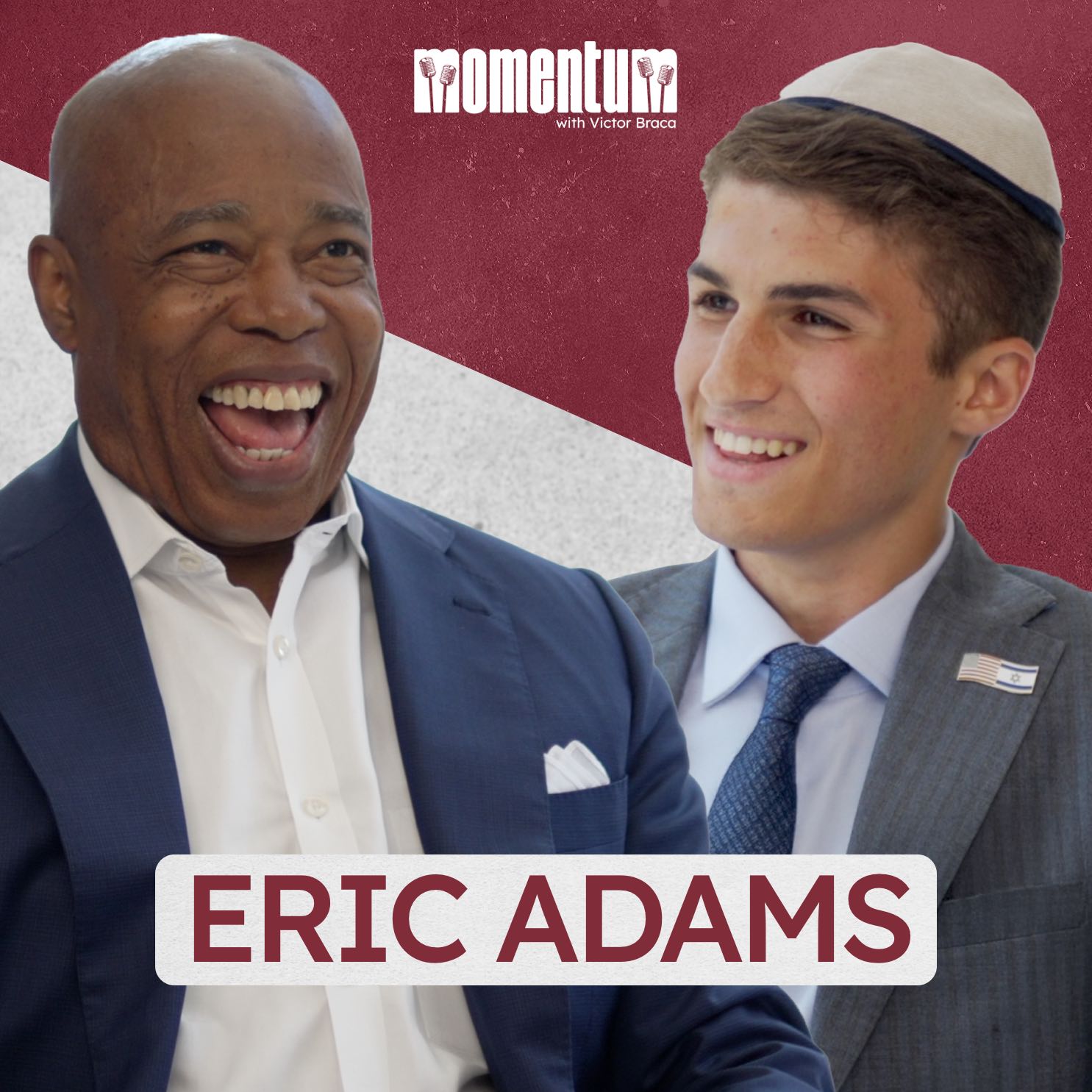


NYC Mayor Eric Adams joins the Momentum Podcast in this special episode–and it got real.
He opens up about his childhood: getting bullied as the “dumbest student,” working the streets squeegeeing car windshields, and the 5-second moment that transformed his life.
We also got into his fight for NYC: public safety, affordability, and his plan to take down Zohran Mamdani, Andrew Cuomo, and Curtis Sliwa.
Sponsor
- Sponsored by Goldburd McCone LLP, the tax law experts you want in your corner: https://goldburdlaw.com
Transcript
Eric Adams: I thought that I was a dumb student. I would walk into the classroom. I became the butt of the jokes.
Victor M. Braca: Andrew Cuomo has publicly pledged that if by mid-September he’s not winning in the polls, he’s going to drop out. Would you sign such a pledge?
Eric Adams: I can remember like yesterday and said, “Wow, I’m not dumb. I’m dyslexic.”
Victor M. Braca: What’s one thing you wish you had done differently in your time as mayor?
Eric Adams: With my trusted people.
Victor M. Braca: You’re the mayor of New York City, which is one of the most powerful positions in the world.
Eric Adams: That’s my glory. That’s not my story. I know what on the verge of homelessness looks like. I know what missed-meal cramps feel like. I know what it is to live in a domestic violence situation. Living on the verge of poverty. I didn’t study them in school. I lived them.
Victor M. Braca: My guest today is Eric Adams, the current mayor of New York City. And trust me, this was not your typical interview with the mayor. He opened up about his childhood, getting bullied because of his undiagnosed dyslexia, dodging eviction countless times, and getting beaten up by police. He takes us into what it’s really like to be the mayor of the greatest city on earth, and how difficult it really is to push policy forward. And of course, we discuss the 2025 mayoral election and Mayor Adams’ strategy to defeat Andrew Cuomo, Curtis Sliwa, and Zohran Mamdani. I’m Victor Braca, and Momentum is where I dive deep into the stories behind business success. Now, Mayor Adams is not a businessman, but his success story is truly phenomenal. You’re going to love it. Let’s get into it. This episode is sponsored by Goldburd McCone LLP.
Mayor Eric Adams, welcome to Momentum.
Eric Adams: Thank you. Great to be here.
Victor M. Braca: It’s great to have you, and I want to thank, you know, Joey Shamie for hosting us in his office. Delta Children is unbelievable. We have a great setup over here.
Eric Adams: Yes. You know, more babies, more babies. Delta wants to sell more baby supplies.
Victor M. Braca: The best, the greatest, the best around. And I want to sort of just get straight into your story. I mean, you’ve been in the shoes of so many New Yorkers. You were used to, you know, going back to when you were 17 years old, you were a squeegee man, right? And you would squeegee the car windshields as people stopped at red lights. You went on to become, you know, an auto mechanic, an NYPD captain, a nonprofit founder, borough president, and ultimately a state senator, and ultimately you, today, you’re the mayor.
And I can say for you, you know every alley, every back channel of the city, like the back of your hand. You don’t just know Park Avenue. You don’t just know Wall Street, but your expertise is across the entire city. If you had to choose one of those experiences, one of the roles, one of the hats that you wore throughout your life, to recommend to somebody like me, a young person, to transform my life, to open up my eyes, which experience would it be?
Eric Adams: A great question. And you’re right. I’m the second mayor of color in the city of New York. I was the first person of color to be the borough president, state senator, a captain in the police department. But all of those items and descriptions, that’s my glory. That’s not my story. My story is growing up in South Jamaica, Queens, and a mother who was raising six children for the most part on her own. And my story is having a learning disability and walking into the classroom every day and being bullied because I stumbled over words when I read. I didn’t realize it was undiagnosed dyslexia. Or even having my car shot at when I was an off-duty sergeant in the police department and still had to get up and take the exams to get promoted. Or going to school at night.
Yes, on the walls, the degrees show an associates degree, bachelor’s degree, and master’s degree, but it doesn’t show 14 years of going to school at night, taking two and three classes just to survive. So my story is the story of a New Yorker, a resilient working-class guy, never giving up. We have what’s called moxie. We have this unidentifiable energy and spirit that we can come to this city and be a dishwasher and then own a chain of restaurants. We can be a person that doesn’t understand English and then open English-speaking schools. Or you could be someone that worked in the mail room and become the mayor. But when I look at all of those jobs, the job that really defined me to understand this city was being a police officer. Any given day a circumstance could happen that you must use not only common sense, but you must use the training and the knowledge that you have. And by the time I finished my 22 years, I had a wealth of items in my CPU that told me how to resolve issues and correct conditions. And that’s what I did for three years and seven months as the mayor.
Victor M. Braca: I love it. And a line that you mention often is that in New York City, the goal is so that the person sitting in the back of the limousine is just as prosperous as the person who’s driving the limousine, right? And I just think that sort of encapsulates your term as mayor and your goals for our city. You mentioned in passing that you had undiagnosed dyslexia for decades of your life, right? And that caused you to nearly fail out of school, to have to take classes at night, and just a slew of issues that not many people overcome, right? A stat that I hear you say often is that 40% of our prison cells are filled with people who are dyslexic, right? And then if we look at—I ran the calculations—if we look at the other side of that, of elected officials with dyslexia, somebody who’s dyslexic is 10 to 15 times less likely to hold a position of public office than somebody without that learning disability. And you shattered expectations on both fronts by sitting in front of me today as the mayor of New York City. Take me into the moment where you realized that what you had originally thought was your downfall or your disability turned into an opportunity for you to really reinvent yourself.
Eric Adams: Well, I thought that I was a dumb student. I would walk into the classroom and on the back of the chair, my chair, they would have the words “dumb student.” I became the butt of the jokes. And if I read that day to children, they would mimic and say, “Let’s act like we’re Eric reading.” And so, little do you know those painful and dark moments are not burials. They’re plantings. And you have to go through them sometimes to get to what your real destiny is. If I did not have to go through that horrific experience as a child, it would not have given me the resiliency of being not only a police officer, but being the mayor of the city of New York. I have an excellent ability to understand it’s not what people call you, but what you answer to. And that has been my motto throughout my career. It has taught me so much on how to just be resilient. And so I don’t look at what I’m going through, but what about a mother that is trying to put food over her head for her children like my mom? What she went through—she never surrendered. She could have walked away. She was a beautiful woman. She could have stated that I’m going to leave these six children and find an easier life. But no, she lived up to her obligation. And that’s what I take with me every day: that everyday New Yorkers are living up to their obligations. So, I have a responsibility to live up to mine.
Victor M. Braca: Guys, I just want to pop in real quick to ask you if you’re enjoying the podcast so far, please follow the show wherever you get your podcast and share with a friend. We’re trying to grow Momentum as large as possible and I can’t do that without your help. All right, back to the episode.
When you were a teenager, you were beaten by police officers, and we look at your career and you get into law enforcement and you’re there for over 20 years, right? So why did that incident either persuade you or dissuade you to get into law enforcement, and how did you ultimately make the decision to become a police officer?
Eric Adams: And you know, it taught me so much because you cannot define an entity by the numerical minority that tarnish an entity. And one would have embraced a total dislike for police and law enforcement. But I was inspired by one of my spiritual leaders who encouraged me to go into the police department and make it what I thought it should be. And so instead of being a detached spectator in any occupation, profession, or any way of life, we need to make these entities into what we believe they ought to be. And one person can make a difference. History has shown that.
And I was inspired, after we saw a series of terrible interactions between police and communities, to go into the police department after being instructed by my spiritual leader and fight from within. I started an organization called 100 Blacks in Law Enforcement Who Care, and we fought for justice and safety. We know that justice and safety can coexist, and we proved that as we saw the reforms take place that were well-balanced and thoughtful, and we saw crime drop in the process, and I bring that into the mayor’s office as well.
Victor M. Braca: Well, one thing I love about you is all of your initiatives and your programs, and you like naming the initiatives, you know, “Breaking Bread, Building Bonds” and “100 Blacks in Law Enforcement.” I think we could have worked on that title a little bit, you know, for that organization. You believe that you can enact change, and as a New Yorker, people oftentimes throw their hands up and say, “They should fix this. They should make these changes,” and yet you wanted to become them.
Eric Adams: Yeah. And that’s a very good point. Because even going into policing, I felt that I could make a difference. And when I went from policing to become a lawmaker, I went to Albany because I felt I could make a difference. And I was the same when I became borough president. I felt I could make a difference. And that is what has always been the fuel that has moved me forward. And my vehicle is really fueled with the belief I can make a difference.
Victor M. Braca: I understand why you wanted to make a difference, obviously, especially because you were put into these scenarios, these situations where you were beaten by the police, where your car was shot at and all these other scenarios that no one should go through, right? And you obviously were able to relate to anybody else who’s gone through an experience like that. But why did you think that you can make a difference? You know, for a person like me, I see in my community, something as simple as going to the polls and voting, “Ah, my vote’s not going to do anything. What’s the difference?” Right? But you took that so far that you were going to run for office with the belief that you could make a difference. I would say 99.9% of people do not think like that. How did you develop that mindset?
Eric Adams: And that’s a great question. I believe that it was probably in my first year in college when I learned that I was not dumb, I was dyslexic.
Victor M. Braca: That’s your first year in college?
Eric Adams: Yes.
Victor M. Braca: Wow, that’s very late in life.
Eric Adams: Yes. Yes. I heard a young lady listening to a documentary on dyslexia and I took it out, and when I saw it, I can remember like yesterday leaning back in the chair and saying, “Wow, I’m not dumb. I’m dyslexic.” And so from that day on, I just really felt that any and everything is possible. The word impossible just no longer existed for me. And I felt whatever I got involved in that I could make a difference. And it became my motto of looking at injustices and reversing them.
Victor M. Braca: And what I love is how you climbed the political ladder, right? Through the offices of the state senate, through the Brooklyn borough presidency, and ultimately to the mayoral office, which is where you are today. People often think of the New York City mayor as this all-powerful figure, right? People like you, Bloomberg, Giuliani—these figures occupy so much of the public’s attention. But behind that commanding image, behind the office of the mayor and the stamp of approval, right? There’s a slower maze of bureaucracy, of agencies, of legislature that you have to navigate in order to pass your legislation, to push your policy forward. And most New Yorkers never see that. Can you walk me through the friction that is required to put policy forward that people don’t see? Sort of like what people think the mayor’s office holds and what you’re really able to do.
Eric Adams: Well said. And there are many mountains and barriers that get in the way of real results. First, you’re dealing with human beings, and that is the most challenging aspect of being a mayor. I have 320,000 employees. I have to deal with the personalities of 51 council persons. And you have to deal with what’s orbiting both in the Assembly and in the Senate. And people bring their own agenda, their own personalities, and their own mission. And you have to find a way to coalesce all those groups to operate for what’s best for the city of New York. We’ve been able to do that. When you do an analysis of what we have accomplished: everything from bringing down crime—the lowest number of shootings and homicides in the recorded history of the city; reversing our economy—we were down a million jobs in January 1st, 2022, when I came into office, and we broke the record with over 4 million jobs, more jobs we have in New York in the history of the city; decreasing unemployment to make sure people believe in themselves again; what we’re doing around children and families, our ability around Pre-K and 3K universal after-school programs; we’re on a pathway to accomplish that; building more housing in the history of the city in individual years and even moving people out of homeless shelters into permanent housing. And so when you look at what we have accomplished and the record that’s associated with it, it comes straight from commitment. And although the flaws that we have as human beings, we can have us coalesce together to turn those flaws into positive action for working-class people.
Victor M. Braca: You’re the only candidate in this race with four years of mayoral experience, right? I mean, you’re looking at three other candidates who either have no track record at all or no mayoral track record, right? And I want to ask you, what’s one thing you wish you had done differently in your time as mayor?
Eric Adams: My trust of people. I have a huge heart and I like to give people the benefit of the doubt. I like to give them opportunities and I made some misjudgments of characters and they disappointed me, you know, while they were volunteers for the campaign. And you learn from that. Life is not living in a cocoon. You’re going to meet people that are going to disappoint you in life and I’ve learned that and you have to move on. You don’t allow them to jade you not to trust others, but you learn from that experience. And I think that’s one area that I’m a bit disappointed because of my being overly trusting.
Victor M. Braca: It’s interesting to hear the fact that you’re the mayor of New York City, which is one of the most powerful positions in the world, and yet you’re still a human. You make mistakes and you trusted people too much, and I’m sure you learned your lesson in that regard. I just think it’s very interesting. People see you on the news, they hear you at press conferences, and yet we’re hearing you right now and you’re opening up about your biggest mistake or about something that you wish you had done differently. I think it’s inspiring for people, for young people especially.
Eric Adams: Well, I try to be as authentic as possible and as honest as possible because if the people are going to love you, they’ve got to love you for who you are and not who you pretend to be.
Victor M. Braca: If we compare New York City today to the New York City from the 1990s and early 2000s, under somebody like Bloomberg or Giuliani, for example… people are looking at today and the streets don’t feel clean. The subways overall have a dangerous feel to them. You’re watching on the news and overall New Yorkers just don’t feel happy. Like the public sentiment doesn’t feel upbeat and doesn’t feel like we’re in the golden age of our city. For me personally, I’m 18 years old. I don’t really have a point of reference. I can’t remember a time when things were different, right? But I can tell you for me, when I take the subway every day to and from work, I’m scared to fall asleep down there because of everything that I hear about. And so to the people who think that New York City needs a fresh start and we took our chance on Mayor Eric Adams and might be leaning towards Zohran Mamdani, what do you say to them?
Eric Adams: Well, I think that we have to get rid of the noise and focus on how do we judge cities. And the independent eye on judging cities are the bond raters. They have an unbiased look. They look and see how well a city is doing so they can make a determination if they would suggest people invest in the cities. And the bond raters in my first year in office raised our bond and they continued to keep it at that high level because they basically stated that no matter what crisis this mayor had to face—including the migrant and asylum seeker crisis, the public safety crisis, and the COVID crisis—I made smart fiscal decisions and we were able to navigate through those crises.
And then for everyday New Yorkers, it takes a while before they go from what they felt to what they’re feeling. The city is safer. As I gave you how crime has decreased and has decreased every year, not only is the city safer, but we have done more to make it more affordable. We put $30 billion back in the pockets of working-class people. We’re paying off medical debt. We reduced the cost of child care. We are paying for college tuition for foster care children and giving them life coaches. We’re paying high-speed broadband service for NYCHA residents and we’re now doing it for other affordable housing. And no low-income New Yorker pays income tax at all. We’ve taken away the income tax of low-income New Yorkers.
And so when you start to look at what we have done—from removing 22,000 illegal guns off our streets to our children are outpacing the state in reading and math, to what we are doing around dyslexia screening so our children don’t end up in jail because they believe they’re dumb instead of knowing that they just learn differently.
Victor M. Braca: Something that you experienced personally.
Eric Adams: Exactly. You know, so I looked at what I went through in life and what got in my way to make sure we removed and dismantled those barriers so those who are going through a lot know they have a mayor that has gone through a lot.
Victor M. Braca: It’s amazing and it’s the American dream, right? I mean, it’s like the perfect example of somebody who started from a poverty-stricken household who ended up becoming the mayor and you now lead the people, many who live in those poverty-stricken households as well as the rest of the city. And you know firsthand what they’ve been through.
Eric Adams: Yes. And that’s so important because when you know firsthand what people have gone through, you are willing to fight on behalf of them. I know what on the verge of homelessness looks like. I know what not having the meals to eat and missed-meal cramps feel like. I know what it is to live in a domestic violence situation, living on the verge of poverty. I know those things in a real way. I didn’t study them in school; I lived them. And a leader, a mayor, should be a mayor that has a full scope and understanding of what life is like for people so you can improve on that life. And policing has shown me so much on how to correct conditions. That is my goal. And it’s about common common sense, not always dollars and cents.
Victor M. Braca: If we take it to—your main political opponent right now in the race, Zohran Mamdani, his popularity is surging. He’s personable, he’s charismatic, he’s appealing to not only young people but people across the board. And New Yorkers are excited by the prospect of free stuff, as they should be. Who doesn’t like a freebie? But you have to distance yourself from his campaign while also scratching that itch for the rest of New York who Zohran Mamdani’s policies appeal to. So, my question is: what are you doing to respond to those policies and make your policies more appealing to the broader New York?
Eric Adams: Well, number one, we have to tell our record. He has run on a mantra of affordability. We’re not running on that; we did it. We made this city more affordable. $30 billion of using the power of the mayor’s office, not overpromising and under-delivering. That is very important. As a person who grew up in poverty, I know how disappointing it was for my mother when each year or so a candidate would run with all of these promises that they knew they could not deliver. That’s what we’re dealing with now. These policies on paper sound good, but in implementation, mayors don’t have those powers.
Mayors do not have the powers of raising income tax on the 1% of high-income earners. Albany has that power. Assemblyman has that power. He’s an assemblyman; he didn’t do it as an assemblyman. So to use the money from the income tax to pay for free buses when you know that you can’t do that is wrong to promise that. And then even freezing rent: we have a million renters that are part of rent-controlled housing. You have over a million or so more that are not. And so they’re not going to be impacted by that. And government-run grocery stores—that’s going to impact our independent supermarkets and our bodegas. You have all these different ethnic groups that have embraced selling food to their constituencies that will be impacted by it. And so when you examine the policies, you see they’re hurtful to New York City. And I must show how our policies have not only been helpful, but how we have moved New Yorkers forward and given them an opportunity to know that the person who drives the limousine is doing well and the person who sits in the back of the limousine is doing well. They both must be safe. They both must have a good healthy environment to raise their children and families and they both must ensure that New York is there for them.
Victor M. Braca: Do you think the strategy lies in educating New Yorkers on Mamdani’s empty promises? Do you think it lies in spreading your track record to as many people as possible? Like where does the shift in the strategy for your campaign come in?
Eric Adams: Well, number one, what many people have not grasped is that 9% of the vote is voted; 91% have yet to speak. And so those who were motivated by what he was saying, that’s a numerical minority. The numerical majority have yet to speak. And if they were so excited about what he was selling, they would have been mobilized to go to the polls. And people look at how much energy his campaign has generated. They’re not looking at how much energy is generated by those New Yorkers that state we can’t go backwards, we’ve come too far. That’s not being reported on. And so my focus is on the 91-percenters—to mobilize them, to encourage them, to have them come out to the poll and let their voices be heard. It’s more of us than it is of them. And we need to make sure that those of us that realize we cannot harm our city will come out and register to vote. And I think they will.
Victor M. Braca: There’s a growing sense among many New Yorkers that the New York that represents the American dream is in a way no longer alive, right? If you’re not part of the elite, ultra-educated group of bankers or lawyers or executives, then New York is just not a home for you. It feels like the New York that we all grew up with where you could start something small and get by and succeed is drifting out of reach. Have you felt that shift? And what are you doing about it?
Eric Adams: No, I do not feel that shift. I see a lot of optimism in this city. This city is not coming back; the city is back. You’re seeing excitement again. You’re seeing people coming outdoors again, enjoying our parks. Broadway has had the best 12 months in recorded history of the city. You’re seeing jobs and unemployment drop. People are believing in themselves again. And I think it is not properly being defined that New Yorkers are feeling optimistic about their future. Yes, there’s always an issue around affordability in the country and in the city and we must do what’s possible within our powers as the mayor to ensure that we give New Yorkers the help that they deserve. And that’s what we’ve done on so many levels and I think people appreciate that and they’re going to see the fruits of our labor in the years to come.
Victor M. Braca: You’re currently running as an independent on the safe and affordable line. How does your 20 years of experience in the NYPD offer a different, more pragmatic approach to safety in our city?
Eric Adams: Because I understand on the ground. Being a beat cop, being a police officer that rode the subway system during some of the most challenging times during the mid-80s when we were dealing with a lot of violence, a lot of drugs. I know what it takes to keep cities safe, but I also know what it takes to make sure that we don’t have heavy-handed over-aggressive policing. I was one of the leading voices against some of the police practices that were heavy-handed. And I think from learning from that experience and learning how to keep us safe, I think it’s the perfect combination that is needed.
Victor M. Braca: If we get into the race for a second—it’s getting crowded, right? We have you, you’re the incumbent, you’re running as an independent. We have Andrew Cuomo, who last week Trump seemed to support. We have Curtis Sliwa, who won 27% of the vote in 2021, which is definitely significant. And of course, we have Zohran Mamdani, a socialist who is running for public office in the world’s greatest symbol of capitalism, right? He seems to be doing well. We’ll get to Andrew Cuomo, but my main question is: how do you deal with Curtis Sliwa? I mean, if he garners anywhere near the chunk of the votes that he got in the last election cycle, then the win seems to be going to Zohran Mamdani.
Eric Adams: I think that this election is going to be a unique election because it’s going to be about voter turnout and new voters. There are going to be a large number of people who have not voted before and who are going to come to the polls. Traditional polling looks at likely voters. It doesn’t look at those first-time voters, those voters who voted one time and never returned back to the polls. We are going to go after those voters. You had 2.5 million Democrats that didn’t vote, a million independents that didn’t vote, and several hundred thousand Republicans that didn’t vote. Our goal is to go after those voters. And I believe when you look at a population of 4 million potential voters, you have an excellent chance that no matter what the lineup is, because remember, you just need to have the majority of votes. You don’t need to have 51%. You just need to have the majority of votes and we’re going to go after that.
Victor M. Braca: And so, how has your campaign strategy shifted from when you were running in the last election cycle to when you’re running today? I mean, today it sounds like you’re targeting these new unlikely voters that the pollsters are not calling up.
Eric Adams: It has remained the same. Get on the streets. Let people know why they loved you in the first place and show your success. I did that as the borough president when I ran to be mayor and we’re going to do the same. We’re going to infuse more social media into our communication strategies. But it is clear that I’m the only person that is running for mayor that has ever won being mayor. And I know how to connect with voters. No one is going to out-campaign me because I authentically care for working-class people in this city.
Victor M. Braca: Did you know that there are ways to fight back against the IRS? I know it sounds crazy, but guys, I want to tell you about my sponsor, Goldburd McCone LLP. They are the very best that tax law has to offer. From audits and big tax balances to penalties and complex cases, they know exactly how to handle it all. And when the IRS throws you a curveball, they hit back hard. Whether you’re a business owner, high-net-worth individual, or facing global tax compliance challenges, Goldburd McCone is the team you want in your corner. Goldburd McCone delivers creative tax strategies and real results. Guys, take control today. Visit Goldburdlaw.com or call 212-302-9400 to schedule a consultation. And don’t forget to use code “MOMENTUMTAX” to save on the consultation fee. Goldburd McCone LLP, because you shouldn’t have to face the IRS alone. And guys, be sure to stick around. I’m about to challenge the mayor on whether or not he would drop out of the race for the good of the city. And his answer might surprise you.
All right, let’s get back into it. You’ve said many times that you’re a servant of the city, and I think it’s evident through everything that you’ve been through. Andrew Cuomo has publicly pledged that, you know, if by mid-September he’s not winning in the polls, he’s going to drop out and he is pushing on you and others to sign this pledge. Would you sign such a pledge?
Eric Adams: No. Because think about what he’s saying. He’s a very shrewd and oftentimes I think selfish elected official. The thing about September is four weeks or even more out from the election. Look at where he was six weeks out from the primary. And even the day before the primary, he was putting out a poll that he was up by 10 points. He lost by 13 points because he underestimated the new voters and the voter turnout. And so if Mamdani and the other eight people who are running for office, if they would have stated whoever was up six weeks out, everyone should surrender to… then Cuomo would have prematurely become the Democratic primary winner.
Voters start paying attention three weeks out from the race when I was behind Andrew Yang by 13 points. We did not start creeping up next to him and passing him until that window of those three weeks out. So to throw in the white flag as the sitting mayor of the city of New York by a scheme that Andrew Cuomo created would just be the wrong thing to do. Voters heard his story. He spent $25 million selling his story. He did not campaign because he never wanted to be the mayor of the city of New York. He felt we were a consolation prize, and New Yorkers responded to that arrogance and they did not elect him. He’s a double-digit loser in the primary, so he should not decide the rules for the general election.
Victor M. Braca: What if we get to a point where we’re two, three, four weeks out of the election like you mentioned and, you know, the candidates that are all in the race now are still in the race at that point. And the way the vote is going to be segmented so deeply, a lot of people think that it would guarantee a Mamdani win. How do you reconcile your commitment to staying in the race with your devotion to serving the city?
Eric Adams: Well, I think that it’s not over till it’s over. I believe in a 4 million vote pool and an additional 15% that have not registered to vote. I believe there’s more than enough voters for us to vie for that we will win this race. That’s what I believe. If I didn’t believe that, I would do nothing to jeopardize the safety of the city. The policies of Mamdani and the policies of Andrew have hurt our cities. Both of their policies. Andrew did bail reform. Andrew’s policies saw 15,000 of our elders die in nursing homes. Andrew had the cannabis law that witnessed we had to close 1,400 illegal cannabis shops. So when you look at the policies of Mamdani, look at the policies of Andrew, New York has come too far to go back. They’re able to look at my record and my policies, and it’s a record in policies that is about growth, smart business, public safety, and protecting children and families.
Victor M. Braca: Throughout your time in government in the political sphere, you’ve been through a lot. You were indicted on federal charges that were ultimately dismissed and you’ve called that the most difficult period of your life. You tried to reason with the Biden administration over the migrant crisis and you were told pretty bluntly to be a “good Democrat.” And you’ve lost key members of your team over the years. You faced political investigations and backlash from all sides. You’ve really seen the ugly side of how political feuds can play out. How do you justify staying in politics after all this?
Eric Adams: Well, I think it’s because I have New York resiliency, New York grit. And if you were to do an analysis on the day that I was indicted and looked at what happened in this city after, you have to appreciate the resiliency that we have as New Yorkers. We passed the most comprehensive housing reform in our city. A proposal that’s now potentially building hundreds of thousand new units of housing. We continue to drive down crime even with the threat of the indictment that was hanging over me. Our city continues to drive down crime. You saw what we’ve done around Pre-K, early childhood education, what we have done for children with disabilities, what we have done in building housing, what we have done in returning businesses. We broke the record for businesses.
So what you saw is why I think bond raters increased our bond. They said, “Here’s a person that’s dealing with professional and personal crisis, but he still gets up every day and delivers for the city.” That is what I’m asking New Yorkers to look for. Yes, we made mistakes; never broke any laws. Yes, we trusted people that we should not have trusted. Any human being when you reach my age would tell you that that potentially could happen. But we got up every day and we did what New Yorkers do: we do our job. We serve our city and we represent the city well.
Victor M. Braca: I think what’s amazing, Mr. Mayor, is that you look at other candidates, you look at other elected officials and you can’t say the same, right? If they’re facing federal charges, if they’re facing an indictment, most people drop out. Most people step aside, step away from the office, right? and resign their position. And you sort of put the city first. You didn’t know whose hands the city might go into if you did resign. And you believed in your confidence to serve the city even when you were under that unbelievable pressure. I think that is an amazing thing that the people of our city should know, right? We’ve seen your face, we’ve heard your voice on TV at press conferences even during that period of time where you couldn’t speak at all about the indictment and the federal charges that you ultimately knew were false.
Eric Adams: Yes. Yes. And it was lawfare at its best. Not only happened to me, but even President Biden stated that the Justice Department was politicized, and that’s why he pardoned his son. President Trump talked about the politicizing of the Justice Department when they went after his family. And even Brian Benjamin—many people don’t know Brian Benjamin was the highest-ranking African-American in the state as a lieutenant governor. The Justice Department went after him because of him receiving campaign contributions from a nonprofit provider that was really a good nonprofit. The nonprofit didn’t give it to him, but people who were affiliated gave it to him. They indicted him. The judge dismissed it before even going to trial, but it destroyed Brian Benjamin’s career and he lost his position as lieutenant governor. So, there’s a history of what the Justice Department has been doing and has been politicized. And that was the comments from the former president, that his Justice Department was politicized.
Victor M. Braca: It’s almost unbelievable that that could happen in our country and we see it often. Do you have any plans for your second mayoral term to reform that side of the government where local agencies will go after their political opponents? Do you have any plan to reform that?
Eric Adams: Well, that’s outside our scope. The prosecutorial arm of our government, they have a non-mandate. No one can mandate they do anything. And we have to just hope that those who pick our prosecutors and those who oversee them will make sure that they do the right thing. That’s outside the scope of the mayor’s office.
Victor M. Braca: I know you’re a man of deep faith and obviously you could tell by the kipa that I’m wearing on my head that I’m also a religious guy. Very strong faith in God. How has your connection with God and your belief in God shaped the way you have led our city, particularly when you’re dealing with religious communities like the Jewish community of New York City?
Eric Adams: It’s everything to me. Faith is everything. And we are a city of faith. We believe in faith and family and freedom. That is who we are. There’s a reason we have “In God We Trust” on our currency, because it’s in God that we trust. And when I see my brothers and sisters from the various faith-based entities, I appreciate that and I admire that. But specifically the deep faith that the Jewish community has here in New York. We have the largest number of Jews outside of Israel. And it’s not only what they do in their synagogues and shuls, but what they do every day in their benevolence of volunteering. And mitzvah is a word that they use to show of giving back. When that’s embedded in your culture, that speaks volumes of who you are.
And so during my most difficult moments, I lean on my faith. I like to say I turn on my GPS—my God Positioning Satellite—to direct my life. And I see that in the Jewish faith. Every morning you’re up at the synagogues. What you do in Shabbat, making sure you pause and engage in family. What you do in Passover, pass down your faith for generation after generation. So there’s a real foundation that those who believe in God will prosper from God.
Victor M. Braca: I think you’re ready to convert, Mayor Adams. I think you’re very familiar with the Jewish religion and the culture, which I just think is amazing. I want to shift towards our signature question. I named the podcast Momentum because if you look at the life of any successful person, there’s always some sort of shift, a moment of internal change where whether it be a realization, an epiphany—not necessarily a proudest accomplishment but just a moment of shift that really instilled confidence in somebody and ultimately allowed them to build up momentum. And I want to zoom into a point in your life where you gained momentum. What has been your momentum moment?
Eric Adams: So many. I think that life is like a vehicle on a long-distance travel and every once in a while you have to stop in and be refueled, and there have been many moments when I had to be refueled. But I think probably the most significant moment was when I shared with you learning that I was not dumb, I was dyslexic. Probably prior to that, I had a negative opinion of myself. And it taught me never to judge yourself by others. There’s a hidden jewel inside all of us. And whatever God takes away, He adds double time. And that experience has made me who I am now. And it gave me a great deal of momentum. It was a load lifted off my shoulders and I realized that there were great things for me in the future.
Victor M. Braca: Amazing. Mayor Adams, any closing words to the city of New York?
Eric Adams: Oh yes, we are going to win.
Other: I just want to say it’s a proud moment to have these two individuals here. Two people that I love—from our young future leader and maybe even present leader Victor, to really one of the greatest mayors the city or even the world has ever seen. Mayor Eric Adams is a great friend of our community, of the Jewish community, and really a great friend of all communities in our city. We wish him the best. We thank him for the four years that he’s done and we look forward to the next four years together.
Victor M. Braca: Thank you. Love you. Thank you. Thank you.
Hey guys, so glad you made it till the end of the episode. If you made it this far, drop the word “resilient” in the comments. I like to end each episode off with three things you could take from the conversation into your own life.
So, here goes. Number one: if something around you isn’t working, don’t wait for somebody else to fix it. Mayor Adams didn’t like the way policing was being done, so he became a cop. He didn’t like how laws were being written, so he ran for office. Instead of just throwing your hands up and hoping your community’s problems solve themselves, take the lead and do something about it.
Second: use your story to your advantage. One thing I picked up from the mayor during our conversation is how good of a storyteller he is. You could tell by listening to him how many times he’s told his story, how he hones in on different points and brings you into the emotion. Mayor Adams uses his story to connect with people. The actionable takeaway here is to dial in your story. Learn how to tell the story of your life in an impactful way. I highly recommend the book Storyworthy by Matthew Dicks. It’s a phenomenal book on this exact topic.
And third: your mindset could change everything. For 20 years, Mayor Adams thought he was dumb until he realized he had dyslexia. Then all of a sudden, he felt like he could do anything. If you’re feeling stuck, ask yourself, “Is the story I’m telling myself actually true?” Sometimes it’s not your ability that’s holding you back, it’s your interpretation of it.
Guys, that wraps up this episode with Mayor Eric Adams. I want to thank Joey Shamie for putting this together. Joey is the co-president of Delta Children, the number one children’s furniture brand in the world. I actually interviewed Joey on Momentum a while back and it was one of my most popular episodes. You can check it out by clicking the link in the show notes or by searching “Momentum Joey Shamie” on any platform.
And with that said, everyone, I want to give you a bit of homework before we go. You’ve got to do one of the following: either share this episode with three friends, or comment down below one thing you loved about this episode and one thing you think I could improve. Guys, it’s really going to help me improve the podcast, whether it be you sharing or you giving me feedback on how to improve. I’ve been doing the podcast for about a year now, and I’m still improving every day with each and every episode. And I make this podcast for you, the viewer. So, anything that you can do, any feedback that you can give me, would be highly appreciated.
Guys, don’t forget to comment “Resilient” down below to join the secret club of viewers who made it until the end. And I want to thank Goldburd McCone LLP for sponsoring this episode. They’re the go-to guys for tax law. Check out GoldburdLaw.com. And with that said, thank you so much for watching. Until next time.


Leave a Reply