

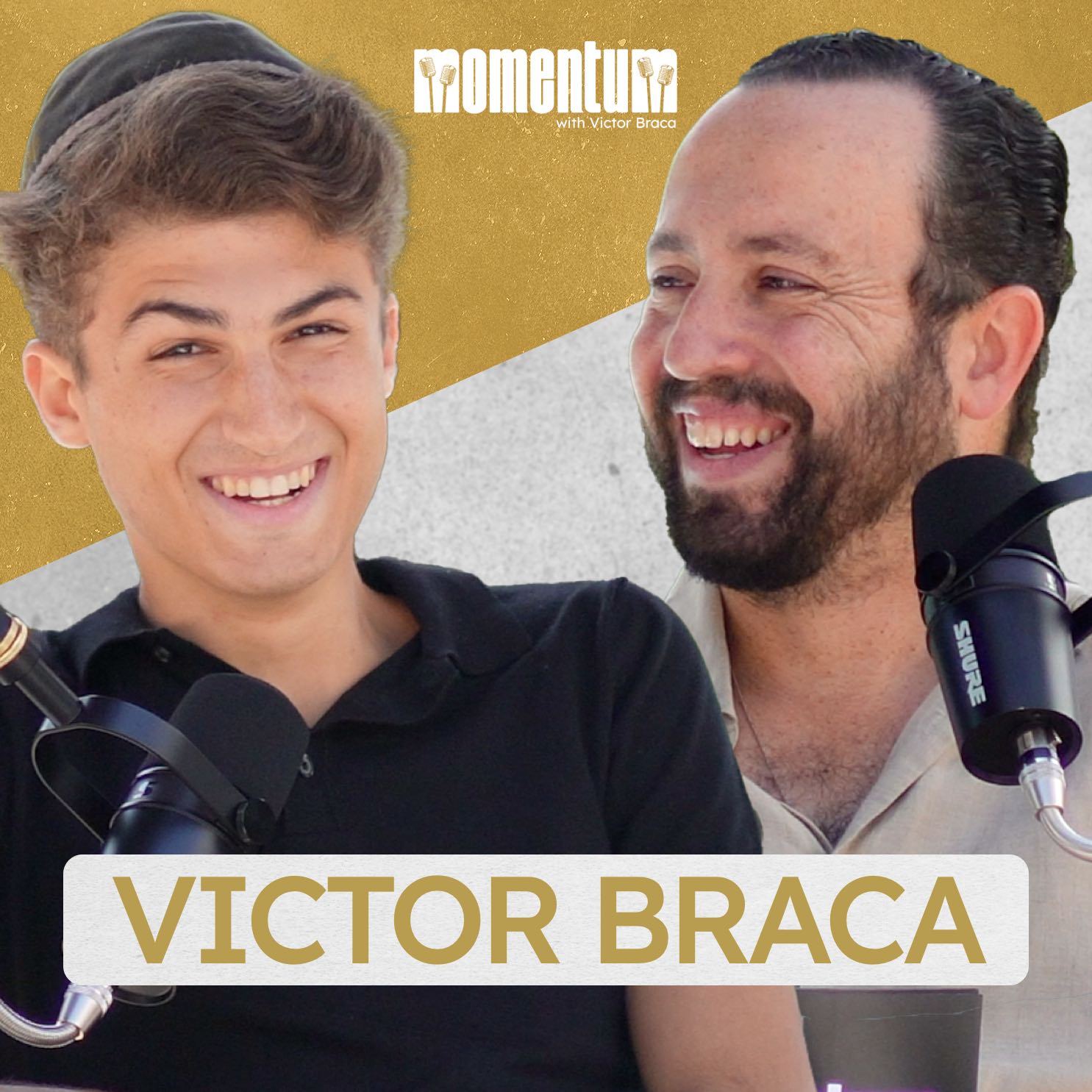


In this special episode, Marshall Mizrahi (my 3rd-ever guest) interviews me (Victor Braca, aka your host) about my journey starting and growing Momentum.
I open up about how my “cute side project” changed my life, how I went from idea to execution in just 5 days, and some of the funniest stories from my time hosting Momentum. Plus, Marshall puts me on the spot with a challenge to match memorable quotes to the guests who said them.
Enjoy!
Links
Transcript
Victor M. Braca: Joe Cayre calls me. I leave my house. I’m in a frenzy. I pack up all my gear. I’m driving down Norwood Avenue. All of a sudden, I see all my papers flying all over the block. They’re gone.
Marshall Mizrahi: What was the thought process in saying, “I want to start a podcast”?
Victor M. Braca: I was actually too embarrassed to even put my face on it before the first episode. I got some followers. You know, my family is so cute. You know, look what Victor’s up to.
Marshall Mizrahi: Do you think people were coming up to you at parties? “Oh, hey Vic. Maybe you should consider me for your podcast.” There’s some people who hint. There’s some people who don’t hint. What do they say? “Can I be on the podcast?” And what do you say if you don’t want them?
Victor M. Braca: Okay, I’m revealing all my secrets here. I’m going to be honest, guys. I’m a bit nervous to release this episode, but here goes. After a year of hosting Momentum and sitting across from some of the most accomplished people in our community, I finally switched seats.
Marshall Mizrahi put me in the hot seat to talk about how the podcast started, the behind-the-scenes moments no one sees, and how the show that began in my backyard with zero followers ended up generating hundreds of thousands of views and completely changing my life. I’m Victor Braca, and Momentum is where I usually dive deep into the stories behind business success. But enjoy this special episode where we dive deep into my journey and the story of Momentum. Let’s get into it.
Marshall Mizrahi: Welcome to a very special episode of Momentum Podcast. I’ll be your host, Marshall Mizrahi. Today we’ll be interviewing the one and only Victor Braca. Victor, it’s good to be here. Welcome to the show. I think to change things up today to make sure that people get to learn a little bit more about Victor and this podcast, I think you should be in the hot seat and not in the interview seat. I think you should be in the interview seat, not the… You’re in the wrong spot.
Victor M. Braca: Okay, I should get in the guest seat. Okay, that’s it. Switching spots. Wow, this is crazy. This is very new to me.
Marshall Mizrahi: Did you ever sit on this side ever in any interviews?
Victor M. Braca: I don’t think so. Um, this is, you know, I got to get used to it.
Marshall Mizrahi: You don’t know how it feels to be interviewed. It’s very uncomfortable.
Victor M. Braca: I never sat in the hot seat before.
Marshall Mizrahi: Good. Now you’re learning a lot. So, what do you got on the agenda? What’s really been on my mind the past year is this amazing podcast. I think it started as something fun that you wanted to do as a project. Not exactly sure. I want to find out today. But I think the audience has gotten to see you asking questions for a year, but they didn’t really get to know you. So, in today’s episode, we’re interviewing Victor Braca. Let’s get into it today.
We have these very special momentum cards. Very fancy. We’re doing a real interview today. It’s going to be good with our very special guest. I have some great questions set up for him, a couple of quizzes, a couple of tests. We’ll learn more about what was exciting to Vic this past year, what he learned during the interviews, and some information he could share with the young guests. And I want to put it out there that you thought of the questions, not me, right? These are my questions, not Victor’s questions about himself. So, Victor, why don’t you just tell us who you are? I know it sounds crazy, but they’re watching you for a year. Like, if it didn’t say your last name on the podcast, they might not know who you are. Who are you? Where’d you grow up? Where’d you go to school? Give us like the basic Victor Braca stuff.
Victor M. Braca: So, I’m Victor Braca. I’m 18 years old. I grew up in Brooklyn. Went to Flatbush for pretty much all my elementary and high school years. Graduated last year, which is when I started the show. So I graduated in June. I started the show really in late June, early July.
Marshall Mizrahi: You really went from idea to execution relatively quickly. So Victor Braca from Brooklyn, one day he’s like, “I’m starting a podcast.” What was happening? You were finishing high school. So you’re 18. That means a year ago you’re 17. You’re barely 17 and you’re like, “I’m a kid finishing high school and I have an idea. I want to do something that I think somebody will listen to or everyone will listen to.” What was the thought process in saying, “I want to start a podcast”?
Victor M. Braca: Right. So definitely I didn’t have the grandiose vision that it would turn into something big. Definitely not as big as it’s turned into today. I think it’s twofold really. My father came up to me and said we have so many successful people in the community who are successful at whatever it is that they do. And I think the goal of showing people the—what we want to show people with this podcast—is that success is not easy, but it’s simple. It’s a far reach, but it’s attainable for anybody with hard work, with a little bit of luck, and a little bit of obviously Hashem and being in the right place at the right time.
And there are so many people like yourself, like everyone else who I’ve interviewed—there are hundreds of community members who are extremely successful and who are great role models for people like me, 18-year-olds, in terms of their success in business, their involvement in community activities. You’re on the board of SBH and Magen David, and there’s hundreds of other people just like you in the community and each one has their own unique story, their own unique advice, their own unique things to share that can really drive the point home. And so my father had the idea originally. Shout out to your father Morris for that.
Marshall Mizrahi: He’s the best and it was totally his idea. Okay, there you go. See, you’re welcome. You’re welcome, Dad. What about your mom?
Victor M. Braca: Yeah, she’s great. She’s actually watching us from the inside, too. And she lets me take over the house every time I want to film. So, thank you. Shout out Mom for allowing me to do that.
Marshall Mizrahi: And shout out to his sister who helped me write up my cards today.
Victor M. Braca: Yes. Shout out Vivian.
Marshall Mizrahi: So, you’re 17, you’re finishing high school, and your dad says, “Why don’t you do a podcast?” Or did he say, “Do a podcast”? Or did he say, “Why don’t you meet with successful business people, men and women, just to learn from them?” Did he say do a stoop talk? What was that initial concept and when was it?
Victor M. Braca: Right. So I actually remember very specifically when we thought of the name. So it was always going to be a podcast. I think my father had the initial idea to make it a podcast. I think SBH and the Center and our organizations and Pathfinders and Flatbush, they run these amazing stoop talks for young adults to learn, and I’ve always gained from those. I said, “If we can streamline that and sort of make like a career day every day and upload those to a virtual library and allow people to access them whenever they like, there’s unlimited reach when it’s online.”
I remember it was the beginning of the summer. I was in Pier Village with my family. We’re getting ice cream at one of those shops and I asked my dad, “What do you think I should call it?” It was really just an idea at that point, but it had stuck with me. I was thinking about it for a little while. I said, “What do you think we should call it?” And right off the bat, he knew: “Momentum.” Why Momentum? It really encapsulates what the show is and how you hit a critical mass, you hit a breaking point in your career and you get on a hot streak and you gain the momentum.
Marshall Mizrahi: Building momentum.
Victor M. Braca: You build the momentum and that’s how it goes. So, it was my father’s idea. I remember I cold-texted Michael Harari, who was the first guest—Cracking Up Crackers. We didn’t really know each other at this point.
Marshall Mizrahi: Did you own equipment? Did you have a date? Or you were just like, “I think Cracking Up Crackers is my first guest.” Where would you jump in? How did you choose to jump in there?
Victor M. Braca: Right. So, I didn’t have any equipment. I actually confirmed with Michael Harari for Sunday and I think that was Thursday. I didn’t have any equipment or anything then. So I remember texting my father, “Please order this equipment within 15 minutes so it ships tomorrow so I can set up.” I remember setting up with Joseph, my good friend. He was helping me in my backyard. We were like, “How should we do the setup for the first episode?” We were really trying to figure it out.
Michael Harari said he’ll do it. I wanted somebody young, up-and-coming, somebody who’s going through it that could be relatable to young people like myself who want to start their own business. And Michael is really popular within the community. I kickbacked off of all of his friends and his network and his popularity and that was a great first episode. Looking back, even though I wasn’t the best host at the time, Michael really carried the conversation a lot and it really went well.
Marshall Mizrahi: I think if we added up what you just said in the past six, seven minutes of chatting, it’s the most words you’ve said in the past year for sure. So, this is the most anyone’s ever heard from you so far. Now, you called Michael Harari. It was a 15-minute episode. I just checked it.
Victor M. Braca: No, it wasn’t 15 minutes. It was short. It was shorter than the rest.
Marshall Mizrahi: No, you checked it on Instagram.
Victor M. Braca: See, I didn’t know anything back then. I uploaded it incorrectly to Instagram and it only put the first 15 minutes up. So, there’s a whole episode people didn’t watch.
Marshall Mizrahi: Wow. Guys, go out there. There’s treasures out there. You can watch the end of the episode. Uncover the secrets.
Victor M. Braca: Behind the scenes. But, no, it was like 45 minutes.
Marshall Mizrahi: How nervous were you meeting him? He’s not older. He’s not scary. He’s a fun guy. Were you nervous?
Victor M. Braca: I wasn’t nervous. I knew that if I was nervous, it would come off on the camera. So, yeah, I sat down with Michael. I think we were scheduled for 10 a.m. I was ready by 9:00. I woke up at 6:30. I was really excited for the first episode.
Marshall Mizrahi: You don’t seem like a guy who sleeps late.
Victor M. Braca: I try to get to bed at a time where I can wake up early and still get seven, eight hours of sleep. I’m very into health and eating healthy and living a healthy lifestyle in that sense. It’s very difficult when you’re ambitious and you want to do a thousand things and the night is when you’re excited and you think you know how you’re going to make a billion dollars.
Marshall Mizrahi: So for anyone looking, he sleeps seven to eight hours. He eats a healthy lifestyle. Do you exercise?
Victor M. Braca: I’m taken, actually.
Marshall Mizrahi: What do you mean you’re taken? So that means you have a girlfriend.
Victor M. Braca: I have a girlfriend.
Marshall Mizrahi: We’re talking about that right here. You said for anyone looking… I mean, you don’t have to break their hearts.
Victor M. Braca: I apologize. Don’t look.
Marshall Mizrahi: Wow. He’s locked up. This guy’s 18. Yeah, because she saw you on the podcast?
Victor M. Braca: No. From before the podcast.
Marshall Mizrahi: Like now that you’re famous. Congrats to Merryl. Scooped up a good one. Okay. So, you had Michael Harari. Then you went to Urban Pops, right? Sophia Cohen was number two. So, how did you choose? How did you find Sophia?
Victor M. Braca: Sophia is friends with my mother. My mom suggested her. She gave me her number. I didn’t have to do much convincing. Sophia likes telling her story. She’s a great storyteller. She has a great story to tell and she’s a great storyteller. We spoke for maybe two and a half hours. Something crazy. I was like, “I can’t post it. It’s two and a half hours. No one’s going to listen to it.” I cut it down to an hour or an hour and a half. So, we really cut a lot out. We really got into the weeds and I kept the best parts in. The goal is to not be able to tell that it’s cut, right? That’s really—I mean, I think I barely noticed that it’s cut when I watch my own episode.
Marshall Mizrahi: Exactly. I have a hard time remembering what was cut out.
Victor M. Braca: Exactly. And we switch the angles to hide those. Like, I come from a video production background. I remember—I don’t know if you remember—when I was in maybe 10th grade, I did a video for SBH. I was sitting behind the camera. I was like a little guy, little boy.
Marshall Mizrahi: You’re still a little guy.
Victor M. Braca: Okay. I was way smaller then. And I was filming you for an SBH video. That’s how I knew who you were and that you were an interesting guy and that you would really make for a good personality on the show.
Marshall Mizrahi: Thank you. Thank you for thinking of me. So you went with crackers, then food… I didn’t want people to think it was a food podcast. Then you went to me. How did you go to children’s underwear? To licensing and underwear? You’re like, that’s a jump. How did you get to me?
Victor M. Braca: There’s no theme in terms of the industry that people are in. I got all the suggestions pretty much most of them from my father in the beginning. So we’re talking about Elliot Horowitz who was right after you. Joe Cayre and Jack Hidary were classics, and they’re like community celebrities in that sense. So they were always on the list. And then afterwards I got Zee Dwek, also friends with my father. Jack Ovadia. A lot of the guest suggestions from the beginning were from my father. I don’t know exactly how I made the decision. I’d have to scroll back through my texts and see.
Marshall Mizrahi: I think it was a random call or a random text.
Victor M. Braca: I called/texted you because you didn’t really know who I was. I didn’t really know who you were.
Marshall Mizrahi: So when you called me, I was practicing at the time saying “no” to things. That was my thing for that month. I’m like, “I got to learn to say no. People are always asking for something. People always want a favor or volunteer. I have to be better at saying no and picking my battles.”
Victor M. Braca: Which by the way, you’re very bad at.
Marshall Mizrahi: I’m pretty bad at it. But I had said no to someone a week before and I was so inspired by my first “no” that when you called, I’m like, “I’m going to tell this kid no.” And then you said something about, “I mentor a lot of young adults in the community and this will reach out to your 300 followers at the time.”
Victor M. Braca: Maybe even less. I remember it being 300 because I remember looking it up. And there was a different momentum podcast, I think by a sports player. I didn’t do my research so well when making the name.
Marshall Mizrahi: So I said, “Okay, who’s going to see this?” I said yes, just going, “Look, this is a nice kid. If I can reach 300 young adults, then it’s worth it. So, I’ll say yes to this nice kid.” Thinking, “No one’s ever going to watch this.” That’s so funny. No one’s ever going to watch this. At what point did it explode? Was it a few weeks later with Joe Cayre?
Victor M. Braca: Enter Joe Cayre.
Marshall Mizrahi: So, tell us how you suddenly went from Marshall Mizrahi over to Joe Cayre—a leap of generations and a legend in our community.
Victor M. Braca: Joe Cayre is definitely a legend in our community, a living legend. And his name is on every building in terms of the chesed that he does and the philanthropy. Unbelievable. I didn’t really know his story. I had done some researching. I had texted him. I try not to email; I try to text. It’s a laid-back thing. We’re all community members, so I try to text everybody. I texted him asking him to be on the show. No response. I usually don’t get a response; people are busy. I have to follow up multiple times.
All right. So, I’m at an AIPAC event at Joey Shamie’s house last summer. It was a Friday morning, and Joe Cayre spoke. He spoke about the importance of getting involved or whatever it might be. And afterwards, I’m at the event with my father and he tells me, “You should go up to him.”
I said, “What do you mean go up to him? I’m not going up to him. What if he says ‘get out of my face’? What if he says ‘stop wasting my time’?”
You could say “no.” What’s the big deal? And so I told myself that and I eventually went up to him and then we were talking for like 8-10 minutes. He was really investing his time into talking to three young guys. And then he says, “I have to go,” and he turns his back and he’s heading towards like a back exit. And I’m thinking to myself, “I missed it. I squandered the opportunity. What am I going to do?”
And I was like, “You know what? I can’t let this go. I have him right here. I have to pitch it to him.” He’s walking out. I grabbed him by the shoulder. “Joe, I have to tell you one more thing.”
“What’s up? I got to go.”
I turned my 30-second elevator pitch into an 8-second, one-sentence pitch: “I have a podcast trying to inspire young community adults. Will you be on it?”
“If it helps the community, for sure, I’ll do it. Text me.” That’s what he tells me.
And so just like that, I was like, “Wow, I got it.” So I run up to my father. I’m very excited, and I texted Joe. He calls me back later that day. He says, “Call me Sunday. We’ll do it.”
I said, “For sure.” So I’m doing my research. Saturday night, I didn’t go out with my friends. Sunday morning, I wake up early, I prepared my list of questions. And Sunday, it was High Heat, right? He said, “I’ll probably want to do it in the 1 to 3 p.m. range.” I said, “Sure.” I go to High Heat with my friends and I left super early to get ready.
This is probably the funniest story that’s happened of the entire podcast. I’ll tell you what happened. So, Joe Cayre calls me and I wanted him to come to me because I had the whole setup by me. I was more comfortable and I knew it would be better produced if it was by me. But he’s 15 minutes away from me and if Joe Cayre wants me to come to him, I’m going to come. I knew it was going to be a very popular episode. So he calls me up. He says, “Let’s do it now.”
I said, “Okay. Heads up: I need like 30, 40 minutes to set up by you. Is that okay?”
He goes, “Oh, I want to go back to the tournament. Let’s just come now. We’ll do it.” And he thought it was going to be a 10, 15, 20 minute thing. And I’m planning to sit down for an hour.
I leave my house. I’m in a frenzy. I pack up all my gear. At the time I was driving my Jeep—my Wrangler—and I had no doors. I had taken the doors off for the summer. And I have all the gear in a storage container in the car. And I have my notes, and I didn’t have a clipboard or anything at that time. I’m driving down Norwood Avenue. All of a sudden, I see all my papers flying all over the block, all over the street. They’re gone. I pull over. What am I going to do? I had researched him. I printed out his Wikipedia page, news articles about him. I had written down all my questions and now all of a sudden they’re all gone in the street. In the street for people who shop at I&D to see.
Marshall Mizrahi: If someone finds those, those are very valuable today.
Victor M. Braca: That’s true. You could flip them on eBay. But I was flipping out. I was really nervous. Maybe it was better to be not stuck to a script. Looking back, it probably was, but I was super nervous at the time. I got in my car panicking. I started picking them up. I was like, “This is not going to work.” I was going 30 miles an hour. They were long gone.
Marshall Mizrahi: Do you recommend doors on Wranglers going forward?
Victor M. Braca: No, I recommend securing your cargo.
Marshall Mizrahi: You should have put them in the bins with all the equipment.
Victor M. Braca: I had them on top of the bin because I just had printed them out, I remember. And they were gone. And I didn’t use a paperweight or anything. So I get to Joe’s house. I’m sweating. I have to carry this huge storage container into his house. His wife, Trina, opens the door for me. So I go to set up downstairs. I set up the whole thing. I didn’t like the setup. It was echoey. I take the whole thing down. I set up upstairs.
25 minutes later, Joe says, “Call me when you’re ready.” I’m like rushing. Then my mics don’t work. I had always been using these podcast microphones, but inside I don’t use these because they’re very bulky and heavy and you have to clamp them to something. So, I have the clip-on microphones. I hadn’t—I didn’t own them. I had rented them because that was the first time I was doing an indoor podcast. I had rented them and they weren’t working. I was flipping out. I didn’t know what to do. I have Joe sitting down at this point in the chair ready to go and the mics weren’t working.
Thank God, somehow, someway, I ended up figuring out the microphones. We sat down. I was sweating. You couldn’t tell in the video—I scrutinized the video to make sure, but you couldn’t tell. I was super nervous. But I said that if I’m nervous, it’ll come through and people watching will feel awkward. They’ll feel uneasy. They’ll feel secondhand embarrassment or whatever it might be. So, I tried to forgo my nervousness and Joe and I had a great conversation and that ended up being the episode that really put me on the map in terms of getting the show to the community. And almost everybody I see who approaches me about the podcast, I’d say 70 or 80% of them tell me the Joe Cayre episode was great. He has a great story. He told it very well. One of his clips got half a million views.
Marshall Mizrahi: That’s another question. So, how many minutes were viewed or how many views did Joe Cayre get? How many views total do you have or how many minutes watched total?
Victor M. Braca: It’s a good question. A metric I love to use is watch hours or watch minutes because if your show was watched for the hours that are in a whole month, that’s pretty cool. That’s a couple thousand people. So, I can’t tell you total numbers. It’s hard to aggregate them between Spotify and YouTube and Instagram, but Joe Cayre was the most widely circulated. Ab Sarway, who was a young guy, 26 years old, top guy at Douglas Elliman, one of the most popular episodes—and that I love because he’s an up-and-coming guy. Joe Cayre, everybody knows his name. Ab Sarway, not everybody knows his name, but you see this 26-year-old is the top guy at Douglas Elliman. He sells hundreds of millions of dollars worth of real estate every year. And you click on that and you hear his story and he really delivered.
Marshall Mizrahi: So give us some stats. You’re avoiding the answer. We need some stats.
Victor M. Braca: Half a million views on just one of the Joe Cayre clips. We bring in around half a million views per month total on Instagram throughout our clips and our episodes. And on Spotify and YouTube, tens of thousands of views per month. I wish I could tell you more exact numbers. I should have prepared.
Marshall Mizrahi: So let’s go back. You did something that wasn’t about money, which gave you crazy access to people of money. Let’s even say that—to well-rounded successful people in our community. Here was an idea of: how do I make connections? But it’s not about the money. I started the show briefly to meet people and because I wanted to spread the content to people. I knew I would enjoy it. So, you did this for you or you did this for us?
Victor M. Braca: Half and half. Totally 50/50.
Marshall Mizrahi: Were you ever—you were the guy behind a camera you just told me a few minutes ago. Were you ever the guy in front of the camera? No. Were you ever on stage, theater, speeches, parasha?
Victor M. Braca: I was always into speech and debate and things like that. I’ve been doing that since sixth, seventh grade and throughout high school. So I was always very into public speaking. I think it was my father who instilled that in me from a young age. A lot of people are scared of it, and I’m scared of it too, but it’s something I’ve always loved. I didn’t really—it’s funny—I didn’t really consider the podcast as a forum for public speaking for myself even though it definitely is. Doesn’t feel public when it’s only the two of us here, so it’s very private and if we make a mistake it could be edited, so it’s not really public.
Marshall Mizrahi: Meaning you were the guy behind the camera, now you’re the guy in front of the camera. What I’m hearing from you is I think what a lot of the people who are being interviewed say: you just got to jump in and give it a try.
Victor M. Braca: You got to jump in. You got to give it a try. You got to start before you’re ready.
Marshall Mizrahi: Start before you’re ready. Start before you’re ready. That’s a crazy sentence.
Victor M. Braca: Listen. You’re never ready. You’re never going to be ready.
Marshall Mizrahi: Exactly. Wow. You’re never going to be ready. I want a bumper sticker: “Start before you’re ready.”
Victor M. Braca: One bumper sticker “Momentum” and then one “Start before you’re ready.” Anyone who has a business idea or a dream or a hope: start before you’re ready. Just start. Those two words: “just start.” Michael Harari was saying that a thousand times throughout our first episode. I’m so glad I chose him for that reason. Why start before you’re ready? I heard a quote: if you made a logo, you’re starting too late or you’re overthinking it. If you made a website for your new business, you’re starting too late. I think the point is just like we all like to hide behind big things. If we want to start a business, then we hide behind, “Oh, I don’t have any followers on my social media yet. Oh, I don’t have any inventory. I can’t call China to buy this. I don’t have the money.” We hide behind these big things that we build walls with.
Marshall Mizrahi: That’s a great point. Meaning, I want to start a podcast on Instagram. I have zero followers. Oh, maybe I got to build up followers before I start the podcast. You released episode one with zero followers.
Victor M. Braca: Yeah, with like 50. It’s your friends, right? “Tag your friends. Do me a favor. Follow this.” I was actually too embarrassed to even put my face on it before the first episode. So I put text on screen: “Momentum is a podcast where we interview successful people in the community.” And I sent the link to my friends’ chat, to my grade chat, my class chat. I put it on my personal Instagram story and I got some followers. My family is so cute: “Look what Victor’s up to.”
And that’s how it really started. I didn’t really have a vision. I didn’t know what I wanted to do. It happened to be that my summer plans had just fallen through. So, it was an opportune time and I had time to work on this and I really spent the whole summer on it. What would I advise young people to do? Do things that make you uncomfortable. I’m a social guy, but we’re all uncomfortable in some social situations.
In senior year what I did when I was looking for an internship for the summer was I cold-emailed like 10,000 people asking for an internship.
Marshall Mizrahi: That’s a lot of emails.
Victor M. Braca: A lot of emails. It wasn’t manual. I learned a lot from that experience. I sent mass emails and what you would have gotten is like, “Hey Marshall, my name is Victor Braca. I’m a 17-year-old who will be starting at NYU Stern studying finance in the fall. I checked out Handcraft Manufacturing’s website and was inspired by your unique approach to the industry. I would love to hop on a five-minute call with you.”
Marshall Mizrahi: Like you really wanted to get an internship.
Victor M. Braca: “I would love to intern by you and if not then let me please hop on a five-minute call to pick your brain.” They were mass emails; they weren’t personalized. I got some responses. I got like 15-20 calls and I got one internship offer from those calls and I said, “Wow, that’s all I need.” That was actually the arrangement that ended up falling through—they wanted to do it virtual. I learned a lot from that experience about how to network and meet people and how to tell people about myself.
Marshall Mizrahi: Okay, let’s pivot a little. Now you start to become successful, or the podcast starts to become well-known. People watch the Joe Cayre one. I’m getting stopped everywhere after the Joe Cayre one—my wife hates you for it because now people are watching mine and my wife was so upset we couldn’t go out for dinner because everyone’s coming over to our table. “I saw your episode, saw your episode.” That’s awesome. Um, and she’s like, “Ugh, this guy, his head is getting so huge.” In my episode, I really didn’t talk a lot of business. I talked a lot about being the best version of yourself, which I think really hit home with people. I had a lot of adults stopping me saying they’re telling their kids to watch the episode. But at a certain point, do you think people were coming up to you at parties or in shul like, “Oh, hey Vic. Maybe you should consider me for your podcast.” Is anyone pushing themselves on you now?
Victor M. Braca: There’s some people who hint. There’s some people who don’t hint.
Marshall Mizrahi: What do they say? “Can I be on the podcast?” And what do you say if you don’t want them?
Victor M. Braca: Okay, I’m revealing all my secrets here. I always get great suggestions from people: “You should have this person on the show” or “I would love to be on the show.” I write down every suggestion. I have a very detailed system where I write down the suggestion itself and who suggested that person in case I need to reach out to them for contact info. And then I’m very detailed in terms of when I follow up with people.
Marshall Mizrahi: Which guest surprised you the most? Besides that you had a great time with Joe Cayre, what was a big surprise like a great interview?
Victor M. Braca: It’s a good question. Sol Betesh really surprised me. Sol Betesh is great. He’s a very young guy. He runs the coolest company I’ve ever seen.
Marshall Mizrahi: Media company.
Victor M. Braca: I’m very into the media world and I think media private equity is something I would love to do.
Marshall Mizrahi: That was a good question. I was thinking: how do you tie media with finance?
Victor M. Braca: Right. I think that would be something that I really want to go into—media M&A advisory or banking. Sol Betesh runs a company called Fallen Media. They are essentially like 20th Century Fox for Tik Tok and Instagram and they make viral hit shows that produce billions of views every year. We spoke for maybe two and a half hours. I remember that night that we were recording, it was my brother’s birthday dinner. My family was going out for dinner to Castelli’s. I said I’ll pop in at the end. I ended up going for the last 10 minutes of the dinner because Sol and I were really engrossed in the conversation; I just couldn’t leave the chair. That was great.
And then one thing that surprises me is that our community is very small and insulated, so you think you know everybody. But you really don’t. When Sol Betesh suggested Ab Sarway—and Ab Sarway is a young community member who is one of the top guys in the country in terms of real estate—I was surprised by his track record. And when I heard about Lori Kassin and her personality and her unbelievable giveaways, that surprised me. I think my guests often pleasantly surprise me. You surprised me by being somebody who’s just very interesting and out of the box and not the typical cookie-cutter businessman. That really made for a great episode that young adults really loved.
Marshall Mizrahi: I’m glad people enjoyed it. So now I prepared a few quotes from episodes. I went very random. I tried to just pick an episode and fast-forward and just whatever they said I wrote down. So hopefully you didn’t cheat and look at my notes when they were being scotch-taped to these cards.
Victor M. Braca: I did not.
Marshall Mizrahi: We’ll see how well you know them. I don’t know if I would have guessed any of them correctly.
Victor M. Braca: I think I’ll be pretty good, but I really don’t want to be too cocky. I listen to every episode.
Marshall Mizrahi: Out of context and out of order, I think they’re going to be hard.
Victor M. Braca: Okay. I’m a little nervous.
Marshall Mizrahi: The first one: “I made a book of questions that…”
Victor M. Braca: Wow, I didn’t even get it. “I made a book of questions that people would typically ask on the phone, so I always have the answers.” Ab Sarway.
Marshall Mizrahi: Yeah. Ab Sarway. Go watch that episode. I agree, I was surprised as well.
Victor M. Braca: I used to have a book of questions, meaning anytime I was on the phone and somebody would ask me a question, I would write it down.
Marshall Mizrahi: Okay. “People hesitate to get started or look for a way out. When you’re young, go out and do something cool.” Whoa. What? That sounds like you. I’m not going to lock it in. Wait, I see you. You’re smiling. It’s not me. Just do something cool. Don’t say who it is yet. “People hesitate to get started or look for a way out. When you’re young, go out and do something cool.” Do something cool. He was talking about stop thinking, “I have to get into finance or start a business or be in real estate.” He’s like, “Go do something cool. Try new things when you’re young.”
Victor M. Braca: Wow. Tough. The first one I didn’t even get two words in. This second one you’re stumped. Not doing too well. “When you’re young, go do something cool.” I’m going to say Joey Shamie.
Marshall Mizrahi: This one was Sol Betesh.
Victor M. Braca: Why did Joey Shamie talk about doing something fun and cool when you’re young? I don’t know. I had a feeling. Gut feeling was wrong.
Sol Betesh: When you’re young and you’re in your early to mid-20s, specifically your early 20s, go out and do something cool.
Marshall Mizrahi: Next: “You don’t close billion-dollar deals by chance. It’s years of grit, trust, and showing up when it matters.” So, you paraphrased. I tried not to. I even used ChatGPT at one point to comb through something.
Victor M. Braca: I use ChatGPT a lot in my editing process and if you don’t yell at it 10 times repeatedly not to paraphrase, it will do it.
Marshall Mizrahi: Some of these I typed myself. Okay, but that one was paraphrased. I know for sure.
Victor M. Braca: That would be very interesting if you could tell me that it’s paraphrased and I still know who said it. Okay, tell me again.
Marshall Mizrahi: “You don’t close billion-dollar deals by chance. It’s years of grit, trust, and showing up when it matters.”
Victor M. Braca: Billion-dollar deals… I could think of Erwin Dweck, who has closed multi-billion dollar deals. It’s Dweck.
Marshall Mizrahi: Okay. I don’t want to leave you hanging there. Wow. It’s pretty good. I’m impressed with myself. This one’s really easy: “I was told I’d never amount to anything. Now I’m a judge.”
Victor M. Braca: Gina Abadi.
Marshall Mizrahi: Gina. I really felt like a lot of us heard that in high school—that you’re not going to be a whole lot. I remember hearing that myself. This one’s another easy one: “From slicing deli meat to building skyscrapers, every step taught me something about resilience.”
Victor M. Braca: That was the title of Joey Jerome’s episode.
Marshall Mizrahi: But it just grabbed it. But that’s great. It’s great that he still talked about it. Working in his [father’s] deli. He’s not hiding where he came from. He’s saying, “I started at the bottom slicing deli meat and now I’m here.”
Victor M. Braca: Yeah, that was unbelievable. He was like hustling as a DJ when he was young, right? He was a DJ in the community doing parties for a couple hundred bucks. Fast forward couple decades and he’s doing billion-dollar deals. It’s crazy.
Marshall Mizrahi: Okay, I typed this myself: “At 18 and 19, worrying isn’t helpful. It’s not going to motivate you. Don’t worry about worrying. Focus on working and accomplishment.”
Victor M. Braca: Joey Jerome?
Marshall Mizrahi: I just did a Joey Jerome one.
Victor M. Braca: I know. But he said—and you might be trying to stomp me—he said that worrying is the worst thing for young adults or pressure is the worst thing for young adults.
Marshall Mizrahi: Can you read the quote again? “At 18 and 19, worrying isn’t helpful. It’s not going to motivate you. Don’t worry about worrying. Focus on working and accomplishment.” You’re stomping me here. This is tough.
Victor M. Braca: I loved it. I love Michael Harari.
Marshall Mizrahi: This was Zee Dwek. And I just wrote “Zee.” “Don’t worry about worrying.” I really like that one. Especially when you’re young, stop worrying so much. Just jump in.
Victor M. Braca: I’m not doing too well over here, but it’s nice to reminisce about the episodes and great advice all across the board.
Marshall Mizrahi: This one you’ll get: “You can’t just aim to hit home runs. You have to start adding up a lot of singles first.”
Victor M. Braca: It’s totally out of context, right? But it’s a great quote. “Don’t aim to hit home runs. Start with a few singles.” Anyone could say that. It really ties into the theme of momentum.
Marshall Mizrahi: I had given similar concepts in my interview about small goals.
Victor M. Braca: Joey Jerome did say to set small goals. Ab Sarway talked about setting input goals, but I don’t know if this was him.
Marshall Mizrahi: “Don’t aim for the home run right off the bat. Aim for single, single, single.” Elliot Horowitz? This one was Avi Akiva.
Victor M. Braca: Really? It was towards the end. Oh, wow. I’m not doing great over here, but that’s good advice. My biggest belief is go single, single, single. They add up and once in a while you’re going to bloop and hit a home run.
Marshall Mizrahi: Also, I hope this isn’t—I really thought I would do well, by the way. You got the first one so easily that I thought I was going to be in trouble. “Building a top team isn’t about numbers. It’s about nurturing relationships and delivering consistent value.”
Victor M. Braca: Melanie Kishk.
Marshall Mizrahi: Yes. How did you know?
Victor M. Braca: Because we talked a lot about her team in that one. It gave it away.
Marshall Mizrahi: Also, she didn’t say that. It was ChatGPT.
Victor M. Braca: Stop it. ChatGPT.
Marshall Mizrahi: I couldn’t watch all the episodes, guys. Three nights ago I started watching and fast-forwarding and I realized there’s a thousand minutes to watch.
Victor M. Braca: What did you do? You copy and pasted the transcript or you just put the link in?
Marshall Mizrahi: I just took the entire link, dropped it in. I said, “Pull quotes from every episode.” And then I started fighting with ChatGPT. We have an interesting relationship. Okay. I’m going to make sure I do a not-ChatGPT one. “Treat your business with a sense of accomplishment and pride. Don’t just look at your bank account. If you build something amazing and you’re proud, I guarantee there’ll be some money in the bank.”
Victor M. Braca: Is it you?
Marshall Mizrahi: It is me. How did you remember? It’s a year ago.
Victor M. Braca: That’s pretty good. I remember you talking about not focusing on making money and I remember particularly that you said that you and your brothers, when you were building the business with your father, you didn’t focus on getting rich or buying a mansion or getting a Lamborghini, but rather you put your head down and worked for 10 years. And then you looked up after 10 years and you said, “Wow, we built this.” So, I remember that.
Marshall Mizrahi: Look, I still get that question today when I meet with young adults. A lot of them are saying to me—I tell people—I want you to fall in love with something. Fall in love with a piece of your business or the quality of your fabric or the way that you finance something. It should be unique. You should fall in love with that aspect of what you chose to do. And if you build it and you’re super proud, I guarantee there’ll be some money in the bank. What if nobody watches this episode, which is about you? That’d be pretty embarrassing. Would that be embarrassing?
Victor M. Braca: Yeah. Yeah, it would be pretty embarrassing. Can we just pull it down if it doesn’t do well?
Marshall Mizrahi: I’m going to keep it up. You know, public stakes, right? But listen, I hope people watch. You’re the one who said everybody wants to hear about me. So, I feel like it’s on you if nobody listens to this. Wow. Imagine I’m wrong. I feel like no one knows who Victor Braca is. This was a chance to get to know Victor Braca today on this very special episode of Momentum. I think he’s found success in this project that he started which is only benefiting everyone in the community and it’s eventually benefited him as well with connections to everyone in the community including the job that he got. So kudos in starting something and your father pushing you to just start it and figuring it out. But I wanted to read one more quote to you. Let’s end it off with the bank. “I don’t want to focus on business. I want to focus on success.” That’s very vague.
Victor M. Braca: I have no idea.
Marshall Mizrahi: That was said by Victor Braca.
Victor M. Braca: What?
Marshall Mizrahi: Yeah. I guess you said it in one of the interviews.
Victor M. Braca: That’s so funny.
Marshall Mizrahi: I was just scrolling past and you told someone like, “Listen, I don’t want to focus on business. I want to focus on success.”
Victor M. Braca: That’s so funny.
Marshall Mizrahi: And I was like, “Wow, that’s great.” Well, what do you think that means? I’ll flip it on you. What do I mean by that?
Victor M. Braca: Look, I think for me it’s a lot of what I discussed with you. We could talk and sit here about the nitty-gritty of how to do licensing or real estate or marketing. We can get into those and I could sit and teach a licensing course or someone could teach a real estate course, but that doesn’t always equal success. And success is exactly what happened here: having an idea, jumping off the deep end, and saying, “I’m gonna start a podcast. I’m gonna do something and see if it works.” And that was the success. You found a way to build success, and you’re enjoying it. And that to me is the best part of success: enjoying the project that you started.
I was thinking a couple months ago, what does success mean to me? I think a good rule of thumb how to define success is if—I think all of us, a lot of people, we go to work, we live for the weekend, and we just want time to pass. We live for the weekend during the week; during the winter we want the summer; during the summer we want vacation; during vacation we want our beds at home. It’s always “we want time to pass.” I think a very good measure of success is—I want, even now, in order for me to consider myself successful, I want time to move slower, not faster. I want to love what I’m doing and I want to be so engrossed in everything that I do and go to work and feel like I have so many things on my plate and I just need more time. I don’t want the weekend to come because then I can’t work, and I don’t want the weekend to end because Shabbat is great. So I think a good measure of success for me is I want to wish that time moved slower.
Marshall Mizrahi: That’s very pretty. I always said I wish there was more hours in the day for me to get more things done. But listening to you, I think the definition of success for me is a sense of accomplishment. Meaning, if you set out a goal and you got there, that was success. So, I’m always telling people: set goals. Start small. Hit a few singles before you aim for the home run because you’re gonna feel a sense of accomplishment. And all those little bits of accomplishment start to tell yourself, “I’m a guy who accomplishes. I’m a person who gets to my goals.” And you carry that with you into the workplace. You carry that with you all day. Even in Judaism: I could pray every day. I can get this done. I could start a podcast. I could start a business. I could accomplish these goals. So for me, I think success is a feeling of accomplishment—setting a goal and getting there.
Victor M. Braca: I love it. And with that definition, anybody can be successful. Anybody can find success in whatever they do. Ab Sarway and Joey Jerome echo the point that you should set small attainable goals and reach those goals and build up momentum. And that’s why we put that on the card. I was very excited about the cards. Marshall was like, “Do we really need the cards?” I love the cards, guys.
Marshall Mizrahi: You look like a game show host. You look like Steve Harvey.
Victor M. Braca: I look just like Steve Harvey. We’re basically twins. Dressed the same. Today was amazing. Today was a very special episode of Momentum. We switched seats. We got to hear about his beginnings, starting a podcast, meeting the most interesting people in our community. Are there any secrets you want to give away for season two? Like some of the guests that are coming? You mentioned Gitty? Any of the other guests that you have listed?
Victor M. Braca: We’re going to keep it for the season two teaser trailer.
Marshall Mizrahi: Wow. Yeah. It’s a very official thing.
Victor M. Braca: I didn’t know there’s seasons. Oh, yeah. But, you know, I wasn’t going to do seasons and my girlfriend told me you have to. It’s going to help you build up momentum.
Marshall Mizrahi: A lot of talk about Merryl today, guys. Listen, you have to have somebody who is not in the business but who can give you advice about a business.
Victor M. Braca: I think Michael Harari echoed that the first episode. He said his best friend doesn’t work with him but he consults him for business advice. So I think it’s important to be able to call on the advice of people around you who are outside or removed from the situation.
Marshall Mizrahi: I heard you say that your father pushed you, your mother supported you, your girlfriend supported you. So, build yourself a nice circle of people that you trust. 100%. And jump into any project that is in front of you.
Victor M. Braca: Yeah. That’s pretty much it. And start before you’re ready.
Marshall Mizrahi: Start before you’re ready. I think that’s like the number one thing. Start before you’re ready—or just start. Nike has that momentum: “Just Do It.” Just start. This is momentum.
Victor M. Braca: Start before you’re ready. Yeah.
Marshall Mizrahi: All right, Marshall. Close up. Congratulations on a successful season one. I think you’ve impressed the community. You’ve impressed the people that you’ve interviewed. You’ve impressed the hundreds of thousands of views that you’ve gotten—not just in our community, but across the globe potentially. So congratulations to you. I hope that many young adults watching this are inspired by what Victor has been able to accomplish starting in high school. Anyone could do it. Anyone could do anything they set their minds to. I hope that they’ll be inspired by this, you’ll set your own personal goals, and that one day you will also have a bit of momentum. Thank you.
Victor M. Braca: Wow, that was a good time. All right, guys. Thank you so much for listening until the end. Let me know how I did. Comment down below. Send me a message. I really hope you enjoyed this episode. As always, my top three takeaways from this conversation—it’s funny because I’m summarizing my own thoughts in three takeaways, but whatever. Let’s get into it.
First: start before you’re ready. I said this a couple times in the episode and it’s been the key principle that has guided me throughout my journey so far. Not to imply that I made it or anything because I haven’t. But Momentum didn’t start with 10,000 followers. It didn’t start with people asking me to be on the show. It started with a cold text message to my first guest and expediting mics off of Amazon. If I waited until I felt ready, I would have never started the show.
Second: the best way to meet people you admire is to create something. Give people excuses to speak with you. I never wanted to ask anybody for a job or a favor or anything like that. But the podcast gave me an excuse to sit down for an hour straight and speak off the cuff with some of the most successful people in our community. And your thing doesn’t have to be a podcast. It could be a newsletter, film a mini-documentary, a community initiative, write articles, host an event—anything that brings value to others and that gives people a reason to engage with you beyond “Can I pick your brain?”
And third: take action to build momentum. Every small action you take builds on the last. One episode led to the next. A single five-second moment where I pushed myself to approach Joe Cayre turned into my most popular episode. When I started the podcast and I called it Momentum, I didn’t think much about the name. My dad came up with it. I thought it sounded good and I rolled with it. But now looking back at just the last 12 months, I’ve experienced firsthand how momentum builds. And it starts slow. You post one thing, barely anyone sees it. You post another thing, you improve this, you change the style, iterate based on people’s feedback, get better guests, whatever it might be. And then all of a sudden, 12 months later, you look up and realize that every single small thing you did pushed you forward in some way.
And of course, I’d be remiss if I didn’t thank my guests. My early guests took a chance on me. Michael Harari, Sophia Cohen, Marshall Mizrahi, Elliot Horowitz, Alan Shama—those first five had no clue who I was. And to be honest, they had no real reason to sit down with me. They took a chance on me. They thought their podcast might inspire a couple of community members, 5, 10, maybe 15 people. And so to my early guests, I owe the biggest thanks. And to every guest since those early days, thank you as well. Thank you for inspiring others with your experience. Thank you for sharing your story even when you would have preferred to remain low-key.
But guys, most importantly, I’m so, so, so grateful for all of you who tune into Momentum. Whether you watch the full episode every week or you listen to 30 seconds of a single one, it’s you who make this podcast possible. It’s your shares and likes that keep this going. It’s your comments that motivate me quite literally every day. Comments like this—this is from a 16-year-old: “Holy cow, I just watched the full episode. How do I become like him?” (By the way, guys, he was talking about the guest, not about me.) And this one: “I’m glued to your podcast. I listened to at least four in the past 24 hours. My parents weren’t business people, and business really interests me. This is the first time I could get a sneak peek into it.”
Another thing that keeps me motivated, by the way, is the opportunities that the podcast has given me to connect people with each other. The other week, I heard that a good friend of mine had been looking for a job for a while to no avail. And without thinking much of it, I connected him with one of my previous guests whose business he was really interested in. Again, I didn’t think much of it. All I did was send a single text message. And lo and behold, the guest ended up hiring my friend. I mean, I don’t know about you, but I was blown away by that. Such a simple action on my behalf created so much value for somebody else. I didn’t create anything. Nothing new was created in the world. I just brought one plus one together and it turned into something so much bigger than two. It’s like one plus one equals 5 million. It’s really incredible to me.
And I guess the lesson here is that creating something—anything, whatever it might be—opens doors you would have never expected. So just go out there and create. Do something. Like Sol Betesh said: “Go out and do something cool.”
So that’s it. That’s season one, guys. Thank you so, so much for giving me your time, your attention, your support. I promise I will not take it for granted. The first episode of season two is dropping next week. See you then.


Leave a Reply