

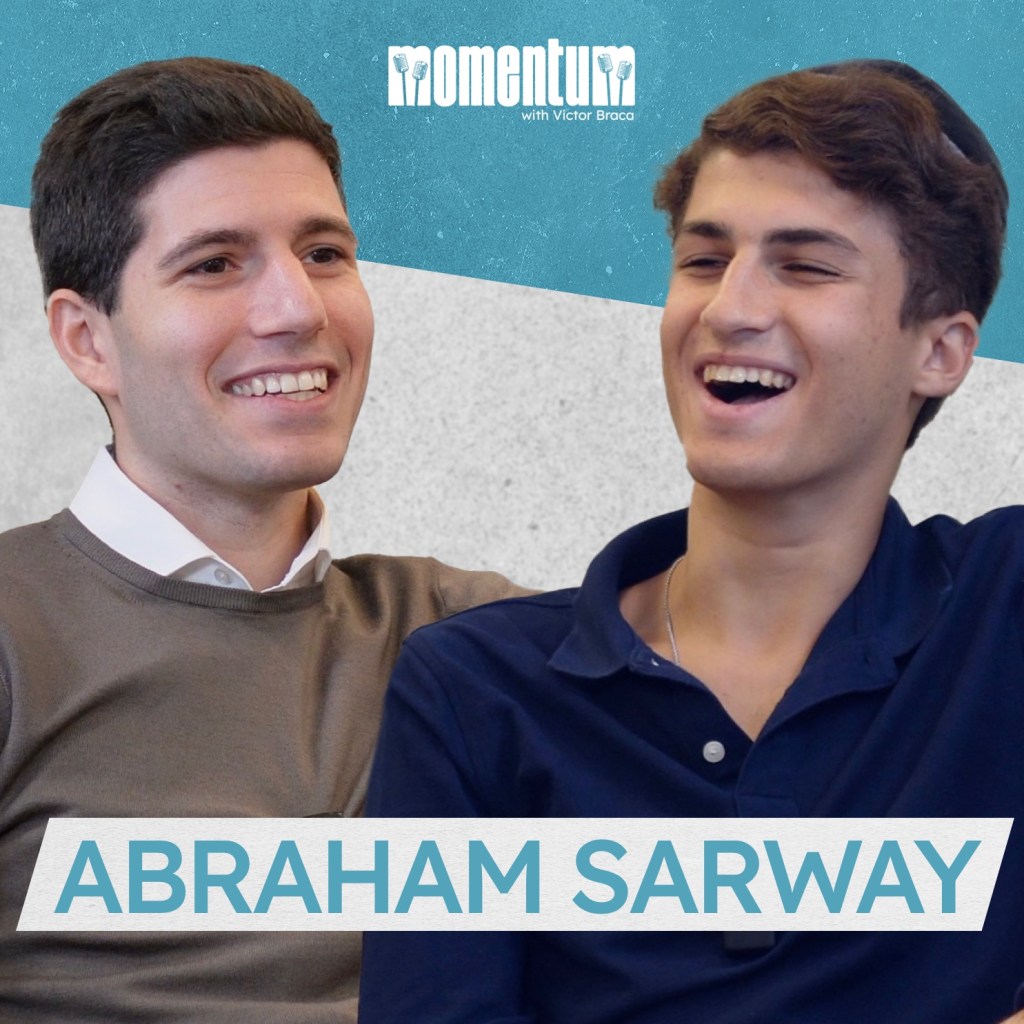




Abraham (Abie) Sarway is consistently named the #1 real estate agent at Douglas Elliman in both sales and rentals. Oh, and he’s 26 years old.
Abie’s team, The Sarway Team at Douglas Elliman, transacts hundreds of millions of dollars worth of real estate every year. In this episode, we dive into:
- Abie’s journey from an 18-year-old cold-caller to leading one of the top-ranked rental teams in the industry.
- He shares the key principles that set him apart-how to make a lasting first impression, why persistence is everything, and the biggest mistake young professionals make when trying to grow in their careers.
- We break down his approach to negotiation, the mindset shifts that changed the game for him, and the hard lessons he learned from losing a major deal.
- We also touch on his emphasis on giving back in his own unique way
Enjoy!
Sponsor
- Discover how The Hedaya Capital Group’s factoring services can help power your business’s financials: hedayacapital.com
Transcript
Victor M. Braca: Douglas Elliman named you their number one real estate agent nationwide.
Abraham Sarway: I have no business being in this business. I was like, “Okay, this is real, like I need to step on the gas.” I remember I didn’t do a deal for like eight months—nothing. Working every day, hard hours. I knew that I didn’t belong, so I needed to make sure I belonged. That’s a mistake. I can’t do that. I need to go get the paperwork. I need to close this deal.
Victor M. Braca: You’ve been awarded the Pinnacle Award recognizing the top 3% of agents nationwide.
Abraham Sarway: My manager pulled me over and he said, “You know, looking at your numbers, maybe you want to join a team?” And I was like, “I’m not joining a team. I’m going to do this myself. But thank you for the motivation.” The truth of the matter is you needed to make money.
Victor M. Braca: Let me just give you a fun fact for a second. My guest today, Abraham Sarway, was ranked the number one team of 2024 by Douglas Elliman as a solo act, meaning that as an individual, he sold more real estate than teams of up to 10 people. Oh, and he has generated $500 million in volume alone. Oh, and he’s 26 years old. Let that sink in for a second.
In an industry where experience often trumps everything, Ab Sarway has carved out a name for himself through sheer persistence, discipline, and an obsession with mastering his craft. He started in real estate at just 18 years old, cold calling luxury property owners while still in college, and spent years building a reputation as someone who delivers results. Today, his team represents some of the most sought-after properties in Manhattan and Brooklyn.
In our conversation, Ab and I discussed how he went from an 18-year-old cold caller to leading one of the top-rated New York City teams. He breaks down his approach to negotiation, why first impressions matter more than anything, and the biggest mistake young professionals make when trying to grow in their careers. We also got into the mindset shifts that changed the game for him, how he tracks every question he’s asked, the power of persistence, and the one lesson he’s learned from losing a major deal that completely transformed the way he does business today.
I’m Victor Braca, and Momentum is where I dive deep with exceptional leaders to uncover the key decisions, defining moments, and lessons that propel them to success and how those insights can inspire your journey forward. So if you’re interested in what it really takes to build a high-level career in real estate, or in any competitive field for that matter, this episode is packed with invaluable insights. Whether it’s learning how to make yourself indispensable, mastering the art of the follow-up, or understanding why the best deals happen before contracts are signed, Ab’s story is a masterclass in persistence and strategy. You’re going to love this episode. Enjoy.
This episode is sponsored by the Hedaya Capital Group.
Ab Sarway, welcome to Momentum.
Abraham Sarway: Thank you for having me.
Victor M. Braca: It’s great of you to be here. Made the trek from Manhattan, by the way, which I didn’t even know about, so thank you.
Abraham Sarway: Of course. I’m all over the place anyway, so it’s easy.
Victor M. Braca: So just to jump right into it, Douglas Elliman consistently names you and your team one of the top among the entire country in Douglas Elliman brokers. So, you know, let’s use that as an introduction about yourself. So tell me, who is Ab Sarway?
Abraham Sarway: So in the work world, I go by Abraham Sarway, but to everybody else it’s Ab Sarway. I run the Sarway Team at Douglas Elliman, where we have three other team members on this team. We sell luxury homes and we represent luxury rentals throughout Manhattan and Brooklyn. We also have another division that represents rental buildings throughout the entire city, South Bronx, and Brooklyn.
Victor M. Braca: Cool, very nice. So let’s just jump straight into your working experiences. You’ve been at Douglas since you were 18, if I’m not mistaken.
Abraham Sarway: Yeah, right out of high school.
Victor M. Braca: Wow, okay, amazing. Let’s even go a little before that. I know you have some good stories about business in high school, about negotiating with your teachers. So just tell me about your high school experience as a whole. How was that formative for you in terms of the skills you built up to operate in real estate after?
Abraham Sarway: I was always obsessed with business throughout my entire life. But coming into high school, you know, I was thrown into a little bit of a situation where I needed to make some money. I needed to go into my own quest of business and really make my own path.
So in my sophomore year, that first summer—which I think is the summer you get your first car, right? Is that like that year?
Victor M. Braca: Sophomore year sounds right, yeah.
Abraham Sarway: No, maybe junior year. Is it sophomore? It might be sophomore. I don’t know whatever it is.
Victor M. Braca: Yeah, maybe junior. I don’t remember either; it just happened to me.
Abraham Sarway: It was two years of high school, and I got a Mini Cooper and I was supposed to be a golf caddy that summer. My idea was I was going to meet some people, make some connections, and really go down that path that a lot of people have said is a great start to their career. That didn’t work out. I get a phone call right as I get my car and it’s like, “Nope, you can’t be a golf caddy.”
So long story short, I said, “What am I going to do?” and I came up with this idea that I was going to be like an Instacart for the community, which was predominantly Costco. Because I knew all these people in Deal and none of them wanted to shop, especially even people in my family and some close friends.
So me and my Mini Cooper, we started delivering Costco. That was really fun. I remember my first time where I did my first delivery. Somebody called me and I think I would charge them like 20% of the bill—whatever your bill was, 20%. And the watermelon from the trunk, because I had to put my seats down, flew to my lap. Like, I just remembered that. That was like the start of my journey in business and I did that for an entire summer. It was actually very successful.
The following summer, it turned into where I was renting U-Haul trucks and delivering around Deal and actually supplying some of the events that we have on Sundays. It’s something I really don’t talk about much, but that’s what I did.
Victor M. Braca: Cool. It’s like you turned a cute little project in summer of 10th grade into a real company.
Abraham Sarway: Yeah, I mean I was trying to get it to a point where I was taking inventory of everything in Costco, creating different routes and plans to make sure I was doing it as efficiently as possible, that I wasn’t having any redundancies in terms of going back for unnecessary stops. It was actually the first step of actually thinking about running an efficient business, which for sure helps me today.
It’s often that I think about some of the principles that I learned back then, even like communicating with people, sharing information, maybe sharing some bad news, dealing with problems down to, “You brought me the wrong produce.” What does a 17-year-old kid know about how to pick lettuce? But now I know how to pick lettuce. So funny. But dealing with people was what I really started doing.
Victor M. Braca: I love how when I talk to founders and entrepreneurs, the things that they learn and apply in their business today, they learned 10, 15 years ago as a kid hustling. It’s great.
Abraham Sarway: 100%. I mean, how do you deal with a woman on a Friday afternoon? She’s cooking her Shabbat dinner and her lettuce is all brown. You have to make sure you say the right thing: “Okay, I’ll come, no problem, I understand. I’ll come return it for you. It’s free of charge, blah blah blah.” You really get that momentum going and it’s interesting.
Victor M. Braca: So you’re running this business when you’re 16 years old in the summer, around 15, 16 years old during high school. Tell me a little bit more about what you learned during high school and how that paved the way for your success later in life. For example, I know you have a funny story with your graphic design teacher.
Abraham Sarway: Oh, yeah. So I went to Heschel High School, which I think gave me a little bit of a different lens through integrating with people in the world. You’re kind of thrown in, maybe with a few buddies, into a different world. They don’t understand where you come from. They don’t understand what the Syrian community means. It’s not like these quote-unquote different things that the community believes in really apply outside the world.
So it was a great learning experience. But, you know, I started off a little bit as not goofy, but I enjoyed my high school experience. I definitely was more conversational with my teachers and I would discuss with them different opportunities that I could work on and different angles—instead of their method, what my method would be.
Victor M. Braca: Love that.
Abraham Sarway: They didn’t always love it. They did not like the unconventional approach at all. Then coming into senior year, even the teachers are tired of the students at that point, right? So it was my graphic design teacher. On the second week, you start to get your own power behind you. I walked into the class and I said, “Look, not that you don’t want me here, but I’m probably not going to end up coming so often. It’s the last period of the day every Thursday. I won’t cause any headaches, I won’t be any bit of an issue for you. You give me a B—so I’m not asking for anything crazy—and nobody will know about it and that’ll be that.”
And he was like, “Fine. No problem.”
Victor M. Braca: Wow.
Abraham Sarway: I mean, like, I took that. I don’t know if he’s still there, but…
Victor M. Braca: I love that. Wow.
Abraham Sarway: I can only say that because the entire school leadership changed. But that was definitely a great experience. Learning that just understanding other people’s interest, you could kind of get them to do what you want. So 10 years later—I don’t even know how many years I’m out of high school at this point—but I could understand that as long as you could kind of appeal to their desires, you could almost get anything you want.
Victor M. Braca: Love it. Like negotiation 101. It’s like there’s a person on the other side of every thing, whether it be the grade that you’re getting on your report card or a building. That’s it; everything’s a negotiation.
Abraham Sarway: Love it. And everything’s a deal to be made.
Victor M. Braca: Love it. And you learned that negotiating with your teacher in high school. It’s great. It’s definitely a good lesson.
Abraham Sarway: But I didn’t even realize it till we sat down.
Victor M. Braca: Right, yeah. You told me you thought of that this morning. That’s great. So take me back to starting at Douglas. You’re 18 years old. Why’d you get into real estate?
Abraham Sarway: A quick funny story about the transition: starting in real estate, I remember I got a text from a woman who was somebody I would expect maybe heard I was in real estate and would maybe want an apartment. When I first saw this person’s name and I opened the message, she’s asking for a Costco delivery. That was my old business. I remember writing the message back to her like, “No, I’m in real estate now.”
So that was really my transition. But to rewind a little bit, I ended up going to college in the city, Hunter College. When I was looking at the scheduling, I knew I had some time. There was going to definitely be a tremendous amount of free time in the day, plus the truth of the matter is I needed to make money. There was no just hanging out. If I wanted to go out and hang out with my friends and be able to advance in life and really move on, get married… I knew I needed to make my own way.
So I didn’t realize the blessing I created for myself early on, which was essentially starting to work without having any true responsibility other than my schoolwork and being great at work. I essentially just said… I had a family friend who was in real estate and I actually asked her for a position and she said no to me. She said, “I’m sorry, I can’t have you.”
I said, “Okay.” There was another family friend in real estate and I ended up working with him and his partner for about two years. I learned a tremendous amount of information. I had so many different mistakes and different lessons and so many different things that came out of just working with this one [team]. It was so potent a time that it really shaped my philosophy for growing in this business.
I was an 18-year-old kid getting into a business where there’s people that dedicate 20, 30 years to this. They eat, sleep, breathe real estate, and that’s all they know. They’re very territorial. Not the people I worked for, but in general, brokers are very territorial. There’s a certain way of doing things, like a kind of hierarchy of respect. And I’m an 18-year-old kid. I have no business being in this business. I think the average person starts around 28, so I’m already 10 years before that.
I started with them and their main thing was for me to cold call luxury property owners for them. My nickname in the office became “Ab Baby” very quickly. I would cold call and stay up till 4:00 in the morning. I’d make my lead list. I would figure out different times to make the phone calls. Is before dinner better than right after breakfast? What about 3:00 in the afternoon? Most people finish their lunch break at 12:30, they want to get back to their desk at 1:00, so if I call them at 2:00… I would really think about all the different ways I could better myself in the position I was in.
I had some success with that. I was bringing in some pretty good listing meetings for the team and they put me on their rental buildings. That first summer, I’ll never forget it because I kind of tell people that call me about getting into real estate if they’re prepared to do something like this. They had some rental buildings—think about the 90-degree weather. I’d be in Deal for the weekend, I would come Friday afternoon right before Shabbat because there was no Fridays off at that time. There’s still no Fridays off; I work 24/6 now.
I would get on the New Jersey Transit at 6 o’clock in the morning on Sunday morning. I would come into the city, suit and tie. I would make a route that was perfectly timed that I would be back on the New Jersey Transit at 12:30 or 1:00 to come back to New Jersey, maybe hang out with my friends for a couple hours.
Victor M. Braca: This is Sunday afternoon.
Abraham Sarway: Sunday afternoon. Well, it would start at 6:30, 12:30 back into Deal, sometimes 3:00 depending. And then I would get on the late train back into the city so I could make sure I’m up Monday morning early, ready for Monday.
Victor M. Braca: Wow, so in the city for the week.
Abraham Sarway: Exactly. So I really took it very seriously from [the start] and put a lot of discipline into my work right away. I had a tremendous amount of respect for it. I knew that I didn’t belong, so I needed to make sure I belonged. That was definitely like a major humbling experience. I’m sweating in a suit and tie sitting in Harlem—it’s not like I was showing these luxurious properties. I was sitting in Harlem or East Village or something like that, and really, my friends are all sitting by their pool texting me, “What’s the plan for today?” and I’m like, “Hey, I’m in the city.” So that was definitely interesting.
Victor M. Braca: Since 2003, the Hedaya Capital Group has been a trusted partner to entrepreneurs like you and I, helping them unlock the growth potential of their businesses with tailored accounts receivable factoring and working capital solutions. With their innovative 360-degree approach, Hedaya Capital goes beyond just financial support. They take the time to understand every facet of your business, ensuring that all factors are considered in creating the perfect solution for you. At Hedaya Capital, they combine the reliability of time-tested values with the creativity of new-school thinking, offering a powerful mix that helps businesses not only survive but thrive in today’s competitive landscape.
Whether you’re looking to improve cash flow, protect your assets, or scale your business, Hedaya Capital has the expertise and resources to guide you every step of the way. To learn more about how Hedaya Capital can fuel your business’s growth, visit HedayaCapital.com or email info@HedayaCapital.com. Again, that’s HedayaCapital.com or email info@HedayaCapital.com. Thank you again to the Hedaya Capital Group for sponsoring this episode of Momentum.
Let’s get back into it.
Abraham Sarway: And then two years after that, after working with them, I think my ideas started to get a little bit more ambitious. Again, I learned a tremendous amount while working for them. We had some good success, by the way. We sold some cool property together. I really learned what it meant to market a luxury property, how to deal with a luxury customer.
I had my first luxury renter—that was an interesting story. I remember it was an $8,000 rental. This guy, who was my first customer, he trusted me to find him an apartment. I said, “No problem.” I had no idea what I was doing and I didn’t even know at what stage of the game a lease happened. He was reluctant to give me his tax returns. I somehow got him to give them to me and he said, “Oh, I could have them delivered to you or you could come pick them up.”
It was pouring rain out, like one of the worst storms I’ve seen. I remember I was wearing jeans and a collar with a sweater and I was like, “I don’t know if I… the documents may get wet. Why don’t you have the messenger send them over?” and I remember right after I hang up the phone I was like, “That’s a mistake. I can’t do that. I need to go get the paperwork. I need to close this deal.” I got comfortable in the deal for a second and that was not acceptable.
So I end up walking to his office, soaking wet. I come to his desk to pick up his paperwork—I think it was like this big, weighs 10 pounds, a thousand different documents in it. And he looks at me and he goes, “You’re wearing jeans to work?” and I said… I made up something. I think I said, “Oh, it’s raining, I don’t have my suit today.” From that day on, I will never, ever, ever not wear a suit to the office because I can’t ever have that experience ever again.
So that was definitely an interesting story. Ended up doing my first deal with him, and that was cool. Anyway, fast forward again. The cold calling had some success and I would say there was a little bit of an ego that built up, meaning like, “Oh, okay, I’m making all these cold calls, we’re getting some great deals, let me go leave the team. I could do this on my own.” Typical “I want to be big and this is what’s going to have to happen.” Not just egotistical, but also entrepreneurial. “I need to go do this.”
But what I was really saying—and what I reflected on a little later on—was that I needed to go fall on my face myself. Because the longer you delay your failures and the way the market tests you and the way business tests you, the longer out you’re going to delay your success. That’s my theory.
Victor M. Braca: Interesting. Quicker you can get to mistakes, quicker you could learn from them and take action, makes your success come sooner.
Abraham Sarway: So anyway, went out on my own and that was a real cold shower. That really shaped where I am now. I remember I didn’t do a deal for like eight months. Nothing. And you’re working every day. Working every day, hard hours. In the office at 7:00, didn’t leave till 9:00, 10:00 at night, figuring out things to do, throwing enough things at the wall hoping something sticks.
I remember a close friend of mine calls me and he says, “I just closed on this building in the South Bronx. Do you want to represent it?” and I said, “You know, it’s not really my thing. I’m a luxury broker. I don’t know if I deal with the South Bronx,” and he was like, “Oh, okay, I have a guy anyway. No problem.”
Anyway, I think like a week goes by of me not making any money whatsoever and I call him back and I say, “You know what? I was wrong. I would love to take on the project,” and he goes, “You know, I gave the guy the building.” Now I found myself begging for the South Bronx. Tables turned real quick and I learned from that. Never say no to an opportunity ever, especially if it’s because of your ego. You have to see it through.
That was really like a real lesson, especially because it was a close friend of mine. Next thing you know, he says, “Okay, fine, I’ll give you two of the apartments of a building.” And I said, “Okay.” I rented out the two apartments, actually set a record for the area—which wasn’t so crazy, it was a $4,000 apartment—but a record for the area. I saw it as an opportunity.
I came out of the building one time and I was like, “There’s nobody here,” meaning there’s no other brokers working in this area. I continued just to stick with it and one day I was walking in the neighborhood with that owner and I met—there was the other largest owner of the area, the developer of the area. He was driving down the block and I waved him down because I recognized his face; I was trying to get in touch with him. He rolls down his window and I introduced myself and I said, “Please, I would love the opportunity to talk to you, share about some of the things that I’ve been doing in the area.”
We had some familiarity with each other; it turns out I kind of knew him from somewhere else but nothing too significant. I ended up having to hit him up for like six or seven months—like every single Monday I would send him an email. “Hey, it’s me, it’s me, it’s me,” and he wouldn’t answer. Finally he answered and he started me with one apartment in the Bronx and I took it and I was like, “Yes, of course.”
The thing that I used the Bronx for at that time—and it’s funny, the name of your podcast is Momentum—as long as you have momentum, new opportunities are going to open up for you because you’re consistently going to be thinking about new things. So that opened up a whole slew of doors for me and the team that, you know, we now represent a ton of inventory in the South Bronx. And I love it. I love the South Bronx; I think it’s an incredible area.
Then I kind of went into a stage where a lot of brokers or even young professionals get tired out, which is when you feel like you’re overworking and you’re not getting anything in return. You’re all day long in the office or you’re working these clients and people would call me all the time for just free advice or throw an impossible deal at me. But what I would say is I would make it my prerogative to be more prepared than anybody else. If I wasn’t physically working on something, I would be preparing for my next opportunity because I didn’t want somebody to call me and say, “Hey, I’m looking for XYZ. Can you help me?” and be like, “Oh, let me get back to you because I don’t really know about that.” I wasn’t prepared for that phone call. I was making sure I was prepared.
I remember I had a moment where I spoke to my manager and I was like, “I really get the hardest deals anybody can ever get,” which ended up being a blessing in disguise because I was doing my best. I remember I closed a very challenging deal that took a lot of collaboration with other people in the company. It was a small sale and just an interesting experience of different legalities and structures—it was a very complex deal. I was just like, “Wow, I keep getting thrown these immensely complex deals and I see the guy next to me closing a quick deal in 24 hours.” I learned a ton from that.
Then I started to find the confidence like, “Okay, I could actually close a deal. I have real value to add. I could grow into something great. I have real information. I’m ready and prepared.” Then I started the team-building process and still learning every day. We’re at the beginnings of a new team at the company, but we’re small and mighty.
Victor M. Braca: A theme I’ve noticed for you is persistence. Like you emailed the developer of the area in the South Bronx every Monday for seven months. You weren’t making money for eight months. How do you go through these times and reassure yourself that it’s going to turn around?
Abraham Sarway: So I would put… a lot of people talk about goals and they set these wild expectations of, “If I sell $100 million worth of property, I hit my goal. If I do 30 rental deals, I hit my goal.” I was guilty of that. I did that for a very long time until I finally realized I can’t control any of this stuff. I can’t control if somebody’s going to call me and say, “Hey, sell my apartment for me.” I can’t control that. I could do my best.
So I kind of switched my thinking to what I call input goals. I would say, what can I control? I could send 30 emails this week to people that I don’t know and introduce myself. I could call 100 people this week. I could reach out to two people that I spoke to that one time and just reintroduce myself to them. These are all attainable things that I could control.
Victor M. Braca: Fully in your control.
Abraham Sarway: Fully in my control. The only reason why I don’t hit these goals is because I didn’t do it. Some are a little bit more challenging, right? Like I remember at one time I had to talk to 300 people every two weeks, which is borderline impossible. But in theory it’s not, right? If you start upping your social media presence—even though I’m very to myself and very confidential and I don’t really share much about what I have going on—I would set unrealistic input goals for myself to make me get better.
That’s really how I stayed focused and I did have some amazing experiences that kept my head going. For example, I had this older woman who now passed away, Alav HaShalom, she was an unbelievably sophisticated woman. Really, she was like one of my true first teachers in this business and I remember she calls me… I think she just really liked me and she wanted to teach me a little bit. She says, “I’m looking for an apartment,” and gave me like the tightest restrictions ever. It needs to be in a five-block radius, it needs to have this, it needs to have that… there’s like three apartments that maybe have that. Two of which are six times the price that she actually wanted to spend, and one of them maybe worked.
I took her to one. I was like 19 now or 20 and I was so young and so new that I actually had to have my manager make the appointment for me because the broker wouldn’t take me seriously. Reputation is a critical thing now.
I remember getting there and it was a nice day. We walk into the apartment and I go, “Wow, this is gorgeous.”
She goes, “No, it’s not.”
I go, “What are you talking about?”
She goes, “Look, watch.” She takes me to the kitchen. She shows me the nicks under the wood paneling. She shows me that the fridge is 10, 20 years old and it’s barely cooling. She shows me that the window sills and the caulking still has cracks in it. She shows me the discoloration in the things I would never have seen—ever, ever, ever. She shows me that there was wear and tear on the wood flooring. She opens up the electrical cabinet and shows me how the records aren’t correct for what needs to be done for the switches. Thousands of things.
That was one of the most amazing lessons that I had because it really showed me how to look at quality and not just say, “Yeah, that’s great.” It was more so, now you have to take a deeper look and double check. She would quiz me on my information. I don’t think she was necessarily quizzing me, but she would ask me everything and anything, really pushing me to make sure I knew everything about the product I was selling.
I’ll never forget this. We walk out of the building on Fifth Avenue, so we’re walking together and she asks me a question and I go, “Yeah,” like that. She stops me. We stop walking and she says, “No, it’s ‘yes’.” I was like… my mind was blown. She goes, “If you want to deal in these types of properties, you have to be proper.” She says, “Yes?” and I said, “Yes, you’re right.” Then she asked me another question and I go, “Yeah,” and I said, “No, no, yes, yes!”
So I had so many different things that really kept the energy moving and I was just more prepared. I would think about how to grow, I would think about direction, I would really keep my eye on the prize which was really transacting in the ultra-luxury market.
As I was on my own, I started to say, “Okay, if I really want to…” I have an ultra-competitive factor to myself where I would look at brokers that were doing this for 10, 15 years, like the number one broker in the industry, and I would see them do a deal and I’d be like, “Why didn’t I do that deal?” That started to develop in me and that fire started to really burn. I said, “Okay, now I know really what’s important to me,” and that is being able to just compete and be able to… I definitely found glamour in the idea that I want to be talking to these brokers, I want to learn, I want to be able to deal with like… I thought more so than a transaction, I thought it was cool that that person got to deal with that client—like a head of a company—because think about how much conversation they had, how much they learned.
I ended up being right in that respect, meaning I get the opportunity sometimes to deal with very successful people and it’s just a learning experience through and through. I almost forget that I’m doing a deal with them and I’m just sitting there like a sponge taking in all their information.
Victor M. Braca: That’s really cool. I never thought of real estate brokerage like that.
Abraham Sarway: Well, that’s really what keeps me going. At the end, there’s guys… I listen to the way they pick up the phone, I listen to the way they answer a question, and I’m a sponge about it. I still remember the way that this guy answered this question about that, and now I think about that all the time. So I try to learn from that: why did he answer like that? How did he keep his information safe and not share information but also keep the conversation going?
To jump around a little, I used to… this was a recommendation of my uncle and my grandfather… I used to have a book of questions. Meaning anytime I was on the phone and somebody would ask me a question, I would write it down. So I was never not prepared. I knew the question was coming. So if I was meeting a new client or having a phone call with that person, I would know pretty much exactly what they’re going to ask me if the last four people asked me the exact same question. So I knew the answers.
Victor M. Braca: Super organized with it, super structured.
Abraham Sarway: That’s the only way, right? I had a few different types of ways of getting started. I would add structure into my day. I would set on my calendar… I would make meetings for myself. “So today I have a busy day: I have cold calling from 10:00 to 11:00, I have marketing from 11:00 to 12:00.” Packed day. Then it started to not work so well because one person calls you and it throws your whole day out the window.
So I’d put different structures but I would wake up early. I would get to the office at the same time every day. I would do things in a repetitive manner because it’s such an unstructured world and it’s very easy to have a moment of ADD where you’re like, “Okay, I’m going to work on this,” but it doesn’t really do anything for you. There were a lot of mistakes there.
I remember one time I thought it’d be great to build out all this infrastructure for a single agent and have pitch packages and this and that, and I noticed I was taking three, four weeks on it and then nothing happened. Because it was nothing that was doing any offense whatsoever; it was just more so building things, but that wasn’t the priority then. So mis-prioritizing was something that was important to learn from. Now when I prioritize my day, it’s like, “Who needs me first?” You have to really think about that.
Victor M. Braca: I love the waking up early part of your structure. I’m personally an early riser myself—not as early as you, I thought I was early but you put me to shame. But it’s like you wake up early, you capture the day, you have time to yourself, and like you said, you get to the office early. I find that as a theme among successful individuals: they’re all somewhat early risers, and if they’re not natural early risers, then they force themselves to be.
Abraham Sarway: Well, it didn’t start out as me being necessarily the earliest riser. I mean, I was always like a 6:30 guy. But then it happened to be that very successful people—you’re right, they do wake up very early—and then my phone would start to ring at like 6:00, 5:45, because that’s when they have time. I get the phone calls before the day, during lunch maybe, and at the end of the day when my wife is so supportive, she lets me take them.
But I said, “Okay, I got to start waking up early because I did want a little bit of time to myself because the day does get crazy as time goes on.” So now I wake up around 5:00, 5:15. I try to get a workout or something and go to shul, do Minyan every day now, which has been for the past year about. And then I get to the office as early as possible and just get going. The more minutes I have to work, the more I could do.
Victor M. Braca: Love it. So you started at Douglas Elliman when you were 18 years old. How long after that did you start building up your team, the Sarway Team?
Abraham Sarway: Here’s the thing. There’s two parts to it. Rewind a second. As an individual, there was a moment when my manager pulled me over after I left the team and when I was an individual. I’ll never forget it because I think it was the real moment that I was like, “Okay, this is real, I need to step on the gas,” which was when he said, “You know, looking at your numbers, maybe you want to join a team? I’m not sure… what are you thinking, what are your goals here?” and really he was just saying, “You’re not doing enough.”
So he goes, “Maybe you should join a team, maybe they could continue to train you, like you’re a little early to the game,” and I was like, “I’m not joining a team. I’m going to do this myself, but thank you for the motivation.” That’s really when I went pedal to the metal.
And then I really had to spend about two years just building my reputation, becoming the real expert, or learning how to lead people. It was very challenging. Even to this day, it’s still a challenging thing to do—to upkeep reputation. It’s the most important thing. I would mull over text messages for 40 minutes before I would send them to make sure I said the exact right thing that would potentially get me the answer I was looking for, or to understand the person and say, “Okay, maybe they’re not going to read this long of an email, let me cut it down,” or “I can’t ask two questions at once because it’s a person that answers only one question at a time.”
To get to the point, though, it was really a time of building reputation and then building a confidence and a following to some degree in terms of management of the company—that I could actually lead a team. I went on to basically say I want to start a team and it failed a few times. I had one person that joined me and they were… everybody that I’ve worked with until now has been older than me, by a lot. So they had their opinions, but I didn’t want to hear their opinions yet. I needed to continue to create my own identity. So that didn’t work out.
Then I had another person that really needed help and I actually thought that I could help them, but I didn’t know how to communicate what I was doing yet. It was too difficult for me to communicate; I just didn’t know how. So that didn’t work out. Then I really wanted to create my own identity and I also didn’t love the team structure that’s traditional in the real estate world, which is basically you have agents that work on your team, they do a deal, you make a cut, they hope you give them a deal and create an opportunity for them.
I don’t like that method. I kind of want a more succinct group of people that are going towards the same goal, that are helping one another, that are not afraid to ask questions—and like even me to ask my team questions. So they have… I think now we’re more diverse and it’s like they know things that I don’t know. Like somebody on my team is incredible at video, so when it comes to marketing, he’s kind of the guy that teaches me.
Anyway, getting back to building a team. I had really five or six different rounds of trying to find the right complement to me that would allow us to grow rather than just for me to grow. That took some time and really up until I would say nine months ago, we finally found a formula that works. And that works really, really well. Thank God we’ve had some great opportunity thrown our way and we’re able to tackle it.
Victor M. Braca: That’s like five, six, seven years into starting your team, right?
Abraham Sarway: Yes. It’s just really hard to find and work with people that a) you can work next to and share your vision with and they understand, and b) have enough business to support that. If you’re not finding your footing in the market and with your own identity, it’s hard to convince somebody else.
Victor M. Braca: Exactly, and you can’t really afford to share your deals with them.
Abraham Sarway: Exactly. But at the same time, that’s like an internal goal: you have to build, you have to do enough business to have a following in the business. You have to do enough business for other people to call. You have to do enough business to grow in the company and to get different sort of growth in your career. It’s not easy.
Victor M. Braca: Your team has consistently ranked among the top at Douglas Elliman. What do you think separates you guys from the rest of the pack, and what are some things that other people—whether it be in real estate or any other industry—can adopt?
Abraham Sarway: Something that I continue to learn, but we have some core principles. Confidentiality being number one of them—being the most important. Like, we don’t talk about anything to anybody. That’s really helped us, especially with higher-level clients; they don’t want their business being discussed and they need to trust that it’s not going to be discussed.
My core principle that I tell anybody that I hire or works with me is that respecting your work is really the most important thing you could have. Meaning if you don’t respect what you do or have a respect for the email you’re going to send or the conversation you’re going to have and say, “Hey, it’s just Sunday, I don’t have to take his call,” or “It’s a quick email, I don’t have to send him the formal document, I’m just going to tell him the comps right over the phone,” you’re never going to get taken seriously the way you want to be. But if you always have the same consistent respect, it’s just going to be more fruitful in the future. That’s really our core.
And the third is integrity. Got to be honest all the time. If you’re stuck in a sticky situation, it’s better to just be honest, be straightforward, rip the Band-Aid off and share the information. Because you can mull over in your head a thousand times how the person’s going to take it, but when you say the information, they say, “Okay,” and you realized you wasted all that time. So you just have to be honest and really share the right sort of information with your clients and the people around you.
Those are the core principles that our team is built on. But I would say in terms of just a skill that’s important is working on calmness and controlling emotion. I learned that from Mastering Influence with Tony Robbins. Great podcast, everybody should listen to it. Things get muddy, the deals get crazy, you see the dollar signs at the end of the deal… and the second you see that dollar sign, the emotion goes into the deal and now you’re not negotiating for the best interest of your client; you’re negotiating for the commission at the end. Over time, for sure, me and my team, we definitely built a barrier against that. We don’t look at the end number; we kind of say, “All right, let’s just focus on the deal no matter what gets thrown at us. Keep our composure and stay calm,” because or else these deals will never close; they’re so finicky to start with.
Victor M. Braca: You’ve done some pretty large deals over the course of your career. What are the factors that go into closing a huge deal? I’m sure there’s a thousand moving parts and the process could take a while. What goes into that?
Abraham Sarway: I would say 80% of it is luck. A large portion of it is definitely luck. The other part is really hard work and giving it your all and really immersing yourself in the preparedness for the deal and making sure that you have all the information readily available and you know your product and you know what you’re selling. All these larger deals, it’s the same thing as doing the smaller deals; you’re just lucky to have that type of transaction amount, but you still need to give in the same amount of work, have the same amount of information, having a certain type of acumen. You need to be presentable and share information in a way that’s digestible to your client that they could wrap their head around and understand and feel confident in.
Over time—and this really only comes over time—is building confidence around the information you’re sharing. If you’re sharing pricing and you’re like, “But maybe, I don’t know, kind of…” if you use any of those kind of words, you’re putting doubt into your customer’s mind and you can’t really do that. But that only comes with having some level of confidence and being prepared. If you have the numbers in front of you and you know what they’re really truly looking for, then you could pretty much get them to do what they want to do.
A lot of people say, “I got lucky,” for sure, but don’t take it out of your hands. You have to be prepared to get lucky, or else when you get lucky you can’t seize it. Opportunity knocks and you don’t answer, it goes to the next person. So 80% lucky, and the next thing is you have to be prepared.
Victor M. Braca: I love it. I love the preparedness. Like you said, you had your book of questions and you made sure to be prepared before you got the call so that when you got the call from a prospective buyer or client, you are a thousand percent ready.
Abraham Sarway: Look, I get upset when I’m not ready because it happens, right? It was like, “I wasn’t ready for that kind of question. Okay, how do I never not be ready for that kind of question again?” These deals, they’re so exhilarating sometimes. You’re in the heat of it: “You said this, I said that. Okay, I’m going to call them right now, they’re going to call me back. Wait, they don’t want to do it. What are you going to do?”
It moves so quick sometimes that you really have to hold your own demeanor. Sometimes I’ll take a few deep breaths before a phone call and I’ll say, “Okay, I need to make sure I’m prepared. I have all my numbers.” I’ll print them out in front of me, so when they ask me these questions, there’s no delay. They have five minutes to talk to me; I’m going to give them as much information as I can. Over time that compounds; people like it. People enjoy somebody being prepared. They could sense it; it’s like a personal expert on something. It was definitely hard to get there, though; it took a lot of time and persistence.
Victor M. Braca: Okay, so just in case you want to be a little bit humble, I want to let the viewers know some of you and your team’s accomplishments within Douglas Elliman and in the real estate market as a whole. You guys do hundreds of millions of dollars of real estate. You rank in the top 10 agents for either sales or rentals every single month. In 2022, I was scrolling through your LinkedIn and every month it’s an article. You’ve been nominated for the Hollywood Reporter’s Top New York City Broker under 35—huge honor. You’ve been awarded the Pinnacle Award recognizing the top 3% of agents nationwide—that’s huge. You’ve been highlighted by Douglas Elliman countless times and by many other publications. I want to ask you: what separates, if you had to boil it down to a couple of things, a top-notch real estate agent from everybody else?
Abraham Sarway: I think that for me at least, being so young, a first impression is everything. And if you ace the first impression, the rest you could kind of manage. My grandfather, who I draw a ton from, he taught me that the first impression really sets you apart. I heard it most recently from one of my clients—I mean, I’m in a suit and tie in 93-degree weather when they’re in a t-shirt and sweating, but I don’t show that I’m sweating. I’m kind and I’m friendly and I’m not overbearing to what they want. I kind of just listen, I keep my mouth shut. I don’t like to share too much right off the bat; it’s more of a listening game.
Everybody tells you what they want to do, and most people listen to answer; I listen to digest. And that conversation that I have that first time, and then with that person when they call me three, four weeks later and we’re discussing something, and I say, “Remember that time you said this?” it shows that I’m listening to them and people appreciate that. But I think the thing that sets me apart and my team apart is our first impression. We always have all the information right off the bat. We always show the best property right off the bat. We pride ourselves on having access and top-notch information.
And it’s just legitimately working hard. Really just working hard. People could sense that when the phone rings and you pick up on the first ring, or if you can’t pick up at that minute, you’re calling them back 20 minutes later. You stop everything and you really give them the attention they deserve. People receive that love. I didn’t necessarily know that that’s what was going to separate me from the beginning. I didn’t really know why I got into real estate other than I needed to make money; there were no two ways about it. And I knew I maybe had some of the innate skills to be in real estate, but I grew to love it.
I grew to love making a great first impression. I grew to love sending an amazing email or sharing an incredible market report or sending a beautiful summary of what’s going on with their property and being communicative and learning from the customer. So I don’t know if there’s an exact science, but I just really enjoy the process of work every day. I really, really, really love it. I get so excited for the next day. And I guess that has turned some results for us.
Victor M. Braca: I like how you touched on listening to people and really being interested in them. I remember in Dale Carnegie’s book, How to Win Friends and Influence People, he tells the story of meeting somebody for the first time. They were having a conversation, but he really let the other person do all of the talking. He listened and he asked questions and he was genuinely interested. And he must have heard that person speak about him afterwards, and they were saying, “He’s such a great conversationalist, he’s so interesting, he always had things to say,” meanwhile he didn’t speak at all the entire time. He was listening, but the person who he was speaking to loved speaking with him because they got to let it all out on him.
Abraham Sarway: No, it’s true. I really draw on learning from my customers and learning from my clients; I would say that was my school for this business. Each and every single one of them—I could go down a list with you and tell you what each person taught me that has directly impacted what I’ve done today. I wouldn’t say what I’ve done today was because of me; it was because of everything I learned from them.
But one of them was just not talking. All of them, when I’m in a showing with them, they don’t say a word. When I’m in a negotiation meeting with them—because I’ve had a few in-person negotiations that were really interesting—they don’t say a word. They let everybody else talk and they digest and say, “Okay, thank you, and I’ll get back to you.” That was a life-changing, such a simple thing, but such a life-changing lesson because people love to talk. It almost became something that was not so great for my business that’s so front-facing and client-facing, because I don’t love to talk as much either. I’ll sit on the phone and they’re like, “You got me?” and I’m like, “Yes, of course I got you.”
Victor M. Braca: That’s great. I love how you’re taking all of this from real life in the field, “learn on the job” type of thing. Did you go to school for real estate?
Abraham Sarway: No, I graduated Hunter with an art history minor and an economics major.
Victor M. Braca: And you’re in real estate—let’s just point that out.
Abraham Sarway: Yes, but I definitely draw on a ton from what I’ve learned in school for sure. I think that going to school was a major bonus for business, but I really got so fortunate to be able to deal with such successful and interesting people with all different backgrounds and stories. In such a local business, you get a world of knowledge and history. It’s so fun.
Victor M. Braca: I want to ask you about your mindset of constantly working and always advancing towards a deal or bettering yourself. You told me you go to the office on Sundays regularly. Tell me about your work schedule and how do you balance work and life? You’re married and you want to see your family and your friends and you want to have a social life, but you also want to be very successful in business.
Abraham Sarway: I’ll start by saying that my wife is incredibly, incredibly supportive about what I do. She loves it, she really doesn’t get in my way about anything ever. If I have to work, she really understands. She actually is one of the most amazing sounding boards when it comes to problems or things that I want to do that are a little bit more risky or forward-thinking. Usually, if she gives me her blessing, it’s a go. Maybe one of the reasons why I married her.
But that being said, I work pretty much around the clock every day besides Shabbat. I shut down completely for Shabbat, and I try to just glance on Saturday night unless it’s an important thing. I kind of really like to take the day in its entirety, especially because I want to dedicate it to my personal life, my wife, and really give her the undivided attention that I give a lot of people—it would be unfair if I’m dividing her attention and not dividing anybody else’s.
I’m in the office pretty much every day, latest 8 o’clock—or my first meeting is at 8:00 or 8:15—and I finish at around 7:30 or 8:00. Sunday morning, I’m in the office until about 1:00 or 2:00, and then if I have showings that day, then that takes priority over anything. It’s not an easy balance and it was definitely a challenge starting out—just getting on the same wavelength of communicating the balance. But it wasn’t a challenge for any other reason than I didn’t know how to balance it yet, because I came from being a single guy ready to go whenever, to having another person who needs my attention.
But she’s incredibly supportive, she doesn’t hug the attention, she knows when I’m in the zone to let me be there because I get a little bit robotic in the day. I go into a trance and she’d rather not interrupt the trance; she’d rather wait for me to be out of it and then chat with me. It was definitely a change, but she’s incredibly supportive. She doesn’t get in the way of anything.
Growing in business takes so much time—like 14-hour days. It’s a lot of dedication. Your mind is always spinning. So imagine your head is spinning about a new idea that you’re so excited to implement the next day, and then you also got to think about your personal life at the same exact time that has the same pressing issues. Where do you prioritize? Where’s your value system? There’s no answer. I would love to talk to somebody that’s been married for 50 years to get a better understanding, but it’s a challenge. I can relate to somebody my age; it’s not the easiest thing, especially when you’re not in a salary job that ends at 5:30. Entrepreneurial-type people have to create their own momentum.
Victor M. Braca: I like the personal brand part of it. It applies to everyone. Any industry, right? You really have—if you want to be at the top of your industry—you have to think about it always. It’s not just something you get to because you’re potentially talented; you have to really work it.
Abraham Sarway: Even me, with all these accolades, I just want to grow for myself. I want to be in better processes, better environments. I want to be able to transact with interesting people—the more interesting the better. That’s really my chase; I don’t chase the bigger deal as much. Some people, their only metric is a dollar amount or a ranking on a screen, and that’s all that motivates them, which is kind of sad in my opinion.
It used to be, for a second, that it would be, “Okay, how many deals did I do? How much money did I make? How much transaction volume did I have?” but it very quickly changed to, “How many more deals can I be a part of?” Who cares about the dollar amount on the other side? It was, “How many more people can I learn from? How much more information can I absorb?” because it’s just going to get me so much better. I mean, I’m 26 turning 27—imagine if I do this for another 10 years, how much more information I’m going to have and how much better I’m going to be then. You look forward to that. It’s surreal to think about.
Victor M. Braca: Love it. Love it. I could just repeat what you said because I’m very passionate about that. It’s huge. Guys, sorry for the quick interruption. I just want to ask you: please, if you’re enjoying this podcast, share with a friend, leave a comment, a like—anything you could do to help grow the podcast would be greatly appreciated. Back to the episode.
Abraham Sarway: The guys that I’ve noticed that look at the dollars and cents get exhausted real quick. They say, “It’s not for me.” It doesn’t make for a passion. It takes so much time, and if the only thing you have to justify it is a dollar sign, you’re gone. That period I was talking about before, where people get exhausted—that’s when the dollar sign number starts to come in.
For an entire year, people were calling me about hotel deals. I didn’t even know how to do a hotel deal. I didn’t even know the term “price per key,” which is the term that people use for how much you’re buying each room for. They would ask me to comp it out. How do I comp out a hotel? I have to learn. Now I know how to comp out a hotel. It would come from, “I want to buy this opportunistic purchase for 50% off… okay, how do I do that?” So many different exhausting things that really taught me how to do what I do today so seamlessly. It’s only because I spent so much time working on things that made not a dollar, not a penny, and I genuinely enjoyed it. I still enjoy it. Sometimes I get lost in it—I just love preparing, I love researching, I love understanding different markets. It’s really fun for me.
Victor M. Braca: That’s great. It speaks to a genuine passion about your work, which is very respectable. For young professionals who want to get ahead in their careers and just set themselves up for success, what do you think is the first step they should take?
Abraham Sarway: Get started early. As early as possible. And get to your first mistake as early as possible. The quicker you can get there, the better you’ll be in the future. I think in some ways I waited too long for my first real mistake, but they started piling up quickly. For any young professional looking to get into their own business, I think get to your first mistake and get it out of your system. It’s like in football: you have to get tackled the first time and then you’re okay. Recover from it and learn from it.
That’s my general piece of advice because that’s really what helped me. Now as I look back and reflect on how I’m moving along in my career, it’s the quicker I could get to mistakes… it’s almost like, “Okay, good, I’m happy I hit that hurdle. Now let’s never make that mistake again and move forward.” Try to make as many mistakes as possible as early as possible, as early as you could recover. Because you could really build your reputation. The older you get and the later on in your career as you start to make mistakes, there’s more at stake. When there’s less at stake and you could recover early, you’re so young it won’t mean anything in the grand scheme of things.
And then just make things happen. Don’t think about, “Hah, this challenge, what if that, what if this?” Just go, just do it. I mean, it’s the Nike saying: Just Do It. Just jump in headfirst. If you swim half the pool and you’re realizing it’s not working out and you’re drowning, okay, maybe start again or keep swimming if you really believe in it. But just get started; there’s no reason to wait.
Victor M. Braca: That’s my favorite piece of advice, number one. I think this is probably episode 25 or something like that, and my number one takeaway is: just start. It goes all the way back to the first episode when Michael Harari, who founded Cracking Up Crackers—
Abraham Sarway: That’s a great brand. He really built that up.
Victor M. Braca: He really did. And his number one piece of advice was just go out and start; you’re not going to be ready, just do it. Since then, almost every guest without fail has said some variation of that piece of advice. I love that piece of advice because I could see that for me—just starting the podcast, I had a sense of urgency. I said, “The summer is two months and everyone’s out with their friends hanging out. I can really turn this into something.” I can see that with you also—you were 18 years old and you had the sense of urgency and you needed to make money, and you just started and you made those mistakes early on. You failed fast, as the startups like to say. The quick failures turn into a tool in your tool belt. You come with no tools, you don’t know what to do. Even I still some days don’t know what to do! You just put one foot in front of the other, you use your tools, everything you’ve experienced that didn’t work and what worked. Just get involved.
Abraham Sarway: I actually love thinking about it in that analogy: you have a tool belt, and every tool you have is just a result of a past failure. That’s it. You don’t learn from a success; you pat yourself on the back and move on. You never learn from success in my opinion.
Victor M. Braca: Interesting.
Abraham Sarway: There’s no gravity like a failure. It really just pulls you down. It doesn’t compare. It’s such a propulsion moment in your career that you’re just like, “Okay, that did not work. Move forward in that direction.” I like to say that business is like being an athlete. You got to keep your body right, you got to train for your career, train for the day. These players, they watch endless amounts of film; it’s no different in your business. You got to be up-to-date on the market, the industry, who the players are. You got to know what dots to connect, you have to know how people are interacting, how the economy is interacting. There’s so much information that you need to harvest on a day-to-day basis. Just think in the business world: how much information are you taking in from what people are doing, where is money shifting, different trends in the market? How can you foresee that? It’s like different quarterbacks saying they could see a defense from a mile away. How can you do that for your own business?
Victor M. Braca: Amazing. I love the analogy.
Abraham Sarway: That’s just something that I actually think about often. Love it. What are your headwinds? Prepare for them.
Victor M. Braca: Cool. I want to go back to you being very passionate about learning from your mistakes and building up the tools in your toolkit. We’ve heard a lot about setbacks you faced and mistakes you made early in your career and what you learned from them. What’s been one of the biggest failures of your career, and what are some of the things that you learned from that that you implement today in your business?
Abraham Sarway: It’s a little bit niche, to be honest with you. It was really my first transaction that I was working on when I was working on my own. It did not close. I was… it was a pretty challenging renovation-type transaction, an apartment that needed a renovation on the Upper Side, and I was marketing it for four months at that time. It was my baby; I needed to sell this thing. This was going to lead me forward, it was going to give me money to invest in myself, into the company, into growing. It was really that mistake I made: I saw the dollars and cents before the deal. That was the first real moment of that. I definitely got emotional like, “I need to close this deal.”
I was still in school at the time, in my senior year of college. I remember we finally got a customer and an accepted deal, and the client calls me and says, “Okay, do you have an attorney for me to work with, because I don’t have a real estate attorney?” Now that conversation usually happens way before this point, but anyway, I said, “Yes, I have an attorney,” and again, I didn’t really have a formidable relationship with one. So now if I call an attorney to connect with my client, it happens pretty quickly. At that time it was like, “I’ll call him at 4:00. I don’t really know who you are, but yeah.”
And that didn’t work. This client ended up hiring an attorney that I never worked with nor did I know, and didn’t even specialize in residential real estate; she specialized in just the real estate field. That was destructive to the deal because she didn’t understand the way that a residential transaction occurs. It was very much like, “What the contract says and that’s it.” There was an idea that the client wanted something that was such an easy “accept,” and this attorney was able to convince my client that this was not an acceptable term. I was like, “What are you talking about? Of course it’s an acceptable term!” Long story short, the attorney ended up convincing the client to go in a different direction in terms of the deal.
I remember myself writing these long emails explaining to her the pitfalls of this and how it’s not really so common and blah blah blah. As COVID was quickly approaching, I said, “Look, you’re going to lose this deal. It’s a very important deal for you,” and the attorney totally just like said, “We don’t… what you’re saying is completely wrong.” And I mean, I had it vetted by people well more experienced than me.
Victor M. Braca: I want to ask you about following your passion. We’ve all heard those three words: Follow Your Passion. Every young person thinks about that. What do you think? Should people follow their passion? Should they chase the money? Is there a nice equilibrium somewhere in the middle?
Abraham Sarway: I think there’s a lot of different answers to that question, and not necessarily knowing the right one. At this stage of my career, I’m not like a guy with gray hair where I could say, “Don’t worry, this is how it turns out.” But from my experience, it really depends on what your situation is. If you need to make a living, sometimes your passion doesn’t fill that gap.
But what I will say is that you have to have some level of your passion involved in what you do or else you’re never going to like it. You’re never going to grow an affinity; there needs to be some aspect at least of something that you love to do. I’ll say for me, I don’t know if real estate brokerage was my passion—I don’t know if I was a born broker like some other people were—but there are some things that I love to do and I grew for this to be my passion. I genuinely love it. I love negotiating. I love getting on the phone in an intense situation and being able to figure out how to get the other person on my wavelength.
But I also love graphic design. I thought that was cool, and website building and a little bit of coding. So I get to dabble with that. If I want to make an Instagram ad or if I want to build my team’s website on a Sunday, I could enjoy some element of my passion. So I think that definitely needs to be a streak of it, or else again you’re never going to grow; it’s always going to stay stagnant and you’re going to get frustrated very quickly. But I don’t know if there’s an extreme.
Victor M. Braca: I like that answer. You have to have some level of something that you really, really, really enjoy every single day or else you get exhausted and burnt out.
Abraham Sarway: Yeah, you have to have… that’s the primary motivator.
Victor M. Braca: Do you have any favorite books, quotes, articles, things you find yourself going back to or recommending?
Abraham Sarway: I think that a really core tape that really shaped how I interact with people and how I request information and move forward is the Mastering Influence Tony Robbins tape. It’s almost like my secret weapon that I just broadcasted to the world, but it takes a lot of repetition to get it. I think it’s such a powerful tool that it covers almost everything in terms of how to really be a person that understands others. That’s number one.
In terms of reading, I love business essays from other people that are successful in business because they share real-time information about what they’re going through or something that impacted them enough to write some sort of essay or tweet on the business world and current events that I could adapt.
Books… I mean there are definitely some great real estate books like 740 Park. I like it just because it shares some of the history about how luxury real estate evolved and what the premise of it is. But I really love writings from successful business people. It’s real. And look, I’m going to be dead honest with you: I don’t always have the patience or the time to read a 400-page book, especially being married and building my career. So a four-page digestible essay about something that’s real and actionable, I really deeply enjoy.
Victor M. Braca: Nice. I like that; that’s unique. I’ve heard TED Talks, books, commencement speeches—Sol Betesh loves the Steve Jobs address—but I like the essays. That’s cool.
Abraham Sarway: There are some great ones and they’re easy to find. Marc Andreessen just wrote an essay about how to hire great people; that was deeply impactful on what I’m going through right now as I’m going forward and hiring people. I was in the middle of an interview process and I was like, “Wow, this is fascinating.” I started implementing it and I weeded out a few people that weren’t so great.
Victor M. Braca: That’s so cool. Okay, let’s maybe we’ll link a couple of them in the description. I would love to read some of those. Tell me a little bit about why giving back is so important to you. How do you find yourself doing it, and how do you do it in your unique way? We were talking before about not just donating money but also donating your time and resources.
Abraham Sarway: For a long time, it was just financially giving back and that’s really all the “time” I had. It’s so hard to make time back, but everybody has the time, really. I found that as I was getting even busier, I said, “This is not possible without…” and it sounds cliché… “without Hashem’s help,” and you need to be able to give back.
This past summer, Carol Dwek is a longtime friend and we ended up talking about Propel. I said I would love to get involved. I have three sisters and a single mother, and I understand that they all work and they all need guidance, and with a little bit of guidance they could maybe even amplify what they’re doing. I know there’s thousands of women in our community that could benefit from what they do. It’s so underutilized because I think that organization would take so much pressure off other organizations. If there’s women that are capable of working and supporting a home, you don’t necessarily then have to rely on the Food Fund in a God-forbid situation. You don’t have to go to SBH for money because you’re adding another income stream. I thought that was very impactful on the community.
With my love of actually sharing some value to people that are joining the workforce, men or women, I thought that it would be a great fit for me. I’m still getting my footing in there; this is very new for me, just actually giving back time. It’s not easy, but everybody has the time.
Victor M. Braca: I want to ask you… let’s say somebody who was in the situation that you were in two, three, four years ago—working, super busy, engrossed in their work—and they don’t feel like they can make the time to give back. Do you think it’s important to push yourself to make the time when you’re young and hustling, or do you think it’s okay to push it off for a little while, wait till you’ve built up a little bit of a foundation and then go into that?
Abraham Sarway: My grandfather always says, “You’ll do anything that you want to do.” So if you don’t want to give back, you’re not going to. If you feel it’s important to you, then you’re going to figure out that time that you “didn’t have,” but now you have it and you’re going to do it. Look, I didn’t give back with time for a very long time, really up until now, because I didn’t know about the priority. Then I learned about the priority and I saw how other people were doing it. I’m like, “Really? You have all the time, you don’t have no time? How do you do it?”
He goes, “You make time.” And I really learned from it. So I’m new to this, I’m going to be very honest, but in hindsight I would say if you’re aware of it and you want to do it, there are so many different organizations that you could help. Even if it’s on a Sunday morning, packing some food and putting it in your car and dropping it off for an hour and a half. Or if it’s not that, it’s getting on a phone call with somebody that just wants to be heard, that’s suffering from some sort of illness and just needs somebody to talk to for an hour. There’s something anybody could do. I’ve learned a great deal in recent times that it could feel impactful for that person that will urge them to move forward and continue to do it.
Victor M. Braca: Beautiful. The show is called Momentum and we have a signature question: the Momentum Moment. It’s when things started to catch on for you and you realized that what you were doing could be a valuable business for you—when you realize that you love what you do and you’re being fulfilled, or you learned a specific lesson. I want to ask you, what was your Momentum Moment?
Abraham Sarway: I got a call one day and it was somebody that I loosely knew. He knew I was in the business, and he asked me to pretty much price out his entire real estate portfolio. I have this many apartments… what can I get for each one? Give me price targets, sale prices, list prices—like a full workup. It was probably the most comprehensive report I’ve ever done at that time, and maybe even till this day. It was really, really deeply analytical.
I gave him my strategy, we had a few phone calls about it, he really liked what I was talking about… and then he pretty much ghosted me. Two, three months go down the line and I see the properties perking up on the market with a different broker. So I guess that was the moment where I was like, “Oh wow, I’m really competing.”
Victor M. Braca: He took your pricing strategy and just gave it to another broker to go sell.
Abraham Sarway: Exactly. He essentially gave the information I gave him. I watched those apartments pretty closely and they all traded within 2 or 3% of what I anticipated.
Victor M. Braca: Impressive.
Abraham Sarway: In that moment, I was just like, “Wow, I know what I’m talking about.” It takes a level of confidence you have to give when you’re pricing somebody’s sometimes most valuable asset. That confidence took a long time to build and I still didn’t have it 100% built and I still don’t. But at that time, it was a really big booster for the next one to say, “No, I believe in this because of X, Y, and Z.” I still never transacted with that person ever again, or at all, but it was a big compliment that he used the information I gave him. That was enough for me to say, “Okay, I could do this.”
Victor M. Braca: That’s cool. I love that. All right, Ab, anything you think we didn’t touch?
Abraham Sarway: I think we got everything. We hit a lot of things, right?
Victor M. Braca: Yeah, I’m very happy with it. It was a great time. Had a good time. Thank you for coming, for making the trek. Really, thank you so much. This is great, you have a great thing going.
Abraham Sarway: Thank you very much.
Victor M. Braca: We have eyes on you to see what’s the next move for Ab Sarway, for the Sarway Team. Number one in 2026, ’27, ’28… don’t look too closely, Ab!
Abraham Sarway: I got to… don’t put too much pressure.
Victor M. Braca: I love it. Ab, thank you.
Abraham Sarway: Of course. This is amazing.
Victor M. Braca: This conversation with Ab was packed with so many actionable insights, but here are a few key takeaways you can implement right away:
Number one: Master first impressions. The way you present yourself from the very first interaction can make or break opportunities. Whether it’s in business, networking, or any career, show up prepared, professional, and ready to add value. It’ll make a difference.
Number two: Make mistakes early on and fail fast. The sooner you encounter setbacks, the faster you can learn, adapt, and improve. The best way to build confidence and expertise is by getting your hands dirty and figuring things out in real time. Like Ab said, making mistakes when you’re just starting out—when you’re young and can afford to make mistakes—is the best time to do it. Each mistake you make is another tool that you add to your arsenal.
Number three: Embrace the long game. We see this in Ab’s story time and time again. Whether it be when he was cold calling as an 18-year-old or when he was trying to make it out on his own and he didn’t do a deal for seven or eight months, working from 7:00 a.m. to 9:00 p.m. every single day, Ab had the long game in mind. He knew what he was striving for and he knew that eventually he would succeed. That’s what got him to succeed. So I think my main takeaway from this conversation was to embrace the long game. Have the end vision in mind and realize that if you’re serious about growth, persistence is non-negotiable.
If you enjoyed this episode, I encourage you to check out my conversation with Sal Betesh. Sal and Ab are actually very good friends, and when I was filming my conversation with Sal a couple weeks back, he recommended that I call up Ab. I didn’t know who Ab was at the time, and to Sal’s recommendation I called Ab up, and obviously this was a great episode.
But let me just tell you about Sal for a second. Sal is the co-founder and CEO at Fallen Media. You can think of them like the Warner Brothers for Tik Tok and Instagram and short-form content as a whole. They create viral short-form content for social media that generated almost 1 billion views last year. Sal opens up about running a business as an inexperienced guy in his 20s and what he learns every day working with some of the biggest brands in the world like Apple, Amazon, Netflix, and Disney. If that conversation sounds interesting to you—I know I really enjoyed it—you can search anywhere you get your podcast for “Momentum Sol Betesh” or you can click the link in the description. Again, that’s Sol Betesh on Momentum, co-founder and CEO at Fallen Media.
Guys, thank you so much for watching. I really appreciate it. I really, really enjoyed filming this episode with Ab, and if you did too, leave a comment. I love to hear your feedback. Every time I have a guest on and I get feedback about their episode, I send it to them and they just beam with pride afterwards. It’s really just such a beautiful thing.
So I would really love to hear your feedback if you enjoyed this episode, or if there’s something that you think I should add to the podcast, if there’s a question you think I should ask people from here right now. Anything—I would love to hear it. I’m really relatively early in my podcasting journey and any of your feedback would be invaluable. I promise I would love that.
With that said, please rate the show five stars; it really helps us out. Whether you’re watching in 4K on YouTube, whether you’re listening on Apple Podcast or Spotify, follow us on Instagram. We post tons of clips there—actionable, bite-size insights that you can consume throughout your day.
Thank you again to the Hedaya Capital Group for sponsoring this episode of Momentum. You can check them out at HedayaCapital.com. And guys, stay tuned; we have a new episode of Momentum dropping every single Sunday morning. Thank you so much for watching, and until next time.




 Momentum
Leave a comment