

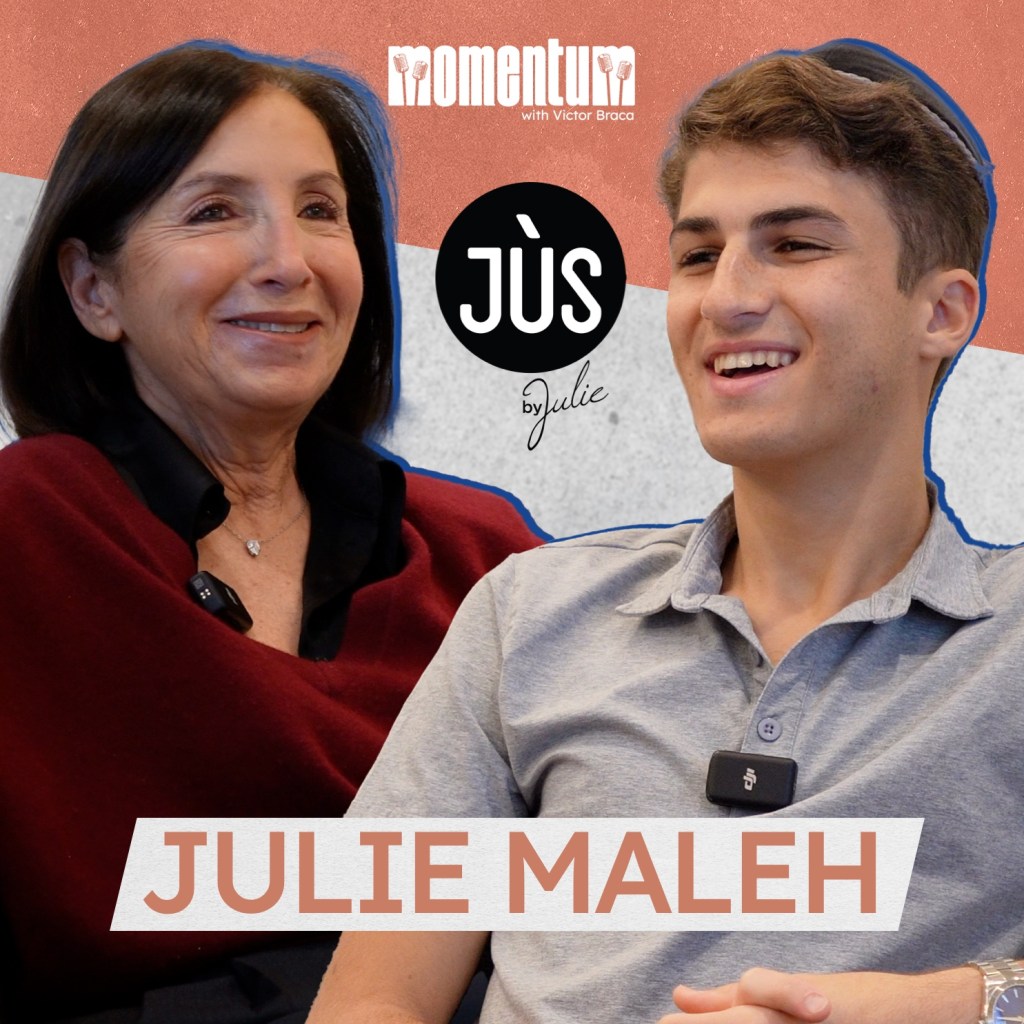




Julie Maleh is the incredible founder and leader behind JUS by Julie, a company that sprung out of her passion for health and now has 16 thriving locations.
In this episode, Julie opens up about the challenges of scaling her business and learning as she grew. She speaks about how to build a valuable brand and we touch on the critical role the community played in her success.
You’ll hear her story, her advice for aspiring entrepreneurs, and lessons on staying consistent—even when the road gets tough.
Enjoy!
Transcript
Victor M. Braca: Hi guys, welcome back to Momentum, the podcast where I sit down with interesting and successful community members in order to have conversations that will inspire and empower the next generation on their journey to success. I’m Victor Braca, and this week I’m thrilled to welcome Julie Maleh, the incredible entrepreneur behind JUS by Julie, onto the podcast.
What started out as a single green smoothie blended in her kitchen has grown into 16 thriving retail locations serving juices, salads, smoothies, and more natural whole foods. Julie shares the challenges of turning her passion into a business.
Julie Maleh: We open, it’s this huge store, and all we have is juices. I don’t know what I was doing.
Victor M. Braca: She also reflected on the importance of staying true to her vision even at a large scale.
Julie Maleh: Follow your heart and believe in yourself and stay consistent and do what you do best.
Victor M. Braca: Julie spoke about the vital role the community played in her success.
Julie Maleh: The support and the loyalty of the community—I don’t think there’s anywhere in the world that we have that.
Victor M. Braca: From blending green smoothies at home to building a brand that’s shaped lives and inspired healthier living, Julie’s journey is a testament to perseverance and purpose. If you’re interested in the food and retail industry, or if you just want to find out how Julie turned her passion into an amazing, successful business, tune in to hear her incredible story and the wisdom she has to share.
Julie Maleh, welcome to Momentum. This is so exciting.
Julie Maleh: Thank you, so excited to be here.
Victor M. Braca: So for anyone who doesn’t know you and your company, give us a brief introduction. Who are you? What do you do? What does your company do?
Julie Maleh: Actually, it all started with juices. The name—yeah, juice—until we put the name together: JUS by Julie. But I was like 50, and my kids were all grown up. I had one daughter home, not married yet; all the rest were married and grandchildren. I was a hands-on grandma, loved being around the kids, but I felt at the time that I wanted to do something for myself.
So I was, you know, I said I love, love, love nutrition and health and everything, and I wanted to learn more, but I didn’t want to go back to college at that age. I was asking my daughter that was home with me, Danielle—she was like 16, 17—and I told her to help me find something online. We searched and they had an online program, Integrative School of Nutrition. I’m like, “Oh, what? I don’t know if this is for me,” test this and that, college type.
I called and it was really the perfect fit. It was an online program. You go to seminars and you get to meet all these holistic, healthy people, you know, scientists. They all come to the seminars and you learn every dietary theory. So you choose, and every person is an individual. That really interested me because I felt like every person has their own [needs], what works for them and eating. I was just so [interested], so I followed this program and I joined it. It was like, you know, you pay but you could get your money back. I hate making commitments, right?
So I started it and I couldn’t get enough. It was like, online, you get an iPod and you listen to all these programs about health, and you learn and you go to the seminars. It was the energy that I got from it, but never imagining anything; it was for my own personal experience. I said if my family becomes more healthy, you know, [that’s good].
I picked up from it that you need greens for your body to work the most proper way from the morning. Plus, also, my husband had cholesterol issues. So I introduced the greens. I would buy everything—you know, the spinach, the kale. Those days, 12 years ago, kale was like not even existing hardly. I created this juice, and it was like a smoothie actually, because of the fiber.
My husband was home; he actually had just closed up his company and said, you know, we have two sons, he said they’ll go on their own and I’ll just find something to do. He was also like 52. So I was giving him a green smoothie every day as part of my learning program, and that’s what I took from it. He would drink, I would drink, and we felt unbelievable from it.
I went to our internist and he was asking—I actually went for myself—and I asked him, “What about Caesar?” That’s my husband’s name. I go, “What about Caesar? What’s his levels and everything?” They were high. So he was checking them and he said they went down like 80 points. Wow. And I was really consistently giving him the green juice every single day. I couldn’t believe it.
I felt like, “Wow.” So I’m a person that loves, if something’s new and great and I love it and I feel passionate about it, I need to share. I was going to the gym every day, I was giving everyone the recipe, telling them how I felt from the juice. Because also, I never ate breakfast, and they say when you—you know, like you should eat like a queen in the morning and a king in the morning, and in the dinner, that’s when you eat less so your nutrients you get in the morning. So I was doing the green smoothie and I shared the recipe with everyone.
This was in the center. My niece also, she’s very health-minded, Fortune. Anything I tell her, she like does the same thing, she believes in me. So she was going to Drive High to Marlene Tawil, and she was telling her, “Oh, my aunt, she loves—you know, she sways by this juice smoothie,” whatever. I don’t know how we connected, and she’s like—she always said people came to her and told her they want to sell this. She had a dance studio.
So we connected and she’s like, “Okay, let’s—what do you want to call this smoothie?” She’s putting me into the business mind, you know? And I’m like, “Call it Lean Green Blend,” because you know, I feel like you get lean and it just helps all the health benefits. She goes, “Okay.” She goes, “We’re going to do like a Hanukkah package.” And they had, I don’t know, Chai.com? Remember they had this thing where you like sign up on the internet? Instagram maybe? I don’t even know what it was. I wasn’t even into the computer, nothing. I’m so old-fashioned.
She said, “We’re going to put this package together.” Okay, so I started blending smoothies in my apartment. My husband, he gets the whole thing together. You just like put it in his head and he’s got the whole business plan together. We didn’t even know what we were doing. We were blending the green smoothies, the Lean Green Blend, we named it. We go to her dance studio when it was a class, and I’m talking to everyone about the smoothie and telling them how I feel from it. They sign up and they prepay, and now here we are delivering smoothies in cups.
Victor M. Braca: You just like threw yourself into it.
Julie Maleh: Threw [myself in], yeah. Now my daughter, she worked in Kitchen Kaboodles also, so they did the package. Everyone prepaid, was like six smoothies for like $30, and they get one every single day. We used to go to the house and drop them off early in the morning. He would be blending, I’m connecting and with the phone just like texting people: address, this, that, code, drop it off. We go in with our car, like driving.
Now, they did the first six days and now everyone wants—these girls want the drink again. And I’m like, “Okay, how are we doing this?” My daughter also, Marcy, she’s very like—she worked Kitchen Kaboodles and she also—she’s exactly like her father. They’re very business-oriented. So she’s like, “We have these carafes.” They’re like in all these glass bottles, like lucite type, and covers. We put labels, went to Staples, because I’m getting all these calls now for this smoothie, for this juice. I had like 30, 40 customers from Marlene’s Drive High.
Nice. So she really set me up. I don’t know if I would have ever did it. I was every night messaging—I don’t know how I had that courage—every night I would text everyone, “You want juice tomorrow?” Every two, three days it finishes. It was like, what’s in this juice? Their body actually craved it, and that’s what I learned, and that’s how I felt. I really believed in it. My husband with his cholesterol and the points, I felt like I was onto something. And my husband knew he had a vision.
Now we’re doing this like the Milkman. He’s getting up, he’s making the juice, I’m going from house to house delivering, knowing these—I know all these girls. So like I knew that this one leaves her house at seven, she wants her juice already before she goes. I was running from house to house dropping, talking to them about the shoes early in the morning. I don’t know how I had that courage, but I also felt like it was like my calling because I just felt everything, the timing was right. And that’s what I was doing. That’s how I started juice. That’s how I only started with the juices.
Victor M. Braca: Right, and you believed in what you were selling. I think that’s a very important part of it.
Julie Maleh: Yes, and I really used to talk to these girls every day, and they really gave me the [motivation]. We connected and we would talk about the juice, and then they would tell me, “Oh, maybe we should do like juices like juicing.” And I was like, “No, no way, I’m not into this. I feel like it’s like you’re starving your body.”
But then I did a lot of research and I believed in my juice, and my husband knew that there was something there more than just the juice. He sees me going and like—you don’t know—I was like taking, they would pay me, I would like—I have no regards for money. I would take the money, put it on the seat of the car, and you would see just crumpled up money getting paid whatever. And he’s like, “We need to start something.” And he was available because he had just closed his company.
I’m like, “No way, this is my hobby. We’ve worked together, we’ve done stuff together, I’ve helped, did a lot of things together, but I love what I’m doing. I just love it and I love sharing and let’s leave it at this.” He didn’t want to [leave it at that] because he had a vision.
So I said, “You know what? Go online, look for bottles. I’m going to create different smoothies to do like a cleanse.” We were looking at like Blueprint, they had juices. But the way I designed my cleanse—because I didn’t want people like after three days, they do juicing, I didn’t want to call it a cleanse and they were doing juicing and then they would like starve. That’s not the message that I wanted to put out there. So my juices had fiber, you actually got full.
We designed like six juices. He did the whole put together online, bottles. He made his own labels for the juices. We got like—we went to Trader Joe’s, you know like they have a six-pack of different kind especially holiday time. We took the six-pack, we bought them, and we were delivering juices in six bottles like for three days in those cartons. Until we looked online and everything clicked.
Victor M. Braca: Makeshift packaging in the beginning, and then once you finally establish it…
Julie Maleh: Cracked that, like we couldn’t believe it. But there was a—like people, you know, everybody wanted it. Exactly.
So that’s how we started the juices. Then one day I’m outside of the center with a cooler and my niece, and they’re like, “We need more ice, we need [more juice].” So now we’re selling the juices from—it’s like selling it from the car, right? We had like a whole set-up in front of the center. I can’t believe I’m so shy and yet I had such a passion and I believed in it so much that I didn’t feel that way when I was [selling].
Victor M. Braca: Wow, you just wanted to share it with people, spread it to people.
Julie Maleh: Exactly, exactly. So now when my husband and I—I asked him, “Could you get me ice?” We’re always doing things together. I’m like, “Okay, could you get me ice?” And he goes, “When I drove up and saw you outside peddling this juice, I have to get my wife a store.”
And I was like, “No way, no way I’m going [into] another business.” Like we were in and out of businesses, it was always on his side like opening, closing. I said, “No.” We opened 99-cent stores, we had resort stores, like we did so many because I got married very young and we were always like a team, you know?
So now he’s like, he wants to get me a store. And I’m again—step up Marcy, like I told you, she was exactly like her dad. So she’s in Jersey, we were going to Deal for the summer, and she’s like, “Ma, there’s a store in Allenhurst, you have to look at it.”
So I’m like, “I don’t know,” I’m very like laid-back with these things. So my husband of course ran to Deal, looked at the store, met with the landlord. Even the landlord, he was like—we’re still in it for the summers—he’s like, “Does juice justify the rent?”
And now I got nervous and everything, we just had juices. I said, “I don’t know, does coffee justify the rent?” Cravings was across the street. I said, “No.” Whatever, we [did it]. I felt like, “Okay, we open, it’s this huge store and all we have is juices. I don’t know what I was doing.”
Victor M. Braca: And how did it do? How did this do?
Julie Maleh: We put like a curtain, it was half empty. So I think we leased it out to Kitchen Kaboodles, actually, and it did great. It did great. Our first summer, we got help. My other daughter Esa works. My kids love working, they all have the same work ethic like their dad and I, so it’s in their blood.
So they worked and then I was doing, in the end towards the end of the summer, I started making like salads. Like two, three salads, that’s it. It was the first summer just like we just introduced like three salads. Now we have like 50 different types of salad.
Victor M. Braca: So you start with juices, you get into salads. I want to slow down, like zoom into the process a little bit. What are you feeling at this point? Your husband pretty much forced you to turn your hobby into a business, and you seem to be happy about it. You’re working with your kids, it seems to be fun, a good time, and the store is doing well. So how are you feeling at that point?
Julie Maleh: No, it was amazing. It was the rush and every single day wanting to get up and just have [that drive]. I still feel the same way today and it’s like 12 years and I feel exactly the same way. Just keep going and be consistent.
In between, you know, you get a lot of different up-downs and everything, but we just stay the course. My husband’s very positive. I like get little like, “Oh you know, scared to make decisions,” but he’s always pushing. When other stores, other business people do the same thing and you get a little like, “Oh I don’t know,” it keeps you in your game. I always look at it in the most positive way. And consistency—my husband always said like you got to be consistent.
Victor M. Braca: Very excited to announce that this video was sponsored by my mother, Rachel Braca. My mom teaches Canasta to people of all ages. It’s a really fun game that brings together people in a dynamic and engaging way. No matter your age or your expertise, anyone is capable of learning. It’s a great opportunity to socialize with friends and family. My mother has 20 years of community experience; she’s taught over 100 people. If you would like to learn Canasta, learn a new skill, get together with your friends, you can email RachelBraca@gmail.com. Again, that’s RachelBraca@gmail.com. She’s the best. Back to the episode.
Love it. So you just mentioned consistency, which I love. You also mentioned work ethic before. Maybe can you go over, throughout your years in business—I think if I’m not mistaken, you have 12 locations? Something like that?
Julie Maleh: Something like that.
Victor M. Braca: Great, amazing. Congratulations first of all. So throughout your years building those up, can you go over maybe a couple of the lessons that you’ve learned working with your kids and building up a company out of your hobby? What have you learned from that?
Julie Maleh: I learned that if you have a passion, you have to really stay and believe in your—really believe in yourself and use all your strengths. Whatever comes your way, setbacks, you just focus on what you believe in.
Victor M. Braca: And you clearly believed in the product.
Julie Maleh: Clearly believe in my product.
Victor M. Braca: Throughout your opening up of 12 locations, you mentioned that a lot of times you get nervous when making a decision. How did you overcome that fear? I mean, going from a hobby to 12 locations is a lot. It’s a lot, and managing all of that and pushing yourself to open up in Manhattan, you know, and Lakewood and places like that. So how did you overcome that?
Julie Maleh: One thing is I always want to help my children in any way possible, and seeing them growing makes me so happy. So my husband, I let him make all the business decisions, and I’m more still the mommy type and I want to give this one that and I want them all to have everything equal. So it’s a very good balance between me and my husband.
In the beginning, he started it, and I didn’t want to—I always say that I give him all the [authority] that he should, and I just trust him and respect him, and that’s what keeps it always [working]. I think that’s what helps with my kids because there’s always obstacles and it keeps them—it gives them their strength to keep on going and doing.
Victor M. Braca: If you had the opportunity to talk to the youth of our community, which I hope that’s what this is, then what would you tell them?
Julie Maleh: Like I have my sons and my son-in-laws now. Actually, we were so—our lettuce, when we made salads, we really follow the hashgacha. We always have like one son that wanted [the best], and then my son-in-law opened in Lakewood and they wanted to have the best hashgacha. They opened up actually—it’s like we have the highest hashgacha, CRC.
Through all these processes, I feel like the way my children see our balance at home and in work—they know Ma, how I am; they know how Daddy is—and it gives them a lot of strength to also push themselves. I feel like that’s like a message: you just stick to your course. Because at the same time you have a lot of people coming into the same businesses, and even my children tell me, “Ma, just focus on what you do best.”
And that is really like key. You shouldn’t drift away and think, “Oh no, other people are doing the same thing.” I mean, no two people could do the same thing. People know you, who you are. I feel like my theory of the nutrition background, what I put into [it]—it’s different. Everyone has a different [approach]. You should never think that someone could take from your [path]. This is you. We always tell each other [that], and that’s what gives us strength to keep on going and opening more.
I thought we were like a mom-and-pop and we were going to stay like a mom-and-pop. So I give my kids that strength and I feel like they help me by keeping on going and growing.
Victor M. Braca: Amazing. I want you to tell me about a setback you experienced and how you overcame that. More importantly, what did you learn from that?
Julie Maleh: So we started with the juices, you know. We had a factory and we started full force juices. We were doing cleanses, selling them online.
Victor M. Braca: At what point did you switch from creating them yourself to moving into a factory?
Julie Maleh: Actually, yeah, we started in my apartment. My husband would be doing the blending, and we would be selling them actually—like I would do events, go to Cedarhurst, bake sales. And then my husband decided that, you know, it was really growing, it wasn’t going to stay small.
So he partnered with my sons actually, my sons and my son-in-laws, because I believe that we should all be equal, girls, boys. So we opened up in a huge factory and we were selling juices online. It went [well], it was really the right time.
We had to actually close Corona time because all the people, factory people, left. The people that were making the juices. It was a great business. I feel bad that we didn’t pursue it after Corona, but that’s what gave us more strength to just all open up retail stores and put our strength more on the juices and salads. That’s what made us open more JUS by Julie stores.
Victor M. Braca: Right, and after that experience, no more online juice.
Julie Maleh: Right, but I’m very like positive thinking. I said maybe this is probably not the direction that we should be going in, and we put more strength into the retail stores. And also, I love it because what I get out of it from the beginning till now, it’s the same for me: seeing the kids grow in the same path and what I really want out of it, because I love helping people.
Every day, different people tell me things like, “I’m able to stay kosher,” you know, like people travel with my salads. They stay very fresh, the lettuce stays good. They’ll go traveling and they’ll bring six salads with them, and you’re able to stay on a kosher [diet]. And younger [kids], now I see young kids coming. It just keeps on growing and turning and we know we’re onto a good thing.
Victor M. Braca: Have you considered franchising as a way to expand?
Julie Maleh: Of course. My husband, not me for sure. So we franchise now.
Victor M. Braca: Oh, you do franchise.
Julie Maleh: Yeah, very nice. And that’s also—so I leave it all to him because I just like my part. Not in it for the money, even though of course it changed our life. It helped us. We had a lot of setbacks together, building.
Victor M. Braca: I think that’s an important theme across all successful people who start their own companies: they’re not in it for the money. Like you said, you have the passion for the product which is underlying, and then when the money comes, you grow and you rinse and repeat. But that’s not your main focus. You started, you wanted to spread this amazing product that made you feel good to the whole community.
I actually want to touch on that for a second. I want to go there. So we’re talking about community. Before we put on the cameras, I want you to tell me a little bit about how being a part of the community helped kickstart your company.
Julie Maleh: Go ahead. Actually, the support and the loyalty of the community—no, I don’t think there’s anywhere in the world that we have that. And I think that’s why I’m here today for sure. The same customers from day one still come. They like ask, “Are you sick of me?” They tell me, “I’m here every day,” and I’m like, “No, you’re not the only one that’s here every day.”
That’s what it is. They feel healthy, they feel good. Men come in, buy their own salads. Juice by Julie is a lifestyle, and I feel like people feel that with me and they understand it and they feel the same way coming in buying a salad. It makes them feel like they’re on a healthy regimen, and that’s the message.
Without the community supporting my passion and understanding it like I do—and it stayed that way because that’s really what I believe. Like people come in and you know, they tell me like they see me eating a salad—”You’re not sick of your salads?” I’m like, “You don’t understand.” I travel with them. If I’m—I very rarely eat anywhere else. I like to know what’s in my food.
It’s really how I feel. I put 150% in every salad that’s in my store. I don’t just [sell them]. It’s so funny like my husband, like he’s like when we make the salads—sometimes he’ll tell the factory, “Listen, we’re short on romaine this week, try to be a little more conservative.” I call up the factory, I’m like, “Mesta, you can’t listen to what Caesar says.” I said because my girls, they love to chew, they know what they eating. They know my product. If it’s a little less, they feel it. I go, “We can’t do that.”
I’m very much into the product being perfect every single day. I’m in there shifting my salads, checking. I was like, “That’s my part of juice for sure.” And my husband, I let him do his—he does it all. But because it’s like that, it’s a great balance and it keeps everything [working].
Because of the community, I feel a connection with these people. The way I feel, I want them to feel. I want them to be happy from this. I get very happy eating a great lunch and it’s like a regimen every single day. I live like that, and I want everyone else to be like that.
Victor M. Braca: Hi guys, you know the drill. I’m going to ask you really, really quickly to please subscribe, like, comment, but most importantly share this episode with a friend, a family member who you think would derive value from it. We’re really trying to spread the podcast as large as possible. We’re trying to impact as many people as possible and we want you to be a part of that. Thank you so much. And back to the episode.
So when I told my sister Vivian—she’s 10 years old, she’s in fifth grade—that I was interviewing you, she got so excited. “JUS by Julie? No way, that’s so cool!” So she has a question for you, I’m going to relay that from her. She told me all of her friends know JUS by Julie, which has got to be very cool for you.
Julie Maleh: Well, makes me [happy]. Fifth-grade girls, yeah.
Victor M. Braca: They know about the company. And I want to ask you, the brand that you’ve built up—obviously a lot of it has come from just caring so much about your product, really making an amazing product—but what do you think have been the top things that helped you build such a valuable brand in the community? JUS by Julie is a brand name at this point. How did you build that up?
Julie Maleh: I feel like people know me since I’m younger, they know that I’m very health-minded. They have a very big trust in me. And like I feel like when people come in—like they see me on the floor, I’m like wiping—it’s not so nice, but I’m wiping tables and cleaning and fixing the salads. And they’re like, “You’re Julie?” And I’m like, “Yeah,” you know?
I’m like a simple person and passionate about what I do and I just think that people feed off that. They just see it in me every single day. I talk to them. Remember when you wanted me to do this public speaking and I’m like super shy? I never did. I want to get myself [out there].
Of course I love that there’s children that [know it]. That’s what makes me so happy. I have videos of like all the kids, it looks like a bus came. I just flourish from it. I talk to them and like I’m just Julie, but this Hashem, it all came from [Him]. It’s all about timing also, was a good time. I feel like whatever is meant to be, timing has to be right. I just feel like people believe in me because I believe in myself. And if you just stick to what you believe in and follow that path, you’ll be very successful.
Victor M. Braca: I love it, I love it. And on that note, I think what inspires so many people about JUS by Julie, your story, is the fact that you’ve built a brand, a company that started in the community, it’s expanded even outside of the community, but it was just from your passion.
So I want to ask you—like nowadays, people like me, 18, 19, 20 years old, who are graduating high school and college—a lot of people are worried about the intersection between following your passion and doing what you love and potentially turning your passion into a business, but they’re worried about the money. Where does that fit in? Am I going to be able to provide for my family, achieve a tuition—all these things are a big question for people. What do you say to these young men and women who are worried about this?
Julie Maleh: Right. So I exactly felt that way all the time. I’m very scared to make the next move. I started out with like a $20 blender, right? Then we got a more expensive one, and then my husband came home with this like big machine, like $600. And I think I had a fight with him, my kids thought we were going to get a divorce! I was like, “No, you can’t!” Like I was very scared to spend money and make baby [steps].
First of all, you have to make baby steps and follow your heart. If you believe in something—no two people are alike in anything that you do—and if you believe in [it]… we started from a juice. How could [that happen]? It’s of course Hashem. But I feel like if you just follow your heart and believe in yourself and stay consistent and do what you do best and don’t go off track.
I remember I started in this—my store was like two by two and it was just they would pick up. I didn’t even have a place for them to sit and they would pick up a salad and people used to ask me like, “Where do they go with their salad?” And I’m like, “I don’t know, I don’t ask.” I guess they go eat with their friend. It’s all just like one thing led to another. Look how we started from the juice, added a salad.
But you have to stay the course, believe in yourself, because there was—I had this like my little first store and then other stores came nearby and opened the same exact product. One day I told my husband—me myself, if I didn’t look close to this salad, it was like an identical JUS by Julie salad, but it really wasn’t because if you would eat it, it wasn’t my salad.
So you have to really trust your instincts, stay with what you do best, don’t fall off the course and try to [copy others]. If something throws you off, my kids would tell me, “Ma, just [focus].” That even made me stronger. Things like that made us much stronger. I said, “You know what? We have to expand because God forbid if we’re just depending on one store and the community business.” So we went to other neighborhoods and we expanded that way just because it was our livelihood also.
I just believe—my son Elliot said, “Ma, just you know do what you do best, don’t look elsewhere and focus on what you do best.” And you know what? There’s seven, eight people that open the same type of business, but no two businesses are alike and you have to stick to what you believe in.
Victor M. Braca: Amazing, love it. I want to shift towards—I know that you and your company, you like to put a focus on community in terms of yeshivas and our organizations. So maybe can you touch on that a little bit? Why is the community so important to you? You touched on how it helped kickstart your business, but why is it so important to you fundamentally and what are some of the ways that you try to give back to the community?
Julie Maleh: So we always like try to give back through organizations. Leftover salads we give to orphans. I feel like I spread my salads anyway that I can, but more in a way that knowing that everybody’s understanding and appreciating it’s not just a salad in a container. It’s not a business—I would never let that [become the focus]. Of course it’s a business, but the passion is never like [gone]. It’s like we have “JUS by Julie, Made with Love.” Like it’s made with love. I’m very connected, I don’t let it drift away.
Of course we need [the business side]. My husband runs the whole back which is the most important. If there’s big sales, auctions, we’re always putting out salads out there.
Victor M. Braca: Opening 12 locations—I know I start every question like, oh you know I don’t even know if it’s from the first to the 12 locations, 11 to 13, whatever, plus or minus a couple—but throughout your journey, a lot of people struggle with delegation, right? They open up their first store and they’re doing everything themselves, and then all of a sudden, third, fourth, fifth store, and they have to hire help, they have to hire managers. Did you struggle with that and how did you deal with that?
Julie Maleh: So that was my biggest struggle. I love doing everything myself. I don’t like asking someone to do [things]. Even when it comes to anything—I’m in the store that needs sweeping, wiping up—I don’t know, I can’t tell someone to do something.
In a way it was good, but you can’t grow that way because you’re going to burn out. So you know, we of course hired a lot of different people, but they—after getting interviewed, it has to be somebody oh everyone that came to work I told them this business is built on customer service. I made it clear to them that it’s like you have to be very [service-oriented]. Are you a people person? I used to ask anyone that came to work for me.
I think every girl that I meet—like I go to Aruba, “I was like she worked for me, she worked for me.” Every girl. But it was great experiences. The young girls, they got to see a regular person like she’s in the store every day. They see that you work hard, you stay with it. You don’t just build a business and walk away.
I believe very strongly that you have to be there all the time, stay connected. Especially if you’re opening in neighborhood stores, people like to connect the brand with the whole concept of [who you are]. That’s what I feel like I’m building on. Even my kids, I tell them, “If you don’t stay in your locations, connect with people, let them know how it started, who we are—it’s not just a store selling salads.” We’re not that.
Victor M. Braca: To close up, we have a signature question. The show is called Momentum and we called the momentum because we want to get the ball rolling for the youth, for anybody who’s ambitious and entrepreneurial to start their own venture. I want to ask for you, what was your momentum moment? What was the moment where you saw what you were doing was picking up steam, it was gaining momentum, and it caught on? What was that for you?
Julie Maleh: I would do a lot of like events and I would do a smaller size salad like for Flatbush. They would call me and ask me, “Could you—it’s like holiday time and we’re doing like an auction and you know could you do the salads?” So I would distribute like 200 salads. And then they would have like leftover, like 60 salads, something like that.
So it was Avi Houllou’s wife at the time, you know, Aleha HaShalom, and she said, “You know, I know a place that we could have someone pick up the salads.” So they picked up, they came, they picked up the salads. It was an orphanage.
After that I got a personal phone call saying—I’m going to like cry—they’re like, “You don’t know, we have someone that distributes each salad to each girl, each person.” They were young children. “And you don’t know what it does.” They called me and then they wrote me like a whole letter of how JUS by Julie salads and healthy and how they felt about it and how each kid waits for it. That keeps me knowing what I did has an impact.
I still get those phone calls today. Same orphanage. It just makes me know that what I believe in is so real.
Victor M. Braca: And that’s amazing. How does that make you feel? I mean, that you’ve built something up that people really, really value.
Julie Maleh: I wish everyone could feel like that when they’re working, because it inspires me every day to—I’m so excited to go to work every day and see the people. It’s like my family. I go to work and that’s what I do, but I don’t feel like it’s work. It’s like going to a wedding every single day, meeting new people and connecting. It keeps me going.
Victor M. Braca: I love that. That’s great, that’s great. Julie, thank you so much, this was great. I hope the people watching really learned a lot. I’m sure they did because we covered a lot. The story was amazing, starting from being so passionate about the product, still being so passionate about the product, but now you have however many locations—10, 12 locations, huge. So congratulations. I’m sure the whole community is looking forward to seeing what you have for us in the future. And yeah, thank you.
Julie Maleh: Thank you. Thank you. Thank you, community, for always supporting me and their loyalty.
Victor M. Braca: Thank you so much for tuning in to this episode of Momentum. Julie’s story is a powerful reminder that following your passion, staying consistent, and trusting your instincts can lead to incredible success in life and in business.
Here are just a few takeaways from our conversation. First, believe in your product and let your passion shine. Julie’s passion for her green smoothies was so contagious that she started by giving them away for free to friends and family, spreading her enthusiasm and belief in her product. You have to believe in your product if you want to succeed.
Second, start small and grow step by step. Julie, like many others, didn’t begin with a grand plan. She started with a $20 blender in her kitchen and focused on making one great product. Over time, her consistency and willingness to improve led to the growth of her business and the addition of new products like salads, packaged goods, and more. Throw yourself into it. You’re not going to feel ready in the beginning, but you have to get started. Start small, take baby steps, and you’ll get there.
And finally, lean on your community for support. Julie emphasized how vital the community was in building her business, from her first customers to the longtime regulars who still visit her stores today. As Julie said, “The support and the loyalty of the community—I don’t think there’s anywhere in the world that we have that.” Make sure to utilize your community.
If you enjoy this episode, be sure to check out my conversation with Sophia Cohen, the founder of Urban Pops, a thriving ice cream pop company based in New York. Sophia, just like Julie, started her food business out of a passion for health and an urge to share her creations. In that episode, she opens up about the challenges of building a startup from a tiny apartment kitchen, balancing entrepreneurship with raising a family, and her advice for young adults who are ambitious and want to start their own venture.
Again, that’s the episode with Sophia Cohen, founder of Urban Pops. You can find that on all platforms by scrolling all the way down; it was the second episode I did of this podcast. Just kidding.
She was like, “Oh my gosh, these are incredible! This is incredible, what is this?” My boss knew that I was great at finessing. Three months later, I got a $3 million order. I broke the account. I remembered sitting down and going, “Oh my gosh!” And that was the moment we realized that it could be a real business. As a woman, I find it to be very difficult, by the way. I forgot we even on a podcast! I don’t know, you could add that in, you cannot add that in. Keep it! And I was like, “Oh my gosh, holy moly, we got it! We got it!” And that was how it developed.
Enjoy, let me know what you think. And finally, if you haven’t already, please share this episode with a friend who would enjoy it. If you’re listening on Spotify or Apple Podcast, please rate the show five stars. It really helps spread the show to new listeners, and of course make sure you subscribe so you’re notified when a new episode drops. Thank you so much for watching and have a great day.





 Momentum
Leave a reply to happily3d3b9a083e Cancel reply