

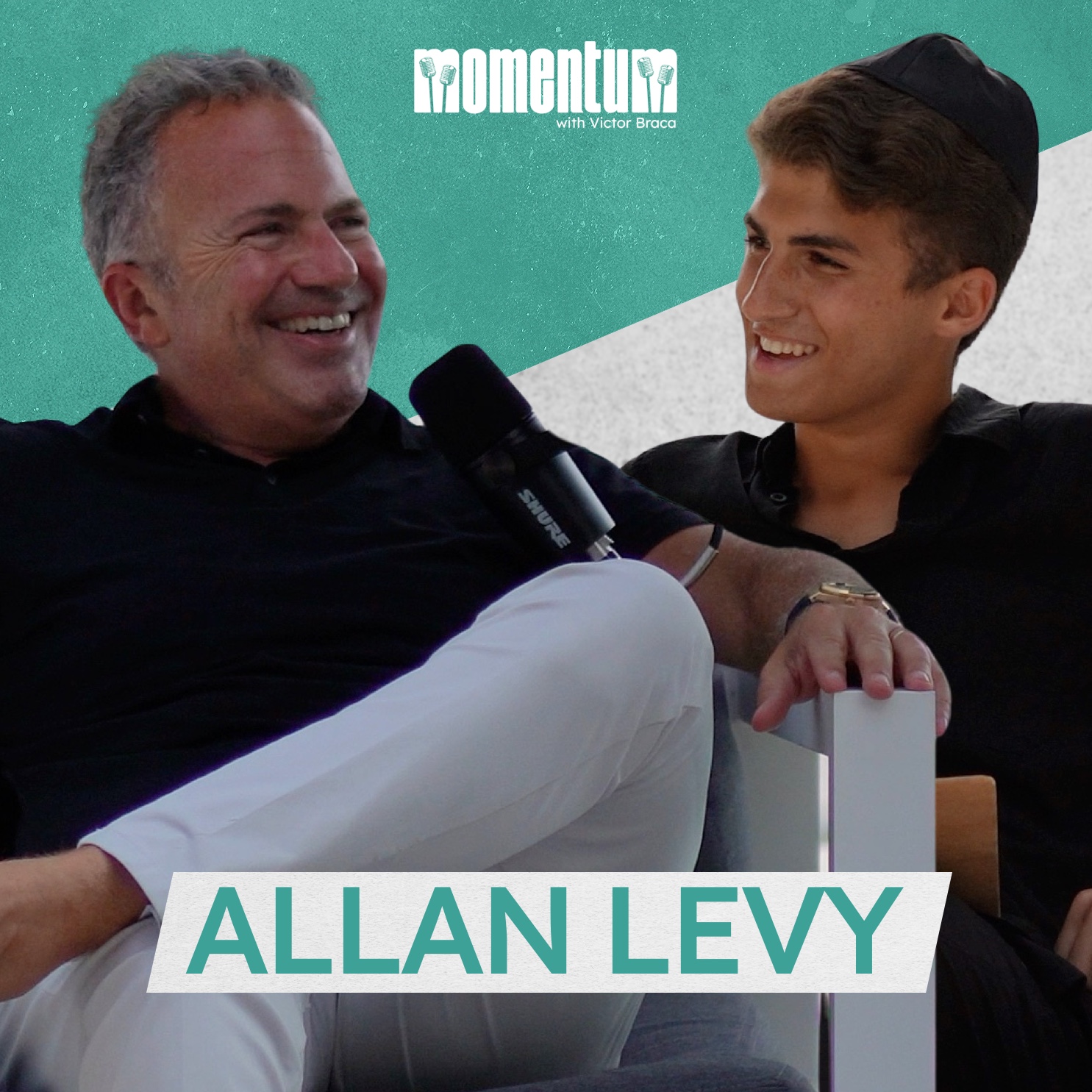


Allan Levy is the founder of Alchemy Worx, a leading marketing consulting agency specializing in email and SMS retention strategies.
Allan shares his fascinating journey from working in his family’s retail business to raising millions in venture capital and building a digital marketing empire.
He reveals the ups and downs of raising over $7 million in VC funding, scaling his companies to over $28 million in revenue, and facing setbacks like a $15 million challenge that taught him invaluable lessons.
This conversation is packed with insider stories on navigating the complexities of venture capital, scaling a service-based business, and the power of resilience, humility, and networking.
Enjoy!
Transcript
Victor M. Braca: Hi guys, welcome back to Momentum, the podcast where we sit down with interesting and successful community members in order to have conversations that will inspire and empower the next generation of our community’s leaders. I’m your host Victor Braca, and today I sit down with Allan Levy, a serial entrepreneur and multi-company founder with an incredible journey across multiple industries.
Allan’s journey began working in his family’s retail business, but he quickly transitioned into building his own companies, scaling them to impressive heights. During my conversation with him, we touch on many topics such as the principles he thinks are essential for success, rising up the ranks at his company, and leading a team from a really young age. As a 22, 23-year-old, I was managing people who had experience well beyond mine and raising millions of dollars in venture capital funding. Couple million in venture funds, hit a plateau, raise another $5 million through the business to 28 million.
Allan’s latest venture, Alchemy Worx, is a marketing consulting company that partners with major companies like Disney and SiriusXM, helping them build stronger customer relationships and maximize their efforts across channels. Working with over 120 brands, Alchemy Worx helps businesses connect with customers and utilize their audiences through channels like email and SMS. Watch the full episode to learn from Allan’s insights, experiences, and strategies in scaling multiple businesses and building lasting client relationships. I hope you enjoy this episode. Let me know what you think. Let’s get into it.
So, Allan, welcome to Momentum.
Allan Levy: Thank you. Great to be here.
Victor M. Braca: I’m excited to have you. There’s a lot to unpack with your story. You’ve achieved a lot. For those who don’t know you, how do you explain what you do?
Allan Levy: So, what we do is—I run a company called Alchemy Worx. It’s a digital marketing agency, but we’re really very focused on one category which is retention CRM: customer retention marketing, customer relationship marketing. And the channels we work in are email and SMS.
And so we work with a company that has an existing database and we help them get more out of that, tap into it, and maximize their repeat purchase rate from their existing customers or the repeat sign-up rate from their existing customers. So while they’ll have an acquisition channel to acquire new customers and new leads into their system, we help them take those leads and convert those existing leads to buyers and even move people—we call it audience management—move people up the funnel from somebody who just visits the site and drops an email or a phone number in for messaging, to somebody who makes a purchase, to somebody who makes a second or third purchase, to somebody who is a loyal customer and buys frequently. So that’s our audience management: pushing people up the funnel until they’re a high-valued customer.
Victor M. Braca: Got it. So, like, when for example if I visit a website, they ask for my email, I put it in, you know, let’s say to get to the next page, your company helps companies manage that, right? Take advantage of those emails?
Allan Levy: Yes.
Victor M. Braca: Got it, got it. Okay, so on Momentum we like to focus on people’s early days, their stories, how they got their first job, how they started their company. So take us back to the beginning. I read about you that your business life started when you were 8 years old, packing boxes in your family’s company. So tell me a little bit about that.
Allan Levy: So like many people of my era, we kind of grew up in the wholesale-retail era—more retail than wholesale. My family had retail stores, so I had the job of organizing the—we had children’s wear stores—organizing the diaper hangers and, you know, packing and unpacking boxes at a relatively young age.
But I learned a lot from my dad. He passed about 10 years ago, may he rest in peace, but you know, I learned a lot from him and I didn’t even realize what I had learned at the time that I was being taught it. At 15 or 16, he would guide me: “Okay, it’s getting cold out. What should we do with the halter tops in the lobby?” All right, logically, let’s move them in. “We’re getting near the fall season. What else do you want to do?” Let’s take the jackets and move them to the front. “What else?” Take the sweaters, move them to the front.
So rather than telling me, “Allan, go move the sweaters to the front, Allan, go move the jackets to the front,” he guided me to come up with the answers so that I could think holistically. And I always thought, “Oh, okay, so he taught me how to think about business,” but I didn’t realize till later on that he taught me how to be a manager.
So I got two skills out of that, not one. The first skill was yeah, think for yourself, right? Why are we doing something? Not just do it no matter what, even if you’re told, “move the sweaters to the front.” Listen as a team member, as an employee or something: why am I being asked to move the sweaters to the front? Oh, I’m being asked because—then the next question out of your mouth should be: “Should I move the corduroy pants to the front? What else should I do?”
And then the other part of that was how to manage. Rather than, on the other side of that, telling somebody, “move the sweaters to the front,” you ask the question. You make them think objectively about the situation. So I got two really critical lessons at a very young age and I was able to take those lessons with me in my life and my business career.
Victor M. Braca: Got it. So your father’s managing pretty much taught you number one, what to do, and number two, how to manage.
Allan Levy: Yeah, his style of management.
Victor M. Braca: So outside of your family business, what was your first quote-unquote real job? How did you get into the business world?
Allan Levy: My first job was short-lived. We grew up in Connecticut as a family and I moved here when I was 18, went to Brooklyn College. For about three months I was working because I had a full day schedule. So I would go to work at night at Century 21 department store.
I was demoted because I was the assistant manager in my family’s store, but now I was demoted to stock boy because that was the job I could get to fill the hours. But I took the same ideas and initiative to that. Rather than just ticketing merchandise in the stock room, opening boxes, I took the same initiative and when there was downtime, I would start cleaning out the racks, moving things down in the stock room, making it more efficient without anybody telling me what to do.
But also learned something else. Another skill is that you treat everybody equally. Now, I was probably the lowest-level employee, so you have to treat everybody equally because they’re all senior to you or at your level. But I didn’t try to make my peers look like they were inadequate because I was working harder. I said, “Hey guys, can you help me do this? Can we do this together? What do you think?” And I kind of gamified it and made it interesting and inspired the stock room to get organized.
Through the Christmas season they invited me to work on the floor and then they told me, “Quit school and we’ll pay you $200 a week and become a manager.” I realized right then and there that was the wrong career path for me. I wasn’t quitting school to work 60 hours a week as an assistant manager or whatever.
I then took a job in wholesale. My aunt’s nephew from the other side had a small, very small wholesale business selling sunglasses. My job was to open up the cartons, retag the goods, ship them out, retag the orders and ship them out. And if I finished all of my work—once it got to the summertime when I was off from school—if I finished all my work, I could then go out and sell.
I always wanted to sell and I took that opportunity and I would literally lug sample cases on the subway up to the Bronx, to Brooklyn, to the streets, and I taught myself how to sell. Going door to door—is that boutique going to buy from me? And I’d have to inspire myself. I’d walk by because I’m naturally a shy-ish person and you don’t really want rejection. Sales is hard because you’re setting yourself up for rejection. But you know, I’m like, “I took the subway here, what’s wrong with me? I got to push myself. I’m going to go back two doors, go back into that boutique and see if there’s somebody there who wants to buy from me.” And I taught myself how to sell in the field.
Victor M. Braca: You taught yourself how to sell in the field?
Allan Levy: I taught myself how to sell and it was just a matter of initiative and customer service and delivery and follow-up and perseverance. And I did that.
Victor M. Braca: That’s great. So tell me about your journey at this company.
Allan Levy: So that was a relatively small company. It was me, the owner, eventually one other person who came in to pack the boxes so I could do a little bit more sales. I spent about a year and a half there. He gave me a raise and then about a month later said, “Allan, I love you, I just can’t afford to pay you less, but you’re going to have to find something else.”
I went into my network and my parents’ network and they sent me out interviewing with friends of theirs in the wholesale industry because I was dead set I wanted to be in wholesale. I landed a job at a jeans company. One of my cousins was working at a jeans company in operations and he said they have an opening position in sales. I took it, I rolled up my sleeves, and I spent eight years at that company working from the bottom up.
I was first in charge of sales. I was very fortunate the company grew very, very quickly. Within 18 months they gave me a promotion to manager, sales manager of a very small division. Then about a year, year and a half after that, they expanded it to a larger division. Then a couple years later—and I made a good portion of my income in commission. I was never afraid to bet on myself, right? So it was commission or bonuses for hitting objectives within my departments, for my team executing.
Now, this was at a very young age. I was 22, 23 years old. I was managing people. I had seven people internally and then I was in charge of the national sales force which was another eight people. That was for all for the smaller accounts. The company really thrived on the larger accounts but I still had to manage people and I was managing people who had experience well beyond mine. At 22, maybe they were in their 30s and 40s.
I had to learn humility and it’s a trait that I learned early on: be humble. Don’t come in and say, “I’m your boss, now do this.” One of my closest friends for years and years—and he subsequently came to work for me in other businesses—was the salesman for the Southeast. He came—I flew down to Florida for a trade show and I supported him. There were some areas that he didn’t want to go sell, you know, there were jobbers or whatever. So rather than me telling him, “I’m your boss, you have to do this,” because you really can’t force people to do things, I got up early, went down there, showed up at the showroom at 11 o’clock, and put a few orders on his desk. I said, “I assigned you three new customers.”
I earned his respect from there on. He was like, “Wow, you did that?” I said, “Yeah, they’re your customers. I did the work, they’re your customers, you get the commission on it. Now, you know, follow up on the sales.” They turned out to be decent-sized customers, but I earned a partnership with him.
Victor M. Braca: That’s awesome. It was a great lesson. How do you learn how to manage these many people at such a young age?
Allan Levy: Really, it’s humility. For managing people, it’s listening and being humble. You have to listen, you have to understand what their challenges are, and then you have to be creative to solve those challenges and help them solve those challenges. So I really believe in being humble, understanding what the opportunities and the objectives are, and finding creative solutions.
Victor M. Braca: If I’m not mistaken, you went on to start your own company after your time here?
Allan Levy: Yes. I was a little ambitious. I started two companies at somewhat the same time. One was a sourcing company with a partner out of Hong Kong, and we were doing apparel sourcing out of Hong Kong but really predominantly China. And then the other was a company where we were manufacturing T-shirts or we were painting on T-shirts in the U.S. and distributing those to retailers here in the U.S.
I grew both companies very quickly but wasn’t well capitalized and didn’t realize the proper ebb and flow of the business. So I got some quick lessons. The wholesale company, within 18 months we grew to $5 million in business. We couldn’t believe it—it was very aggressive, but it was a seasonal product and we got burnt trying to create products for the off-season and not realizing that there was a seasonal flow.
And then the other company—I was really only 29 at the time, 30, and I had just gotten married, so I had responsibilities. The sourcing company, we were limited to what we could do out of Hong Kong/China because of quota restrictions. So we expanded that to Pakistan.
That’s where I got my really first lesson in the country where they say, “yes, yes, yes, I can do everything.” We took on $15 million in orders of which we couldn’t deliver. We delivered three or four. It was just a disaster.
Victor M. Braca: So what happened?
Allan Levy: We slowly backed out of the orders. Didn’t hurt anybody, but it was very frustrating that we had so much business and had to work so hard to replace it and backpedal. We ended up building an infrastructure in Pakistan, but more importantly, I ended up hiring expats from Canada to come live in Pakistan and created a system whereby we can now measure a factory’s effectiveness before we gave them the order.
If a factory said, “yes, I can do it,” we knew how to go in, count the machines, basically engineer the factory or understand the engineering of the factory and do the calculation and say, “Look, you said you could make 10,000 dozen, but you only have the capacity to make 2,000 dozen total, and that’s if you only take our orders.” And then we would constantly measure: Did they buy the product? Did they buy the fabric? Did they cut the fabric? Are they putting it into the lines?
We ended up building that business. The wholesale business, which had grown rapidly, but the seasonality impact of it slammed us. So we focused on the sourcing business and I expanded it to Dubai, Bangladesh, ultimately into Jordan, Oman, and the whole region and grew it pretty successfully over the course of the next four or five years.
Victor M. Braca: Nice. So you grew this business over, like you said, the course of the following five years of your life. At this point you’re 35-ish?
Allan Levy: Yeah, at this point I’m about 35. My son was born within that period of time, I guess around 30, 35 he was born, and I realized that I was literally away 6 months of the year. One of the owners of one of the factories, a friend of mine, said to me, “You know, in this business you’re traveling and you’re going to watch your kids grow like this in the crib, rather than little by little where you don’t notice their growth.”
It resonated with me. So I ended up selling that business and starting another wholesale business. We licensed a couple of brands for tween and children’s jeans, and we grew that business with departments in some of the department stores and TJ Maxx business and a Burlington business. We grew that business over the course of the next few years from ’96 through ’99.
And then I sold that business because I saw this thing called the internet happening. Although we weren’t doing any transactions online, we had a website and I saw that the teenagers were engaging with our website, answering questions, answering forms.
I really had a goal. My goal at that time of my life, close to 40, was to learn how to raise capital and learn how to raise outside capital. I spoke to my accountant at the time and I said, “I want to roll up a bunch of apparel companies and, you know, raise capital and build it and sell them off.”
He smiled and said, “There’s no interest in that. If you had an internet business, you could raise capital.” And that was my goal.
Victor M. Braca: This is what year?
Allan Levy: Late 1999.
Victor M. Braca: Wow, right at that point.
Allan Levy: Right at that point. And I wrote a business plan—learned how to write a business plan—raised some friends and family funds of $200,000, built out a concept, raised another million dollars, and executed on the concept. Realized I needed to pivot, pivoted the concept once or twice and grew the business. Raised a couple million in venture funds, continued to grow the business, hit a plateau, raised another $5 million, and grew the business to 28 million over the course of from 2000 to 2006.
Victor M. Braca: Wow. Nice. So what does this business do?
Allan Levy: So that business eventually became a lead generation business. We had multiple websites and brands: a shopping brand, a recipe brand. The goal of that business was to get people to sign up for our brands and go through and see our advertisements. So it was really a publishing business and we would promote to them in email, we’d promote to them on the website, we’d promote to them as they signed up, captured registration for other partners as they signed up.
At one point we were buying a lot of media, a lot of search media at the time to drive traffic to our websites. At one point we were generating 150,000 new sign-ups every day. We were monetizing those sign-ups; we were paying about a $1.50 a sign-up and monetizing them at about two and a quarter to 2.50. So it was profitable downstream monetization.
So the business had grown. Unfortunately—and part of my legacy—I was fired from that business in 2006 because I had brought in a COO and she went to the board and told the board that she could do a better job of me of growing the business.
Victor M. Braca: Oh wow. The person that you brought in?
Allan Levy: A person I had brought in. And within eight months of me bringing her in, she went around to the board and then they fired me. I still owned a decent chunk of equity in the company, but unfortunately—and we had three, four million dollars in the bank and we were growing, we were profitable. Unfortunately, she took the company in a different direction. Within six months burned through the cash and I just watched the whole thing. My position on the board was relieved and I had no control of it and so watched it happen.
But I then started this company that I own right now, Alchemy Worx, in 2007.
Victor M. Braca: Right after that?
Allan Levy: Right after that. On the heels of that. She gets you fired, you’re like, “Watch me now.” And then you go to your next company and built this business. No outside capital, nothing. Own 100% of it and have grown this business significantly. We have 130 people working for us.
My first team—and this goes back to learning cultures—my first team I built in Manila in the Philippines. 80 people out of my current team are all in Manila. I knew how to deal culturally with dealing with a different country. It’s been amazing growing this business. We have about 120 brands that we actively work with.
And the one thing—talk about humility—it’s just so important. Brands that I started with in 2007, 2008, 2009 are still clients today. Most agencies burn through their brands within two or three years maximum. We have clients with us six, seven, eight, 10 years.
Victor M. Braca: So I want to go back to your startup for a second. Can you tell me a little bit about raising capital? VC funding seems to be a very complex world and I’m interested in that.
Allan Levy: There’s a bunch of things that you really have to take into account. First and foremost, you need to write a business plan. And the reason you write a business plan is not so much for the fact that you’re going to execute line-by-line on the business plan. It forces you to think about the marketplace, the opportunities, the strengths and weaknesses, what you need to do, the competition. It really forces you to look wholeheartedly at that piece of the business.
I’m talking about a comprehensive 40, 50-page plan with financial projections, with objectives. And that plan usually doesn’t get read by the venture capitalist; it gets read by the analysts working for the venture capitalist. The analysts tend to be MBA students getting their way through the world reading through like, “Hey kid, go ahead read this, figure it out, see if there’s an opportunity here for us at these firms, see how good it is.”
They may highlight it and then they may give one of the senior partners a look. If it’s interesting, the senior partner will look at some of it. They want to know how you think through things. And so that business plan lets the investor understand: How do you think through things? Have you looked at all the pitfalls?
Because inevitably, no matter what the business opportunity is, it’s not going to be what you thought it would be on day one. You’re going to have to pivot. I was just listening to one of the How I Built This podcasts by Guy Raz.
Victor M. Braca: Yeah, that’s great.
Allan Levy: It’s an amazing tool. And he was interviewing the founder of Harry’s, the shaving subscription company. He said, “You know, when we started, we had Harry’s razors, we had women’s razors, we had two or three other products, and we had a content site, we had a health site. We realized at some point we had to pivot and just focus on our core products.”
And I’m sure his business plan was significantly different than the model that they rolled out, but the investors just want to know: Are you a smart person when something goes wrong? Because inevitably something will, whether it’s in your control or outside of your control. Whether it’s the economy, the elections, the weather, the shipping costs—there’s something in the world that’s going to impact your business and go wrong. And how you deal with that is going to identify whether you’re the type of person I want to have my money with or whether it’s not.
And that’s what these analysts are trying to gauge. That’s what the venture capitalists are trying to gauge. The analysts want to just gauge the first piece of that, but that’s why it’s critical to write the business plan. And if you can get the meeting, that’s why it’s critical to be really good on your presentation skills and really understand your business well and the marketplace well, so that when they ask you the question that’s not in the business plan, you have the answer for it.
When they get the meeting, they want to understand your ability to be a critical thinker. They don’t want to argue with you about the statistics in your plan, whether it’s a hundred-billion-dollar market or a 10-billion-dollar market. It could be a 5-billion-dollar market and they want to exit anyway at 100 million and that’s okay—you just got to get to 5% of the market and everybody’s happy.
But they want to understand your ability to be a critical thinker, and they also want to understand whether or not you would be a good partner. We get some of that on Shark Tank. When you watch Shark Tank, it’s not perfect—certainly it’s hours and hours of scripted television—but you get some of it when you see an entrepreneur arguing with the shark. Is that who you want to be on the board with? Is that who you want your money with? Somebody who’s going to argue with you, or somebody who’s going to convince you in a good way that there’s something right?
Victor M. Braca: Nice. It’s cool to hear the sort of inner workings of a venture capital funding deal, you know, because that was also very big at the time that you were doing it.
Allan Levy: It was very big at the time I was doing it. I’ll walk you through some of the tranches and some of the things that I learned from that. First and foremost, it was very helpful for me to raise friends and family money. Where did that money come from? It came from people who had done business with me in the past. It showed future investors that I had gained the confidence of other business people and they’re willing to put their money in. I had to put my own money in as a matter of fact also; they want to know that you have skin in the game.
Between putting my own money in and raising that capital, then I had to prove I could do something with it. So my very first was just build a website. You have 200,000, build a website, hire a couple people, show you have the ability to attract talent, you can get things off the ground. That’s what I did.
The next tranche came from an extended round of friends and family. So I went back to the people I had raised money from, did a second round—some family funds and things like that, slightly more sophisticated, but it was still not venture capital yet. But it got us to the next level. It got us a running model, it got us business, it got us cash flow. It got proof of concept.
Then came the A round, the seed round. We raised $2 million and we hired at that point an investment banker or a small firm that was going to earn a commission on the raise to help us raise the money. We hit the first stock market bump in 2000.
Just to clarify, guys, Allan meant to say 2000. I think it was March of 2000. As soon as we had our business plan printed and right off the press, there was the first crash in the stocks. But we pivoted. We went from a B2C brand to a B2B brand. We went out to market with the B2B methodology and we were able to bring two VCs in to raise $2 million.
We subsequently grew the business to about $7 million, but we hit a plateau. In 2005 I hit a plateau with the business. As a matter of fact, we were cash strapped because in the year that we grew, we overextended ourselves on the team. We had grown to 7 million and my first half of the year was very profitable, but the second half of the year I was losing money. We made a small profit that year, but my overhead was just too high.
So the second half of the year was losing money and we right-sized it in 2006—but by the time we had right-sized it, or maybe was 2004, 2005 whatever it was, by the time we right-sized it, we started to shrink. So we went from seven to six to five million year-by-year. In that year that we did five million, we had hired an investment banker to sell the company and inadvertently they brought in—we couldn’t come to terms on a deal to sell, but we brought in somebody who wanted to make an investment.
Even there, here I was with the company that had shrunk, but I had a good story. We showed that cash flow was the reason that we hadn’t grown it properly and we raised money. We subsequently did an acquisition. We went through pitfalls in the fundraising portion where one fund backed out, another fund came and they backed out right before the holiday season. It’s very hard to raise money in that season, but we had 14 million committed, of which we ended up taking seven from five different funds.
We made a decision and we took the 7 million and we jumped the business literally that year. We paid 5 million, bought a business that added nine. Our core business went to 18 million and then subsequently went to 27, 28 million year-by-year. So we really put the money to good use.
Victor M. Braca: That’s great. Hi guys, sorry to interrupt in the middle of the episode. I’ll make this quick. Please, if you’re enjoying this episode so far, like, comment, but most importantly share. We’re trying to grow the podcast to the entire community and maximize our impact with these amazing conversations. Anything you can do to help would be greatly appreciated. Okay, thank you so much, back to the episode.
After your experience at the startup, what do things look like for you?
Allan Levy: So I had to pivot really quick personally because I was no longer running the company and didn’t have a strong exit. I had to build something from scratch. And so I took my skills from both parts of my career—my apparel skills and understanding retail/wholesale and my digital skills—and I combined them and I started the current company which is Alchemy Worx.
In 2007 I started the company. Worked with a handful of friends who had retail businesses or through contacts. Met with them—digital retail businesses—looked at their existing programs and came in and said, “I can do better than you’re doing running your program.” And same thing: “Pay me a commission.”
That’s how I built the business. I started out and I said, “You’re doing, I don’t know, a million dollars a year in these channels. I want a commission on everything above a million dollars a year you’re doing and I’ll do all the work for you.” And that’s literally what I did. Took on a handful of clients and blew the business up for them.
Victor M. Braca: That’s great. I want to shift gears a little bit towards the advice you might have for young adults looking to get into business. What’s one principle that throughout your business career you think has propelled you forward to ultimately where you are today?
Allan Levy: It’s funny. My youngest son graduated a couple years ago from University of Maryland and he’s been in business working now for a company for about three, three and a half years. We sat down the other night to talk and he reminded me—because he interned for me a number of years ago—of some of the business advice that I had given him back then.
He still had it and he actually emailed it to me. I said for the purposes of this conversation, “Ricky, could you email it to me?” I want to see what he remembered or what he wrote down.
Respond immediately. Really, this is Customer Service 101, right? And so you think customer service is just for the person handling the complaints, but customer service is for everything that you do. Whether it’s a job application, whether it’s a reference that somebody says, “Victor, I want you to meet David,” and puts you on an email or an SMS or a text with David. Respond immediately.
“Hi David, great to meet you. Hi Don, thanks for making the introduction, I really appreciate it.” Sometimes you can’t get an answer, sometimes you’re not at a place that you could look at your schedule to make the appointment. Respond immediately and set the stage for: “Hi David, I’m out of pocket right now, won’t be able to respond until the morning. I will respond first thing in the morning, but I do appreciate the introduction.”
Just an immediate response because if somebody makes that introduction for you and you don’t immediately respond, it’s hanging out there: Did you get it? Did you not get it? I put myself out there to make the introduction. Just respond immediately even if it’s not for you, even if you haven’t had a chance to look at the person’s website to see if it’s the kind of position you want. Maybe you don’t want to waste anybody’s time—doesn’t matter—but just respond immediately with a set expectation.
And it’s okay to miss a deadline, right? It’s okay to tell somebody, “I’ll take a look at your website and get back to you by the end of the day with my thoughts.” It’s okay to not get back to them by the end of the day with your thoughts if, before the end of the day at 3:00 or 4:00, you jump in and say, “I know I told you this morning I’d get to this by the end of the day but something came up, my apologies. Is it okay if I respond by 2 or 3 o’clock tomorrow?”
If they see that, they’ll know that you’re on top of it and it shows that you care. You didn’t leave somebody hanging, you didn’t leave somebody out there and it just is a reflection. So to me, that response time no matter what you’re doing, whether you’re in sales or receiving or buying or selling, it doesn’t really matter: respond immediately.
Victor M. Braca: Nice, nice. That was the first principle that your son repeated back to you.
Allan Levy: My son repeated back to me. And part of that: give people the opportunity for escalation. Let’s say you’re going to ask, “is it okay if I get back to you by the end of the day?” or “is it okay if I move this till tomorrow?” Give them the opportunity. If not, I’ll leave what I’m doing.
When I was first starting out in this company and I’d get an email from a client or I’d get a phone call, I’d be in the middle of a meeting. I’d see that they called me. I’d text them back: “Hey, I’m in the middle of a meeting, I’ll be finished at 2:00. Anything you need that’s urgent? I’m happy to step out and take the call now.” And they would immediately say, “No, nothing urgent, speak to you at 2:00.”
So I gave them the opportunity to escalate. They were important enough that I would do that—I would escalate if I needed to. So that was number one.
When there’s a problem, whether it’s within the company or for a client, immediately acknowledge the issue and assume responsibility. Don’t say, “I don’t know, that’s not my problem, that’s not my job.” Client has a problem, go to the client: “I’m on it. I will deal with it. I understand that something went wrong here, let me look into it, let me get all the facts.”
You don’t have to say, “we’re sorry we messed up”—maybe we didn’t mess up—but let me get all the facts, let me get all the details, but let me address it immediately. Don’t put things off. It’s a riff on the first one.
Victor M. Braca: It sounds productive. It sounds like you’re optimizing for productivity, for efficiency.
Allan Levy: Yeah, and taking the edge off, taking de-escalating rather than escalating. When you’re on the phone with a client, a prospect, an existing relationship, always try to build the relationship. Don’t jump in and say, “Okay, here’s what we have to say today.”
“How’s it going? How’s the weekend? Where am I finding you? What part of the country are you in?” Even if you’ve never met the person before: “What part of the country are you in? Oh, you’re in the South? You guys got battered by those hurricanes, were you good?”
Something to tie it together. The weather is always a very neutral piece. Something to build a bond between you and them. “Is it hot there? It’s hot here.” Something that you can build a soft relationship with. Don’t waste their time on it, but it’s really, really important that: “Hey, I’m a human being, you’re a human being. Let me get to know you, let me understand that.”
Take notes. Always, always, always take notes. If not, acknowledge that you’re going to take notes on your phone: “Hey, would you mind if I take notes on my phone? I’m not answering emails.” Take notes. Somebody’s giving you information, feeding information to you—if you’re not taking notes, if it’s not being recorded and you’re not taking notes, it’s very disrespectful. They’re going to tell you something and then what, you’re going to try to remember it? And you’re taking their valuable time. Very critical to take notes.
Victor M. Braca: Interesting.
Allan Levy: Recap the notes, recap the call at the end of the call for them. “Okay, these are the items that we’re going to follow up on, these are the items… this is the follow-up item.” But really, really critical to take notes.
Be humble. I said it before and I’ll say it again: humility is critical. The younger you are, really critical to be humble because if you’re humble and you show humility, others will respect that. Again, you’re de-escalating rather than escalating. Your knowledge will shine through even if you know more than somebody. Show them that you’re humble, you’ve got a humble approach to it, and that you want to learn from them.
Everybody’s got something to teach you. No matter how smart you are, how knowledgeable you are about something. I listened through something the other day from a client and I was like, “Wow, I didn’t realize that. That’s interesting.” I learned from it. Let people feel that they can impart something to you, share something with you, and that you’ve benefited from that simple gesture.
I didn’t drink any water here, but if somebody offers you water—you walk into a meeting and somebody offers you water—take it. Take a sip. It’s a simple gesture and then you have the opportunity to say thank you. If they offer you water, as a matter of fact I’ll do it just even though I know we’re winding down, but thank you.
It gives them the feeling like, “Oh, I put water out, he didn’t want it. My water’s not good enough?” But they took my water, they appreciated it. You’re welcome. There’s a small little gesture when they put water out or something—don’t feel like not taking it shows restraint. Feel like taking it. If they put a cookie out, even just take a bite of the cookie. Even if you just take a bite, take something, little fruit. Show that you’re willing to break bread. I think it’s an important thing.
Be nice. Be positive. I learned a long time ago, somebody asks, “How’s it going?” “Great!” The first: it’s great! Smile. Smiling is so important in part of a conversation. It brings the mood up. And sometimes it’s not going great—you can say it’s going okay. You should be honest and be reasonable about it. But people want to do business with people who are successful, people who are positive, people who bring the mood up in the room.
So if you walk into a room and you’re smiling—now, obviously you have to read the room, you have to be understanding, you have to be respectful. Sometimes people need to get to the point quickly, so you have to be able to gauge all of that. But being positive is really critical. And that’s the person that when they take a phone call, they’re going to take your phone call because: “Victor always puts me in a good mood,” or “Victor’s always in a good mood. Victor’s the kind of guy I want to work with.” And that’s where you want to be.
Treat everybody—whether they’re on your team or work for somebody else, maybe they’re in a lower position—treat them with respect and appreciation and understand that people have personal lives. Understand that when people are coming at you sometimes aggressively or negatively, they’ve got their own issues and traumas and things that you don’t know about that they’re dealing with. They may have a kid that’s sick at home that they’re nervous about, they may have a spouse that just had something rough happen. You don’t know what went down. So always treat people with respect.
Hold the door for people. And when I say hold the door, it doesn’t mean just the physical door—it certainly does mean the physical door—but it means in general: How can I be respectful for people?
And then the last couple: creating a fun working environment. Make sure your team understands that it’s not all business. Try to connect with individuals on your team: “Just how you doing?” Learn a little about them, take notes on that. Have a meeting with them individually, ask personal questions—don’t get too deep, you don’t have to really pry into their personal life, but you want to know a little bit about them and create a fun environment. We like to do a lunch day once a week; we’ll buy lunch for everybody and make sure the conversation goes off-topic: “How was everybody’s weekend? What did you do?”
Victor M. Braca: It sounds like the underlying theme is make people feel important, respected, heard. For you looking back, what role did networking play in your journey and how do you advise young adults to build up valuable connections?
Allan Levy: Critical. It is critical. I am a consummate networker. One of my largest clients today—I was in the role, I was honored to be in the role of a community organization as president for a number of years. That organization is no longer around; it was an organization called The Angel Fund, became Exceed Network. We helped a lot of businesses get started or helped businesses that were struggling move on.
I said networking was a critical role for me, and he said that I had taught him how critical networking is, how important it is to be a good networker. And to be a good networker you share and you give advice. I’ve advised not only my own sons—I have three sons who are all in the business world today—but I have advised countless youth within the community and I’ve told them: you go out there, you build your network. You go onto LinkedIn, you go onto my LinkedIn and you see who I know and you ask me to connect you with them. But you make those connections.
My son, my 26-year-old, recently switched positions at the end of last year. He’s in real estate and he switched positions. He had built up a lot of friends or network with a lot of people, and I had a lot of people that could help him. He went out there and he met with them and he went face-to-face, brought them coffee when he could, but he followed up with every single one of them with a phone call or a text message or an email. He updated them on a monthly basis what his status was: “I want to thank you, I met with so-and-so that you told me to. It didn’t go anywhere but it was a great meeting and I really appreciate it. I want to let you know that I’ve landed a job and it was through your help and encouragement that that landed me the job.”
Every single one of them is now a contact in his database that he can reach out to because he continued to build that network and leverage that network.
Victor M. Braca: Nice, nice. Somewhere in there you mentioned community organizations. I want to shift gears to that a little bit. How important do you think throughout your journey—even before you’re ultra-successful and once you’re successful—how important do you think giving back to the community is? Getting involved in organizations and schools? I know you served on a couple of boards. I want to hear about that from you.
Allan Levy: I would tell you that it’s so important. As a matter of fact, I think I did an interview about this at one point and I definitely wrote a white paper about it. It is so important, so invaluable because giving back to the community—whether it’s our great community or whether it’s another community—is important. Going back to high school and helping seniors or going back and speaking at some point to the school is important.
When you are on a board—and when I was on the board of Yeshiva Flatbush, for example, or even UJA—and I’m asked to come into a meeting, I’m on that with people who are significantly more successful than I am. And if I’m rolling up my sleeves and doing the work, those people will look to me for my opinion on the work within the school and say, “Well, Allan, you got your hands dirty on this, tell us what you think we should do. What’s your opinion on it?”
And they respected my opinion. So here I am, let’s call it 20 years ago, with somebody who’s worth 30, 40, $50 million and my opinion is respected at the same level as theirs and my decision is equal to theirs. Ultimately, if I want to do business with them or if there’s an opportunity, they’re going to recommend me because they’ll say, “Hey, here’s a smart guy, there’s an opportunity to do business with him.”
And without the objective of doing that, when I got thrown out from my own company in 2007, it was through those relationships that I reached out to people and said, “Hey, can I take a look at your business and see if there’s an opportunity for me to help fix it?” Somebody said, “Yeah, come on in, come talk to me, come talk to my son.” They were one of my first clients. I came in, I said, “This is great, I’ll do it on a commission basis.” We grew, they ultimately sold that business, started another one, I came in and grew it. So it was critical, and it was without intent. You have to be pure.
Victor M. Braca: Yeah, it sounds like getting involved in community organizations and that side of things—obviously you’re fulfilled from it, but also there’s that sort of unintentional byproduct in the professional sense.
Allan Levy: Yeah.
Victor M. Braca: We call the podcast Momentum because we try to pinpoint those moments where you see what you’re doing and you see it’s picking up steam and you see things working out and you know you just have to continue. So I want to ask you: What was your momentum moment? What was the moment of that pivotal stage in your professional life where you saw what you were doing was starting to catch on?
Allan Levy: Fortunately, I’ve had several of those moments. I could tell you way back when in my early career in Sales and Sales Management, there was a salesperson that worked for me and she found a new channel. You’ll laugh, but Costco was just emerging as a business. Costco, BJ’s, the wholesale clubs—there were about a dozen of them at the time. They all consolidated over time.
She found this channel in the late ’80s to sell into and we flew out to one of these clubs. I went out there and said, “Look, we’re here for an 11 o’clock meeting, but before we have our meeting at 10 o’clock in the morning, we want to go to one of your clubs because there aren’t any in New York.”
The buyer came out and said, “Look, I have some time before the meeting, I’m happy to go with you.” He took us to the club and again, I say listen. So we listened and he taught me as much as he could about that business. That business wasn’t a “buy blue T-shirts” business and you’ll be successful. That business was a “turn the inventory” business and “we need to make money out of our money.”
He walked through the floor, he showed me what was selling and what wasn’t selling, he showed me how well it did. And then when we sat down an hour or two later after lunch and we went through everything that we were showing him, I just took a notepad. I took notes, as I said: take notes.
My salespeople were going through the presentation: “You should buy this and we have this and we have that.” They started to ask him what he wanted to buy and I could see he was… I said, “Don’t worry about it, I’m going to tell you what you should do. I’d like to break the assortment down this way: 20% here, 10% here, 10% there. What’re you open to buy? What do you need?”
He gave it to me and I said, “Fine, I got it. We’re going to write the order up and send it to you.” He said, “That’d be great, thank you.”
And that was the aha moment for me in my sales career that pivoted me to listen. Your job as a salesperson is to take the pain away. The pain isn’t writing the order. The pain is first convincing them that they have confidence in buying from you. So we sold our company and the rest of the work that we had to do was taking the pain away of writing the order and making the decisions and taking responsibility—because now if I’m telling him to buy things, I’m taking the responsibility to sell.
And at that point I learned in selling you have to take risks. I didn’t mention it, but risk-taking is critical. You have to take risks but take responsibility. If you’re willing to take risks and take the responsibility, you can take that pain away. If you’re willing to write the orders, then you’re going to succeed.
So that was a pivotal moment in my career where I learned that you have to go to a client and tell them, “I’m willing to do this for you, don’t worry about it, I’ll do it and I’ll take the chance. I’ll take it off your hands and I’ll take the risk that I’m going to do it right.” And then you have to really be good at it and be responsible and do the follow-up and go into their stores and look at how things are going and solve those problems.
Victor M. Braca: Nice. So that was an aha moment for me. That’s great. It’s great that you can pinpoint one of those aha moments and you can try to replicate that. Thank you for coming, Allan, really appreciate it. Super, super insightful and I’m sure it’s going to reach a lot of people.
Allan Levy: I look forward to it.
Victor M. Braca: Thank you so much for watching this episode of Momentum. Just to give a quick recap of what Allan and I discussed today: Allan underscored the importance of betting on yourselves and taking risks and building lasting client relationships. His journey reminds us that success often comes from resilience and adaptability.
If you enjoyed this episode, you’re going to love my conversation with Alan Shama, founder of e.l.f. Cosmetics. Alan Shama, just like Allan Levy, started out working in his family’s apparel business, but in an attempt to satisfy his entrepreneurial urge, he started a cosmetics company, e.l.f. Cosmetics, and watched it grow to a 10-billion valuation. We discussed success principles, what he learned from working with investment bankers and private equity managers, and the number one thing Alan Shama took away from his decades of experience in business.
If that sounds interesting to you, you can click somewhere on the screen or find the episode on our profile. Again, that’s the episode with Alan Shama, founder of e.l.f. Cosmetics. Thank you again for watching this episode. Please, if you enjoyed this episode, leave a like, comment, subscribe, and follow us. And please, please, please share the episode. We’re trying to grow the podcast to the entire community so that we can maximize our impact. Anything you can do to help would be greatly appreciated. On that note, thank you so much, and until next time.



Leave a Reply