

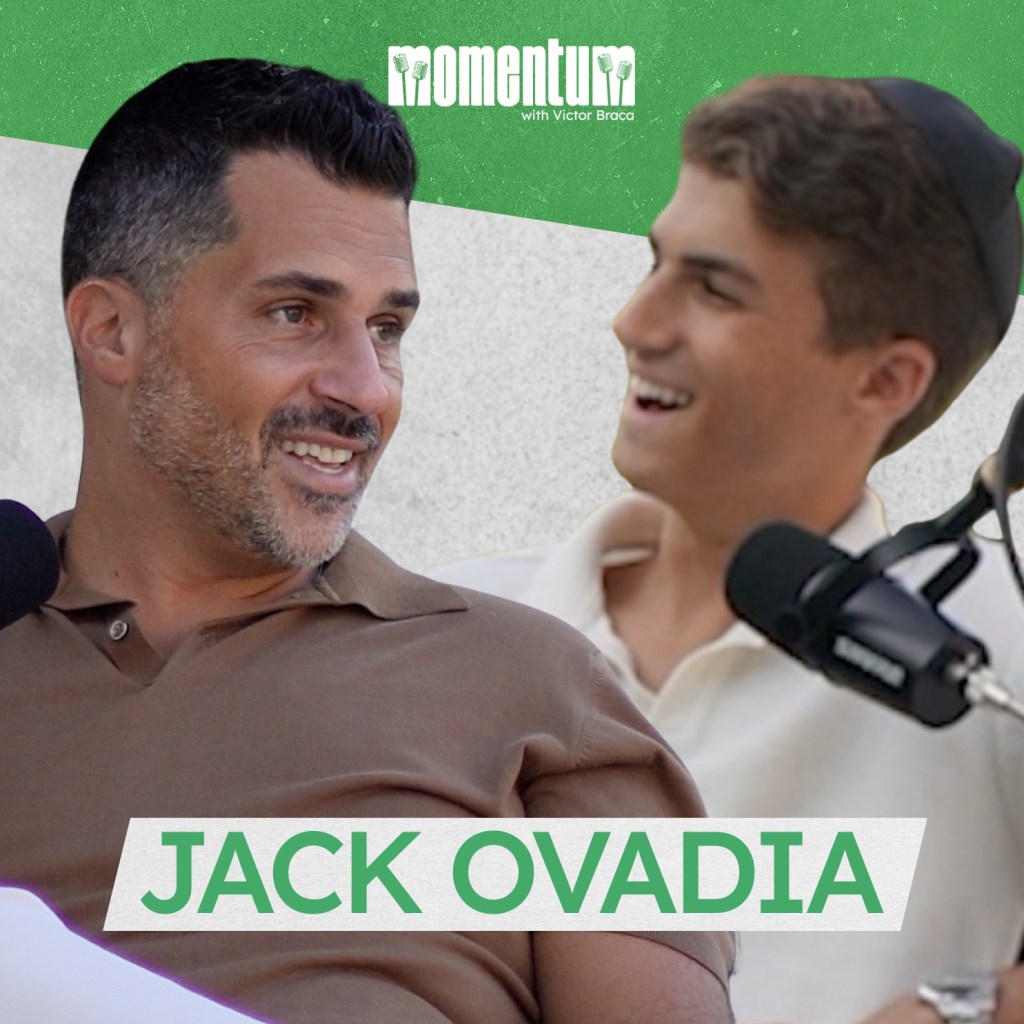




Today on Momentum, I sit down with Jack Ovadia, founder of Ovadia Design Group, an award-winning architectural and interior design firm.
Jack takes us through his inspiring journey of leaving a secure job to launch his own business from the ground up. We discuss everything from his early career struggles to the pivotal moments that shaped his success.
Jack also shares insights on scaling a service-based business, building personal relationships with clients, and the importance of embracing setbacks as opportunities for growth.
Enjoy!
Transcript
Victor M. Braca: Hi guys, welcome back to Momentum, the podcast where we sit down with interesting and successful community members in order to have conversations that will inspire and empower the next generation on their journey to success. I’m your host, Victor Braca, and today I sat down with Jack Ovadia, founder of Ovadia Design Group, an award-winning architectural and interior design firm.
Jack opens up about the struggles of leaving a steady job to starting his own company from the ground up. You’re going from making a steady salary to not making a steady salary anymore. We also get into the make-or-break moments that define Jack’s career. It’s like a slave being freed, right? And to close off the episodes, we delve into the importance of loving what you do, forming valuable relationships, and scaling a service-based business. You’re going to love this episode. Please let me know what you think. Enjoy.
Jack Ovadia, welcome to Momentum.
Jack Ovadia: Thank you for having me.
Victor M. Braca: Thank you for coming. So for those who don’t know you, how do you explain what you do?
Jack Ovadia: So we are in the interior design, architecture, and project management business. So we design homes, community centers, restaurants, office spaces, buildings for people who want to make great spaces. So we design the spaces, manage them, and oversee them.
Victor M. Braca: Love it. So take me back. You know, you started your own company, which we’re going to get into, but I want to get into how your early days in business added to that and built up the foundations for that. So take me back to your first job.
Jack Ovadia: So my first job in the industry was interning at an architectural firm in New York City. I got the job from a recommendation from my uncle who happened to know somebody. I took the job and I was working in between classes on a day-to-day basis. So it was go to class, go to work, go back to class. Go to class, go to work, go back to class.
I really learned a lot over there. I wasn’t doing great work; I was doing work in the library, putting materials away and things like that. But I’d always ask, “What else can I do?” So I’d really finish whatever I had to do in the back very, very quickly, and then I’d grab one of the guys who were working there and I’d be like, “Do you have something I can do? Can I work on the computer?” And they’d be like, “Oh, you’re too young, you’re too young, no, not yet.”
So I’d go home, I’d learn how to draft on the computer, I’d learn how to draw, come back and say, “No, I can do it, I can do it.” And they gave me small stuff to do, but it was good stuff. So I worked there for about four years.
Victor M. Braca: Nice. During college?
Jack Ovadia: During college, the whole time throughout college. And then pretty much then decided that, you know, I knew I wasn’t going to grow. One thing I always found out: staying somewhere, you got stagnant. It took a very long time to climb the ladder.
So I said I’m going to stay places long enough that I can grow, but then short enough that I can go somewhere else and get a quick promotion to be able to, you know, impress the people where I was going because I knew I had a lot to offer.
So then I decided to get up and go work for a residential architecture firm. It was a small firm. I wanted to work in small companies because I didn’t want to climb the corporate ladder and wait 10, 15 years to get somewhere. Went to a firm where we were just two people, so I knew I’d be able to get a learning curve for everything.
Victor M. Braca: It was a new company?
Jack Ovadia: No, he was an older company. It was just—I got a recommendation from a professor of mine. I was looking for a job and she said, “Oh, go work for my friend.” It was me, the principal, and another guy. So whatever jobs they had, I had to do everything from project manage, design, drafting, drawing, etc.
Victor M. Braca: Nice. And you got that experience.
Jack Ovadia: It was a great experience. And then I started kind of dwindling some side jobs with the community. My aunt bought a house, she wanted to renovate it, she said, “Oh, why don’t you help me?” I helped her do that.
It took a lot of work to do that. That’s when you kind of decide that you take your social life and you put it aside, right? And you got to work all night and all weekends to the point where like, Thanksgiving Day, people were hanging out with their family and I was meeting my aunt in the office working.
Victor M. Braca: This is while you have a full-time job.
Jack Ovadia: This is while I had a full-time job. So I took advantage of the days off. And then basically I started getting into interior design. A cousin of mine was getting into an apartment in the city—we were all starting to get married—he had an apartment, he needed somebody to design the apartment for him.
I looked at him while we were hanging out and he’s like, “You know, the job’s too small for anybody to get hired and everybody else that I want to work with is too busy.” I said, “Listen, why don’t you let me do it for you? I’ll do it for you as a wedding present.”
He was like, “Really?” I said, “Yeah.” So I called my boss and I told him I got food poisoning and I couldn’t come to work for two days. I kind of knocked out his apartment. I mean, this was a long time ago, so went to IKEA, bought all the furniture myself, took one of my friends with me. Literally piled my car up so high with furniture that we were nervous that we weren’t going to be able to get into the tunnel.
And yeah, it was a lot of fun. We went there, I built all the furniture, stayed late at night, and that was when I started the interior design.
Victor M. Braca: That was your first interior design experience.
Jack Ovadia: It was my first interior design experience, yeah. My first interior design job ever was building a sunglass store window in Times Square. A friend of mine’s brother had a sunglass store and he was like, “Oh, you want to design my window?” So I said sure. I designed it and I built it over a couple of days. I was always very handy.
And then, you know, once that started to happen, I was young and I noticed working in the residential firm and the residential world was very emotional. I was young—I must have been at the time 22, 23, maybe even a little bit younger—and I was like, “I can’t deal with the emotional aspects of dealing with people.” Husband, wife… you know, you have one meeting, it’s great, then you go to the next meeting and if they’re fighting, the meeting’s terrible.
So I decided to say, “You know, let me go try the commercial world.” I went to go work in an interior commercial firm doing high-end offices, hedge fund companies, Sony Music, St. John’s University, community centers. I worked there for about two years and it was a lot of great experience.
It was definitely great experience. I literally just got married and started working there, but the commercial world was definitely very tough. You have to work all the time. You’re on crazy deadlines. So I wasn’t only working during the day, but I’d also be working all night. It was really hard in the beginning of my marriage. My wife was like, “I can’t believe this is what I’m getting myself into, my husband’s never home.” I was coming home every night from work at 2:00, 3:00, 4:00 in the morning.
Victor M. Braca: And that was new to you even?
Jack Ovadia: That was really new to me because I was nine to six in the residential world. But now in the commercial world, these guys have office spaces, they have leases. The university had to open up for September. These were deadlines and you didn’t have time to mess around. You had to be ready, you had to be done. You had to go to the job site. It was a lot of work while I was still doing a little bit of side work at the same time. So it wasn’t so easy. And then I had my first son.
One of the things I always found out is that every time I kind of monument a moment like that that happened in my life—getting married, having a son—there was a whole shift in my career. You know, it was given from Hashem, literally.
I got a phone call from a real estate developer. Real estate was really hot at the time and they had a concept of just buying buildings and renovating them and renting out the offices, and they wanted to do everything in-house. So the same uncle who got me my first job ended up getting me this job because he was on the train with one of the guys and they were just talking.
I mean, everything is referrals in this business. It’s all about referrals. He got me the job. He was like, “You know, we want to go ahead and bring all our design of all our buildings, our lobbies and our buildings, in-house.” So I said, “Great, you know what, I’m in.” I went, got an interview, they gave me the job. Worked there for about two years. Same thing: all commercial offices here in Manhattan, Florida, running around.
Then on the side, still developing my small residential. I started getting back into the residential market. People heard I did this, I heard I did that, so they started calling me.
Victor M. Braca: That was just an opportunity that came into your hands?
Jack Ovadia: Yeah. You know, just—I did the apartment in the city, then the guy who had the apartment in the city had a friend who was doing an office, and then I did her office, and then he had a friend who needed an apartment in the city, and it just… it’s all word of mouth. It’s kind of like the game telephone, right? But you just can’t mess up because then the word changes.
So I tried to keep my reputation good, which was really important. Try to do good work by everybody and really try to build. And I was working in the real estate firm, and then I had one big—it was my first ground-up house in Brooklyn and it was on Ocean Parkway. I remember it like it was yesterday. It took about two years to do the job.
That’s when I decided to stop doing architecture because I hated that the building department was in control of my process. And if I didn’t have control of the process, the results were not in my hands. The interior design, which was a little bit more forgiving, I was able to grow. So I decided to at that time leave working for the developer and start my own company. I was doing the ground-up house and I was doing some other stuff, and that’s pretty much when the company started.
Victor M. Braca: How old are you at this part?
Jack Ovadia: So I started the company when my second son Joshua was born and he’s 15 years old now. So yeah, the first major shift was my son Max is when I went into the real estate world. Then my son Joshua was when I started my own firm, and then I had my two daughters when I moved to two new office spaces.
Victor M. Braca: Is that nerve-wracking for you to start your own company right when your second son is born?
Jack Ovadia: It wasn’t nerve-wracking for me, but it was crazy nerve-wracking for my wife. She went crazy, she was so nervous, she was so scared. You got to understand is that you’re going from making a steady salary to not making a steady salary anymore. It’s all based off of jobs that I get, finishing them and completing them. So it was really all in my hands. It’s like: you don’t do the work, you don’t get paid.
I didn’t start with a loan; I didn’t start with money from anybody. It was literally whatever I had saved or whatever I was making week to week, which was not a lot because in this industry you don’t make a lot of money. It’s more of a passion of love. The money comes—I mean, I diversified as I got older to kind of make more money—but it was nerve-wracking.
Victor M. Braca: Yeah, so you mentioned it wasn’t nerve-wracking for you and it was for your wife. Two questions: first of all, how did you deal with the fact that it was nerve-wracking for your wife, and second of all, how was it not nerve-wracking for you? How’d you have that confidence?
Jack Ovadia: I think the excitement of going out on my own overcame the fear of doing it. You know, it was just so exciting. Like, it’s kind of like—I’d have to say it’s like a slave being freed, right? Like somebody who’s a slave for 10, 15, 20 years, or somebody who’s in jail, when they get out they’re so excited to get out, but deep down inside they have fear because they don’t know what to expect in the outside world. But they’re going to run out because they want to be free.
So that’s kind of where I was. I had this thing on the side and I just wanted to be free. Regarding my wife, it was just like, “Listen, it’s now or never.” It’s like you have to take that jump. I have friends of mine who never took that opportunity and, while working for people is great and it’s a great security and having partners is great because you have somebody to lean on, it becomes—you want to have that level of independence. At least I did when I was younger.
And also I kind of grew up like that. I was very independent. I didn’t have a father growing up, so everything I did, I did on my own. So going out on my own and doing my own things and growing myself up was kind of natural to me.
Victor M. Braca: Nice. So in your day-to-day operations, what percentage is you following your passion and, you know, creatively exercising yourself, and what percentage is administrative work, business running, the business, managing people?
Jack Ovadia: So it depends on your growth. The first, I would have to say, five years was 90% passion. Myself, an assistant designer… not a lot of money. So when I started, I was very cautious on how I hired people and I couldn’t afford to bring on employees. So I always brought on assistants who wanted to start learning about interior design. They didn’t necessarily have interior design degrees, but they wanted to get into the industry.
So I was always required to be the one that had to deal with all the design, all the passion, or the artfulness. It wasn’t until we were about five or six people that were all paid employees and I really had an overhead, did my day start to become 60/40 design passion to administration. Because now, you know, you’re responsible for those people. They’re responsible for themselves, of course, but at the end of the day, as a business owner, you’re responsible for their payroll. You’re responsible to get the money in no matter what.
And where we are now, I would have to say I give about one day a week to design with my team, and then the rest is all client services, marketing, administration, finance.
Victor M. Braca: Running a design firm, one day out of your week is design? It’s interesting.
Jack Ovadia: Yeah. But one thing about design: my mind’s always running and it’s creative. For example, I have a very regimen schedule; it’s the only way to kind of operate. I mean, when we were smaller I could be all over the place, but now we’re about 17 people in the company and I have four head designers that I need to meet with on a weekly basis.
So I dedicate my Monday to meet with each one of them for an hour and a half, and that’s the day where we sit down, they meet with me, we talk, we design, we talk about what’s going on for the projects, we say we’re going to do this, we source materials, etc.
The rest of the week is having those client meetings, going to the job sites. While I’m in the client meetings, while I’m in the job site, I’m designing. If all of a sudden I’m presenting to a client something that we worked on last week and they didn’t like it, okay, now I’ll have to come up with another idea on the fly or I’ll have to come up with something innovative. Or I’m at the job site and there’s an issue, I’ll be able to figure something out as I’m moving.
So I’m always creatively designing in my mind. I’m always working. While people are going through Instagram, I’m not going through Instagram; I’m shopping for furniture sometimes. “Oh, I got to get this, I got to get that, I got to do this.” So definitely. But when do I get to sit down for two hours and really design? Very hard to find the time these days.
Victor M. Braca: Interesting. So going back to the early days of your company, when most people think of entrepreneurship and building a company, they think of late nights and working on weekends kind of like you mentioned. You mentioned that that’s what it looked like for you. Can you tell me a little bit more about that and about growing the company?
Jack Ovadia: Well, I will tell you it doesn’t only look like that in the beginning; it’s like that forever. So people have to know that once you stop that, it all kind of starts to—you lose it.
And it’s really the same way. It was a rigid schedule. I lived in the city with my wife, so that was convenient. I didn’t have the hour commute, so that really helped a lot. It’s waking up 5:00, 5:30 in the morning, giving yourself a little bit of your time. So 5:30 in the morning: wake up, read, pray, do whatever you have to do. Go to the gym at 6:15, finish working out by 7:15, come home, shower, get dressed. 8:15 I was on the train going to the office.
You’re in the office from nine to six, nine to seven, nine to eight, nine to nine. Depends what day it is. And now you come home, you’re having dinner, you’re having dinner with your wife, you’re having dinner by yourself. And that’s your golden opportunity to decide: “Do I watch TV and bum out or do I try to get a side job? Do I try to enhance myself in 3D modeling skills? Do I try to do something different?”
Once you make that decision, then you just kind of get embarked on what you decided to do. So I was at a desk literally inside my living room. My wife would watch TV, I’d be on my desk working. And it’s okay. The next thing you know, it’s like you’re working and I look at the clock and it’s 2:00 in the morning. You know, that’s kind of what it was.
Victor M. Braca: And you would do that all right?
Jack Ovadia: I’d give one night a week maybe to hang out. But if you wanted to build your business outside of your day-to-day job, you had to go ahead and do that unless you have somebody handing you a lot of money to start a business and then you’re indebted to them. I didn’t have that. I had to take what I made during the day as a salary, live off of that, and build on the side.
Victor M. Braca: The grind doesn’t end.
Jack Ovadia: No.
Victor M. Braca: And you’re still—you still find yourself late nights, weekends?
Jack Ovadia: Hey, look how hard it is for you to get in touch with me for the last month.
Victor M. Braca: It’s true.
Jack Ovadia: And when we’re here at 8:00 in the morning because it’s literally the only hour… so this is what I call my time. My routine hasn’t changed. It’s been adjusted, but it hasn’t changed. It’s the same routine. It’s the same 5:00 in the morning. It’s the same 5:00 to 6:00: your time. 7:00 to 8:00: in the gym. And then 8:00 to 9:00: here we are. Otherwise I’d be traveling to the city right now.
Victor M. Braca: Got it.
Jack Ovadia: So this is because it’s Friday and I’m working at a deal, I have this extra hour of time to give to something.
Victor M. Braca: Nice.
Jack Ovadia: And that’s why when you were texting me, I got to be out about 9:30, whatever. I live by my calendar. I live by it. It could become disappointing. Like I tell people, everybody wants to plan, plan, plan, and whenever man plans, God laughs. Happens all the time. But you have to be structured. Nothing’s just going to happen without structure.
Victor M. Braca: Right. When people think about scaling a business—let’s say in terms of a product business—then all you need to do is sell more product. For you, how do you scale a business that requires your direct input?
Jack Ovadia: It really comes down to hiring the right people. If you don’t hire the right people, you will not be able to scale because I can’t be everywhere at once. It’s impossible. So with me, if I’m out in the job site or if I’m out meeting with a client, I need to know that I have great people in the office designing, producing, and doing the work that they need. So you can’t do it without good people.
Victor M. Braca: Nice. Yeah, because you know, if you think about it, you can’t just ramp up… you can’t just 10x what you’re doing. You can’t just do 10 times the number of homes and offices.
Jack Ovadia: No, so you’d have to—what I kind of did in the last five or six years is you have to kind of grow the business in different directions. Okay? So we’re known for doing interior design, we’re known for doing architectural services. I started going into manufacturing furniture, area rugs, lighting, and a lot of decorative stuff that I can go ahead and also sell to other designers as well. So it’s kind of the way you’re able to grow financially because, yes, like a service business, you can only charge so much and do so many things. So without the good people, you’re kind of just stuck.
So that’s kind of where I decided to help grow the business, is to just do things that were related to the business. And there’s a lot of other ways, too. People approach me to go into—like I see a lot of designers now are doing real estate flips. So they’ll buy a house, they’ll design it, they’ll flip it. A lot of people approached me to go ahead and do that and I felt like that was just too much for me to go ahead and take on, and my design business would really suffer because of it.
Victor M. Braca: For you it’s diversification?
Jack Ovadia: Yes, of different businesses, and hiring the right people and delegating that out as much as you can.
Victor M. Braca: Yeah, especially in today’s world, delegation is huge.
Jack Ovadia: Delegation and accountability, and also making people feel like they’re part of the process, which is very big. So for example, when I named the company, while it does have my last name, I really wanted to name it Ovadia Design Group because we’re a group. It’s not just Jack Ovadia Design; it’s Ovadia Design Group.
Everybody who’s part of the process is really part of the team. So we’re kind of like a little bit of a family. All—like a lot of the employees—have direct one-to-one contact with my clients. You got to really make them feel like they’re part of the project. So for example, we won an award this summer for a project, and I could have just went there and accepted the award by myself, but I really wanted to assure that the person who managed that project in our office really felt like the project was theirs as well. So I took them with me and they came, and it was a really great experience.
Victor M. Braca: That’s great.
Hi guys, sorry to interrupt in the middle of the episode. I’m going to make this really quick. I just want to tell you: please share the podcast, like, subscribe, comment on Spotify, Instagram, YouTube, Apple Podcast—we’re everywhere. We’re trying to get the podcast to the entire community. I’m talking as fast as I can so we can get back to the episode. Please let me know what you think of this episode. I need your feedback. Okay, back to the episode.
So you were able to successfully follow your passion and build a viable business career out of that. What do you say to young adults, people who are worried that their passion might not be able to bring enough money?
Jack Ovadia: Stop planning and really stop thinking. That’s what’s killing everybody today. I didn’t think. For example, my passion wasn’t interior design; my passion wasn’t architecture.
Victor M. Braca: Interesting.
Jack Ovadia: You know, I started and I went to the college advisors—it’s not what I wanted to do—and I had things I liked to do. I liked to cook, I liked to draw on my desk. That’s literally what I went into the college advisor office telling them.
They were like, “Okay, why don’t you try this? Why don’t you try that?” I’m like, “Sure, I’ll try them.” And we tried culinary arts, graphic design, and architecture. I applied to a school that offered all three and I was really excited; I’m going to try them all and then I’ll figure out what I like the best.
I got to the school and they just put me in the architecture program and I was like, “What do you mean? I want to try all three.” And they’re like, “No, you can’t major in more than one subject.” I’m like, “Really? I didn’t know that.” And I was like, “Okay, so I guess I’m doing architecture.”
I didn’t try to. It came to me like anything that I ever wanted and I tried too hard for never ended up happening.
Victor M. Braca: Anything that you didn’t expect?
Jack Ovadia: Yeah, that I didn’t expect. So I went into the architecture. I almost dropped out, but I stayed in. The projects I get… they’re jobs that I don’t anticipate getting. It’s like the ones that I’ve chased or the ones that I got upset about are the ones that I’ve always found out, like, holy cow, thank God I didn’t end up getting that job.
You try to plan to have a kid and it doesn’t happen, you try to plan to start a business and it doesn’t work out. It’ll just come to you as long as you have a positive mindset about it. Don’t chase it because then you might get disappointed, and then disappointment brings negativity and negativity just brings the whole vibe down.
So be positive. Follow your passion, but don’t enslave yourself to it. You know, just work on it, enhance it, improve it. And then I think every industry is different, but you’re going to have to work for it no matter what.
With the whole thing—I know it’s a big thing going on right now—like, “How am I going to make enough money to do this? How am I going to make enough money to do that?” I tell people: listen, you want to go into architecture? If you’re doing it for the money, it’s not the right job. And if somebody told me that when I started working… my wife was making more money than me and she was a merchandiser. It was like, “Wow, I can’t believe I just spent five years in school, I’m making nothing. I can’t even support—my wife’s making more money than me and she didn’t even finish college at the time.”
And I was like, “This is crazy.” And just so many things got built over the years. Over time, opportunities arise and you have to be ready for them. You have to be ready for them, for sure, but you can’t expect them. You can’t say, “Okay, I’m going to go into this industry and in five years—because the statistics show this is how much money I’m going to go ahead and make.” I’m going to be a lawyer and I’m going to make millions of dollars in 10 years, and then all of a sudden you become a lawyer, you work your butt off, and let’s say you lose your first three cases—that’s it, now you’re not a good lawyer.
So don’t project what you think you’re going to go ahead and do. Follow the passion, go through it, and then really be aware of what’s happening along the way. Don’t be afraid to take the chances because the chances are going to be amazing opportunities.
Victor M. Braca: Interesting. So you developed a passion for architecture. You didn’t always have that.
Jack Ovadia: I always had a drawing passion. I was a kid at Magen David Elementary School; I remember it like it was yesterday. First, second, third grade, I used to color on my desk so much that you wouldn’t be able to see the color of the desk. They used to make me stay in school till after school and I’d have to clean and erase the entire desk, and it would take me hours because the desk is about this big and the eraser is this small.
They would punish me, like, you have to use an eraser. I wouldn’t be able to just get a thing and wipe it off. Pencil wouldn’t come off if you try to like wipe it off; you need an eraser. So the passion then just became architecture, and architecture became interior design. I have an architecture degree; that was my thing. I went to school for five years for it. I didn’t go to school for interior design, and somehow the interior design came throughout.
Victor M. Braca: Putting artistic and creativity aside, what’s the most important business lesson you’ve learned in your 20 years of running your company?
Jack Ovadia: Don’t trust anybody.
Victor M. Braca: Interesting.
Jack Ovadia: Have trust in people and have faith in people, but always have eyes in the back of your head. You never know what anybody else is thinking. So always be prepared to hire new people. Always watch your finances because you don’t know who’s playing around with your money. You can hire the best CFO, you can hire the worst CFO; it doesn’t matter. Once they’re in charge, they can make stupid moves.
So while you have this artistic passion, you really need to be on accounting as well because you’re responsible for it. And I’m not afraid. You have to be able to financially spend money to grow. So I don’t hold back on trying to scale the company. It’s a mathematical equation, right? You spend money to make money. You have to spend money to get employees, you have to make money with those employees, but you must be on top of them. Don’t just let the business think that it’s going to run on its own and you’re going to sit on the beach on a Wednesday and Friday hoping that business is getting ran without you, because nobody’s going to have the passion for the company the way you do.
Victor M. Braca: Tell me about some of the most interesting projects you’ve worked on.
Jack Ovadia: I have a lot of interesting projects. We are working now—it’s still in progress, but they’re open—we have the Sephardic synagogue, Shaare Ma’ariv synagogue in Brooklyn. Great project, really touched my heart. I really gave all to that, which is really amazing.
We just recently finished the Wave Lobby Bar in Pier Village and the Wave Hotel, which was really a great project. Super aggressive project. Got it for one of my clients, also a referral. One of the fastest projects we ever did for that kind of a scale project. We designed, built it, and turned it around in 90 days, which is really hard.
Victor M. Braca: Wow.
Jack Ovadia: Yeah, it was crazy. And going back, talking about the hustle, that was when you really need to go ahead and take chances. I was away, I went on vacation, and I got a phone call from my friend saying, “Hey, listen, I’m connecting you to this person. They want to go ahead and do a big project. You got to treat them like gold. This is a one-time opportunity and you got to take it.”
We weren’t really big in the hospitality industry; we were just starting to get small projects here and there. I said okay. I got a phone call from one of the guys. This is what we want to go ahead and do, we have this project in Pier Village, etc. Why don’t you put a proposal together for us to do this, like a price?
I’m like, “Okay, no problem.” “Would you be able to meet us at the job site tomorrow?” I’m like, “No, I can’t meet you, but I’m going to send my top person over there to go meet with you.”
So I called her up. I’m like, “You got to go to the job site, you got to go meet with them, just hear it out, figure out everything that they want to do. Give your opinion, but don’t give too much opinion because you don’t want to go ahead and alter what they were thinking. Just listen and then come back and we’ll talk about it.”
So she went, she did it. And I said, “You know what this is what we’re going to do? While we work on getting them a cost for the project over the next few days, I want you to design the project.”
Victor M. Braca: Interesting.
Jack Ovadia: Just start the design, the whole thing. Start the design, start the planning, start the concept idea. And she really—God bless her—she stayed in the office till 2:00 in the morning for three nights in a row. Brought the homework, we went back and forth with each other. Design, sourcing, floor plans, concept image, the whole entire thing without them knowing.
Victor M. Braca: Without them knowing?
Jack Ovadia: Brought the marketing person, “Let’s put together a whole presentation for them, let’s just knock it out.” So we had a follow-up call after to discuss the fees of the project. So I didn’t even present to them the design yet. I said, “Listen, this is how much the project’s going to cost us to go ahead and work on.”
So they said, “All right, let me talk to management and get back to you.” He spoke to management, they spoke to the team, and they were like, “Listen, the price is not bad, it’s fair, but you know we never worked with you before. Can you kind of give us some ideas or something about what you’re thinking about?”
I said, “Dude, I already have it handled, done. I’ll send it to you in 20 minutes. I designed the whole project already.” He was floored. We sent him the presentation, they loved it. I came back, we ended up meeting in person, signing a contract with them. A lot of tweaks happened from there, a lot of change to the program and stuff, but we really gave it our all. Got the project done, so that was really great.
We finished DSN Beach Club two years ago, which was nice. We have now in construction the Women’s Mikveh in Brooklyn on Avenue J and Ocean Parkway. A lot of ground-up residential homes.
Victor M. Braca: You’re back in the residential space?
Jack Ovadia: We’ve been residential mostly for 15 years. A couple of commercial projects… we were always 70% residential, 30% commercial.
Victor M. Braca: So now that you’re more residential, how do you deal with the issue that you mentioned before with the emotion and the dynamics of the husband and wife and the client needs, balancing that with the vision, the artistic vision?
Jack Ovadia: It’s funny you say that. I actually had a moment the other day. I had a client come into the office and she walked in and she just didn’t look great. Her husband wasn’t there, it was just her. She comes in for the meeting; she’s older, she must be in her 70s. Building a beautiful home for her and her husband.
Now, anybody in that age would go ahead and not build a house like that; they’d be getting an apartment, they’d be retiring, etc. But they’re undertaking this project. We’ve been working on it for like two years now. It’s beautiful and I’m happy that they’re working on it because it keeps them busy, it keeps them on their feet.
She walks into my office and she’s not good. She just finds out that her best friend just died. Now at that age, when your best friend dies, the next thing that goes through your mind is that you’re dying because that’s what’s happening to all your friends at that age.
You’re kind of like: how do you go ahead and react to that? All of a sudden, you spent all week waiting for this person to come in, design presentation showing them their house, and all they can think about is how their friend died. What I realized is that you’re always going to have these moments and these issues.
So what I try to go ahead and do now is kind of not make the projects about me, and realizing that the project is really about them. It takes a lot of work; it’s not easy. We’re having this whole entire thing here and you’re talking to me about what can people do for themselves to become better entrepreneurs and to become more successful businessmen. I’ve spent my whole entire life trying to work on that and figuring that out.
Recently, for like the last year or so, it’s been more about realizing that it’s not about me. If I can make it about everybody else that I’m working with… I have to be happy about myself, but you have to realize that it’s about this customer’s house. It’s about their house and it’s about their experience, and I can only do my best to make their experience great. The success will just come from that.
So the emotions that happen while they’re having a bad time or that they’re going through something, I shouldn’t project that on myself. I’m not having a bad time, so let me at least try to be positive and make whatever they’re going through a better experience—whether it’s emotionally being there for them and talking to them or, “Oh, you’re not feeling well? You want me to get you a cup of water? You want me to get you a cup of coffee?” Let’s chat a little bit before we start talking about the design. Let’s make it more about the relationship.
Victor M. Braca: Personal.
Jack Ovadia: Personal relationship. That’s what makes the experience so great. Like, we get a lot of compliments about our office. My office is a whole experience. Some people feel as if like it’s an escape from their day-to-day work. They come to the office like, “Oh, we love it here.” We serve them lunch, we bring out cookies, we go for a walk.
My meetings, which should be an hour, sometimes are two, three hours. I’m not just presenting. I love to just talk to them about stuff. “Where are you going? Where are you traveling? What are you doing? What’s going on?” And it kind of just makes it more comfortable and brings that one-on-one relationship, which is really great. Once I started to be able to mesh with them, I realized that the whole personal thing is actually great, and I kind of like that more than the design.
Victor M. Braca: Nice. How important would you say networking and the connections you’ve built up throughout your career have been? Because you mentioned that the business is pretty much all word of mouth.
Jack Ovadia: Networking is huge. Have I burned a lot of bridges along the way? Yeah. And you know, when you realize those bridges you burned and why you burn them, it all comes back to the same exact reason: it’s because you made it about yourself.
When you network, it’s great. But people don’t love to be with people who just want to take. “I’m going to networking because I want to get business.” What about going to a networking event to see what can you do for other people instead of what can I get? What can I do? What can I give? If you have that mentality, it’ll start coming back to you tenfold over.
So the networking is good, doing the job right is good. I’ve had so many times where I had to kind of eat something, replace a piece of furniture, buy something, give extra time, do something for free. And it hurts. It hurts a lot. It costs a lot of money, it comes out of your personal pocket, it comes out of your time. It’s sacrifices that you have to go ahead and make. But you’ll always see that it comes back to you.
We’ve had a lot of projects that go amazing and, thank God, only have a very small amount of projects that maybe didn’t go right. But at the end of that, I always got up and did whatever I had to do to make sure that we fix the solution. Because that’s what people remember at the end of the day. There could be a million guys who hit home runs all day long, but if they can’t win the championship, they’re worthless. And to win a championship, you can’t do it by yourself; you got to do it with your team. And it means when you work with a team, you got to pass the ball, you got to give it up. So giving yourself up will allow you to bring real results.
Victor M. Braca: We call the podcast Momentum because we’re trying to inspire young people and to be able to build up their momentum for eventual success, whatever that might look like for them. So we try to pinpoint what we call people’s “momentum moments” and replicate those. Basically, a momentum moment is when you realized what you were doing was working and your company, in your case, was starting to catch on and hit a turning point, and you realized that it was going to be a valuable career for you. So what was your momentum moment or moments, and how did they affect the rest of the course of your career?
Jack Ovadia: Momentum moments to me were the downfalls. It’s kind of like a baby or a child learning to walk. They get up, they get on what you’re calling a momentum, they take three steps, and they fall. When they get back up, they realize what happened that made them fall and they don’t do that again, and then they get their momentum to keep going because that’s what gets you to go ahead and shift.
It’s realizing, “Okay, I did this, this is what happened last time, let me not go ahead and do it again.” It’s not about, “Okay, this is what I did and let me just keep doing it,” because life throws challenges at you. When you think everything is perfect and everything’s going right, it’s not necessarily the case. There’s something that’s going to lead up that’s going to throw you that curveball, and it’s how you get up and work on that curveball that’s going to really get you to the next level.
So the momentum’s great, keep it going. But like I told you in the beginning, have your eyes in the back of your head. You know, make sure you’re ready for something unexpected. And don’t kill yourself when it happens. Don’t go into a downfall like, “Oh my god, it’s over, it’s done.” Look at it as an opportunity to either do something else or to improve on whatever else you’re doing.
Victor M. Braca: During those downfalls, those hardships, how did you change your mindset to look at it as an opportunity? Because it’s tough. You experience a pretty significant setback and to tell yourself it’s going to be fine, this is not going to matter, it’s hard.
Jack Ovadia: I didn’t stop doing what I was doing, right? Not to be irresponsible… meaning, I’ve had a lot of times where I would say to myself, “Okay, you know what? I just interviewed for four jobs right now and if I don’t—let’s say I didn’t get three jobs and I interviewed for a fourth job and I walk into that and I say, ‘You know what? That’s it. If I don’t get this fourth job, I’m not doing interior design anymore. I’m tired. It’s ridiculous. I’m sick of going out and giving proposals out to people and not doing things.’”
I didn’t end up getting that job. Did I stop doing the interior design? Did somebody say, “You know what? The interior design… it’s a crazy job anyways, it’s so much work, it’s so much service. Maybe try to do your furniture business more, try to do your other businesses more and start slowing down on that.” And I said no. Like, that was the test.
And you know what? Two months later I ended up getting a different job. Not realizing that if I would have ended up getting the first job that I really thought I wanted and I got the second job also, I wouldn’t be able to actively work on both jobs at the same time. We’d be overloaded, we wouldn’t be able to give the service that we’re giving.
When those downfalls come, look at them as opportunities and look at them as positive things. Don’t take your personal… I’ve learned to try to brush it off my shoulder. It hurts. There are many jobs I think I’m supposed to get. I’m like, “Yes, I’m so excited, I’m going to get it.”
Like I had the other day. We interviewed for a restaurant job and we were so excited. All right, yes, we just finished the hotel, we’re getting our next job from this job, it’s going to be amazing. We go ahead and we give a proposal and the guy’s on the phone with me and I did everything right. I thought I did it all right. Sunday night with my kids, “I’ll call you, we have a meeting Sunday night.”
And we’re on the phone and he calls me up and we have an interview with his partners and they’re loving it. He’s like, “Oh, are you going to be available?” I said, “Am I going to be available? How many guys had a conversation with you Sunday night with their kids in the house?” We gave them a price and they didn’t end up hiring us.
And I was like, “I didn’t get it?” I was like, “What do you mean we’re not getting hired? Everything seemed to have gone right.” I thought this was like a slam dunk. This is like me running down the court by myself and I have a layup and all of a sudden it’s like you just missed the layup.
And I was like, “What happened?” I evaluated the situation. Now I say, “Oh my god… okay, if we didn’t get this one stupid job, maybe hospitality is not for us? Maybe the restaurants are not for us?” No, maybe this job just wasn’t for us. Maybe it’s not the one that’s going to help our career. Maybe there’s one coming in two months that’s five times the size of this one that we need to be prepared for, that we’re not necessarily going to be prepared for if we take on this other job which is going to require us to have super low fees, sell ourselves, and be overloaded.
So I looked at it as an opportunity. I’m not going to get caught up, not going to hang up. Something will end up coming and it’ll work out.
Victor M. Braca: Nice. I like that mindset. It’s a growth mindset and it keeps you moving forward.
Jack Ovadia: You have to, for sure. The momentum, you know… I had this idea that I wanted to do, just never got to yet. I think we’re going to start working on it. It’s going against the grain of Instagram. Instagram is all about making people look amazing, great. I wanted to do like one week of all the mess-ups that happened. Show everybody the issues.
Victor M. Braca: I love that.
Jack Ovadia: The table that came in wrong, the furniture that comes in the wrong color, the vendor who messes up, the guy who doesn’t answer the phone for a week and we got to now drive two hours to their factory in Brooklyn from Deal and knock on his door because he’s not delivering the product. All that kind of stuff. We want to do something like that, but I’ve been trying to do it for like two years but I just never been able to do it.
Victor M. Braca: I like that idea. Do you have a media team in-house?
Jack Ovadia: We’ve actually been interviewing for a videographer or somebody who can go ahead and handle that. Somebody who can be with me all the time and try to get those funny moments because we do have them; they exist. People in my office laugh all the time. And we said the only way to catch them is to be with me all day long.
And it’s hard because you need somebody that’s on the Brooklyn-Deal schedule, you need somebody that’s really good with media, you need somebody who can then take it back to the office and put it on the computer. So we’re trying to find somebody like that who also has great graphic design skills.
Victor M. Braca: Okay, cool. So if anybody watching… reach out, by the way.
Jack Ovadia: Yeah, for sure. It’d be great.
Victor M. Braca: I love it. Okay, so Jack, thank you for coming on today. Ton of insights. And yeah, it’s a lot. Good luck with the momentum.
Jack Ovadia: Thank you. Very excited for you. Thank you so much.
Victor M. Braca: Thank you. Cool. If you enjoyed this episode, I really think you’re going to love my conversation with Z Dweck. Z, just like Jack, started his own company after years of working at various different companies, but with that entrepreneurial spirit always inside of him.
As always, thank you for watching. If you enjoyed this episode, let me know your feedback, leave a like. If you hated this episode, leave a dislike, comment, let me know. Thank you so much for watching, and until next time.





Leave a reply to Charisse Sisselman Cancel reply