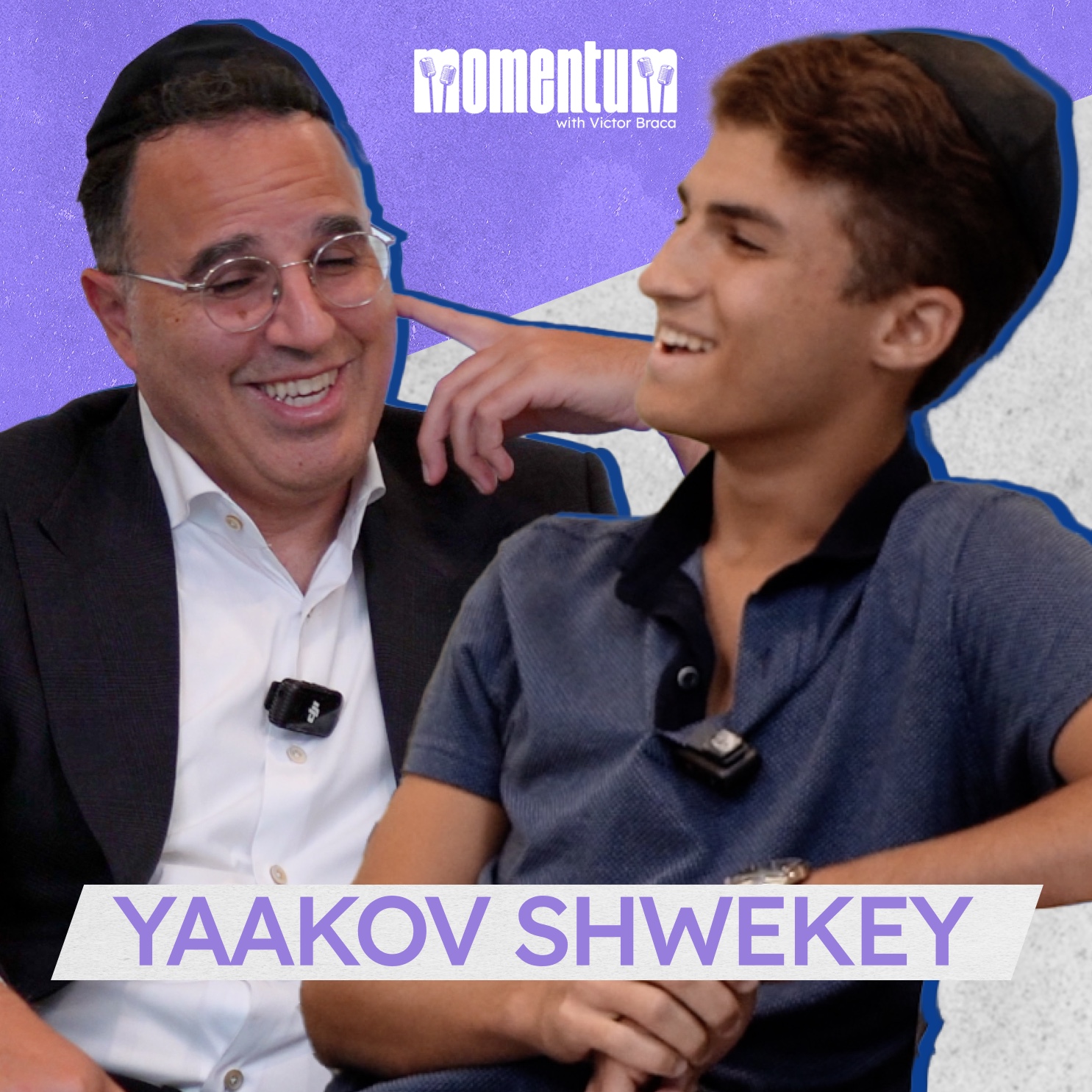


Yaakov Shwekey is a world-renowned figure in the Jewish music space. We dive deep into his journey in the music industry, from his early days to becoming a household name in Jewish music.
Shwekey shares personal stories about overcoming challenges, the pivotal moments in his career, and his approach to staying authentic while connecting with his audience.
We also discuss the importance of giving back and using one’s platform for good, and Yaakov’s passion for helping those in need through his philanthropic work.
Enjoy!
Transcript
Victor M. Braca: Hi guys, welcome back to Momentum, the show where we sit down with interesting and successful community members in order to have conversations that will inspire and empower the next generation on their journey to success. I’m your host Victor Braca, and my guest today is an icon in Jewish music, needs no introduction. Yaakov Shwekey has been making innovations in the space of Jewish music for over 20 years. Yaakov’s music has reached tens of millions of people with hits like I Can Be, We Are A Miracle, and V’hi Sheamda.
In this episode, we discuss Yaakov’s upbringing, how he initially got into the space of music, and what gave him the courage to pursue it as a career. Yaakov shares words of inspiration that are guaranteed to reach anybody, old to young. We discuss some of Yaakov’s concerts, the organization his wife started, the Special Children’s Center, and I really think you’re going to love this episode. Real quick before we start, if you’re watching this in the summer of 2024, Yaakov Shwekey is holding a concert in Deal Casino on August 27th. You can find the link to purchase tickets in the description or my Instagram bio. Without further ado, let’s get into the episode. Yaakov Shwekey, welcome to Momentum.
Yaakov Shwekey: Thanks so much, Victor. Thank you. Honored.
Victor M. Braca: Honored to have you. There’s a lot to unpack with your story and the advice you might have, so we’ll get right into it. Let’s go. So take me back to the beginning. I want to touch on your story quickly and then we’ll get to the advice you might have for the youth, the young generation. You found success in a career that many didn’t. How did you do that? What moment did you realize that that was going to be a career for you?
Yaakov Shwekey: I was a young child in a home. My parents, al shalom, were always involved in bringing the siblings together through song. Sat around the Shabbat table. As a matter of fact, working on a big Shabbat project now bringing a lot of Shabbat songs back. My parents, because of the way I grew up, I grew up in a home that Shabbat was not a burden. It was endless songs with my siblings. Amazing. So I grew up in a home that it was just a beauty to be by the meal.
But going back to my story, I mean, I grew up in that home. So my mother, al shalom, told me, “Yeah, of course you guys want to be in a choir.” It happens to be the neighbor down the block was the guy from the Miami Boys Choir. So we were there and, me, my brother, and we just enjoyed it. And then eventually I said, “Wow, I don’t see myself leaving this. It’s such a joy for me, such a connection.” You see, just even for myself, forget let alone people that are getting inspired from it. I’m like, this is what I want to do. I wish I can take this and do this and learn Torah, it’s all I want to do.
And my mother kept telling me, al shalom, she says, “I don’t know if you can make a living through Jewish music. You know, it’s not enough people. We are the smallest nation in the world quantity-wise, and how many people can you… you could do it maybe as a hobby, but don’t.” I’m like, “Ma, no, I have confidence. I have confidence I’m going to keep trying and if Hashem tells me otherwise once I get married, we figure it out.” “No, you have to go to college. You have to take a course. You have to.” And eventually I just kept pushing it off of my mother, you know, with college and everything. Of course here and there I was learning other things trying to see if it’s…
And eventually I get married to Janine Cohen from Oakhurst, New Jersey, not too far from where we are right now, Victor. And I tell her, “By the way, I sing a little bit, I think I’m going to…” What’s Jewish music like in Deal? What’s Jewish music like in your school? She went to Hillel. “It was a nice thing, it was great. You know, they sing a few things, a few songs. I love it. I love sitting with the girls,” she tells me, “and singing this and that, but it’s not a big part of our life. Didn’t connect with us so much. We go to other concerts, we go to non… you know, we go to events, we go to…”
And I’m like, you know what my dream would be? Is that this entire beautiful community, the greatest community in the world, talk about momentum, to create the momentum of music for kids to understand that the gift of music is given to us to bring to a higher level. The Vilna Gaon writes, if there was no Torah in the world, I will be dealing with music all day long. Greatest rabbis talked about music. David is the mouthpiece of Am Yisrael because he was about inner song. Deep song. Song even when he’s going through travails through life. It’s always a shir, it’s always a mizmor. Even when a son unfortunately goes against him, it’s still a mizmor, still a shir. Those type of things. And to give them songs actually with messages that we want to give our youth. The messages of I Can Be Anything, the messages of We Are A Miracle, messages of Cry No More, whatever you want.
And then eventually years later, I’ll never forget it. We did something in Hillel School, the community, and I was basically trying not to show the kids that I’m crying tears. Tears of joy, tears of inspiration, right? To see every single community child singing word for word, knowing the lyrics better than I do, and singing it with emotion. And I walked off the stage and I told my wife Janine, and I’m like, I know I sing at the Center all the time, the Special Children’s Center which we’ll get to, but to see these kids living the music and seeing your school, your alma mater that you told me years ago did not connect so much because there wasn’t so much out there for them, it was a dream come true. And then from then on, Cry No More and all the songs, and going on and on and on.
I’ll never forget one of my first concerts. I told you about my mom, al shalom, who told me to go to college. The concert was in Brooklyn College. So I invited my mother and I told her, “Ma, I think I made it to college.” She said, “I wasn’t thinking you would make it to college that way.” I said, “The truth is I much rather it this way through music.”
Victor M. Braca: Nice, nice. That was your first concert, in Brooklyn College?
Yaakov Shwekey: My first concert, wow.
Victor M. Braca: What do you think set you apart from the beginning to succeed in the field of Jewish music?
Yaakov Shwekey: It’s a good question, because Jewish music is very authentic and you have to have your message, yeah. And you can’t just repeat words of David and expect people to gravitate to it. You have to put your stamp on it. And thank God with the help of Hashem, I was able to get inspiration from youth. You always gain inspiration, every singer does from how they grow up. But then, how am I going to make this mine? How am I going to make it in a way that’s unique? I want to bring something else to the table. That challenged me not to copy anybody else, right.
I tell that to young singers today as well. They come over to me all the time and I tell them, “You can gain inspiration from me, which is great, I’m happy to inspire you. But at the end of the day to be really successful and to take it to another level, you have to be authentically you.” I like that because nobody wants a copy, right. You know those guys that copy President Trump or they’re a nice act, but they’re not the caliber. And by the way, you have to know that you have something to bring new to the table. It’s not so easy all the time because sometimes it’s just not there. And sometimes it’s okay to be in a place where you’re not the most sought after. You have to be you, and if that’s wherever you’re going to fit into the scheme of things, you have to be happy with that. But bring yourself to the table, bring your authenticity. Bring what you really feel in your heart, wear it out in the song. And you might not know what that is in the beginning. You have to find that.
Victor M. Braca: Yeah, you’re not going to get that right away, right? It’s going to take time for you to develop, to see, “Hey, this is what I really want. No, this song. No, this message.”
Yaakov Shwekey: You’re right, Victor. Takes time, yeah.
Victor M. Braca: So what was your first big break? What was the moment that you realized that you can make this into a viable career if you just kept doing what you’re doing?
Yaakov Shwekey: You know, Hashem, and thank you Hashem for the first album being a hit right away, yeah. Thank God. The songs like Racheim. It’s a song I sang at my own wedding here in Deal, New Jersey in Magen David on Deal Road. Who knew? I sang it at my own wedding, I said let me put it on the album. It became an instant classic and everyone was playing it. Till today they’re still playing that song. So I got very lucky, and it’s a gift from Heaven that right away from the get-go, the first album, Racheim, was a prayer that every single radio station in Israel… unfortunately at that time also it was bombings and every single radio station was playing it nonstop. So it was right away into the performances and I wasn’t ready for it so fast, because learning in Rabbi Diamond’s kollel and having a marriage and right away jumping to so many performances and travel…
Victor M. Braca: That was new to you.
Yaakov Shwekey: Yeah, I thought I was going to take a gradual climb, but that’s what Hashem wanted. It’s exactly what he wanted.
Victor M. Braca: That’s great. And so you know, you mentioned that your album was being played on every radio station in Israel. If you look back at the impact you’ve had in our community, outside of our community, with all ages—kids, teenagers, young adults, adults, the elderly—you’re finding that everyone’s listening to your music. How does that make you feel? Does it make you nervous? Does it make you proud?
Yaakov Shwekey: It makes me want to thank Hashem even more. Yehudi is the word, a Jew, Yehudi comes from the word thanking. And when I say every day I try to focus on, “Hey, I’m nobody more special than anybody else. You gave me a gift that’s not mine, it’s really not.” I’m not more talented, I’m not more… You gave me this gift. And it makes me so proud when the kids come over to me in DSN, wherever I am, I’m playing ball or I’m playing tennis or I’m playing basketball, or I go to shul and I see this little kid in a suit and he’s coming ready to pray for Shabbat and saying, “Hey, you had such an impact on my life.” To me that is the most…
And sometimes they always come over to me and tell me, “Hey, I don’t mean to repeat the same thing over to you, maybe you get it all the time.” Every single person that comes over to me and every child, I take to heart and I feel so thankful and so really undeserved to be a representative for their heart. The Chazon Ish writes that music is the pen of the soul. And if you can give a gift to someone to enhance and elevate their soul, which is them, which is us… me speaking to you right now is my soul. If you can give a gift… Sometimes I could write a book about the stories all over the world, but let’s even focus just on Deal, New Jersey. How many kids told me… I was just walking Shabbat the other day. A guy stops me, I never met this guy in my life, I’m coming back from Park Avenue. He almost made me cry with the story of inspiration, how the music has helped him in life.
Victor M. Braca: That’s so nice.
Yaakov Shwekey: I mean, he goes, “I’m sorry to stop you for so long, it’s hot.” I’m like, “No, no, no, I want to hear your story.” And I came back to my wife, I’m like, “Janine, this guy, I never met this guy before. I’m walking from Park Avenue to the house. He had life-changing stories through the music.” And she’s like telling the kids about it. Some of my kids are young, so it really makes a difference if you can give somebody the gift of moving their soul and connecting them more to not so much an esoteric way of life, but a connection to your heart, to your soul, and to feel.
I want people to walk away from a concert… talking about a concert now that we’re going to be doing here in Deal, New Jersey, which is really the concept of bringing the community together, August 27th, for the Special Children’s Center. Light Up the Night.
Victor M. Braca: We’ll put a link to it.
Yaakov Shwekey: Put a link. We can’t wait for everyone to see you guys there, to really, really light it up. It’s coming closer. Get your tickets through the link. But to see the community come together and dance and sing and connect, special children, the volunteers, it has changed the entire scope of… You can’t put it into words. Music, you just feel it. You come, you see the stage, and you’re singing… Can you imagine we’re going to sing United We Stand? There’s a song United We Stand all about what happened on October 7th in Israel, and we’re going to sing that song. How together we are even through challenges, through travails that we’re going through as a nation, because we’re all one. And we’re going to sing United We Stand August 27th together with the Center. The feeling that’s going to be there is something that you can’t put into words. So how can I… I can’t overstate it to you, Victor, how I feel.
It’s the greatest job in the world I have. It’s a job I would never give up for anything else. You get on stage, I just sang a few nights ago in the Catskills, Ashaz Camp, all these kids. I just walked off the stage. Of course I was sweating, but my heart was just elevated to say thank you for every kid, no matter who they are, around the world. Whether I sing in Paris, in Mexico, or in the Catskill Mountains, or in Deal, New Jersey, for them to connect in such a way to the music and be elevated, and for them to get that into their life, I think it’s something that I thank Hashem for every day and it’s a huge, huge gift. There’s no question about it.
Victor M. Braca: That’s so nice. And you can hear the passion from you coming through, which is great.
Yaakov Shwekey: Got to be passionate, Victor. Momentum is about passion. You have to go all in on something. Sometimes even a song you hear, if you hear the singer not all in it, and not even the successful singers of old, of any… if you’re not totally in it, feeling every note, feeling the message you’re singing about. Especially us, we’re singing about… what are we singing about? Every generation they try to annihilate us, but we are a miracle. We are the greatest miracle in the world. The fact that singing these messages and feeling… we could just close our eyes and think about the words, United We Stand. The way we’re going to go through this challenge of Israel and Iran and all the news and all, and just close your eyes and connect and pray to Hashem that through the unity…
Through the fact that I’m going to help someone else after the night of the concert. The next day, you never know, a child may run from shul and go give an extra dollar to someone he’ll never know. He’ll make an extra lemonade stand to give to a charity. You never know the momentum that is going to cause people on their own. Not because we’re preaching anything, on their own. Because I see this all the time, they close their eyes at a concert and they think about the message of the song. And song is not a class. Not sitting there and listening to somebody speak to you and it’s not that you give in your own class. You’re closing your eyes and you say, “Hey, what’s my song? What is my song to bring momentum to the world, to make the positive momentum a better place?”
I think about it too while I’m singing sometimes, and I close my eyes. What can I do more? What could I do more for the Jewish people? What can I do more for my community? Am I doing enough? Am I really doing enough? Can I go to somebody’s house and uplift them? I really think about it all the time in a positive way. Close my eyes and I pray to Hashem through song, and that is the highest way to pray. We just had the parasha, the gematria, the numerical value is shira. The way Moshe Rabbeinu was successful in his prayers was through a song.
So think about it, Victor. Close your eyes next time and listen to the song and the AirPods or wherever you’re listening to, and think about the message. By the way, unity is not always going to be easy, but what can I do for the Jewish Nation? What can I do more? And you, Victor, by the way, you doing this podcast, I don’t know, I’m sure it takes work on your part. You come here with notes, I see you coming here prepared. It’s such a beautiful thing, you’re singing your own song of momentum bringing, “Hey, I’m good at this. Not only am I going to interview people, I’m going to find a way to let the youth connect and realize that they can do other things as well.”
Each one can have the confidence that you’re good at something. Look what you could do with technology. This podcast is going to go out, you never know some kid in Yeshivah of Flatbush where you went to school, or in Magen David, or in Hillel School, or in yeshiva in Deal, you never know can hear this podcast and say, “I have a song to sing. I do feel that confidence.” The main thing is, and the reason why we wrote I Can Be Anything is because of that. I saw that even around the world that children, a lot of them, the only thing they lack is confidence. They have the greatest gifts. Each one of you listening here today has tremendous gifts. Understand that. Yeah, it might be different. Every single hand is different, every single mark is different, but know that you have a gift to bring to the world. And Victor, you’re singing your song proud and great.
Victor M. Braca: I love that, the way you put it, singing your song, because people connect with that. It’s amazing. You have a song called I Can Be, and I want to get into the passion end of things. You mentioned passion, and a lot of young adults nowadays are worried about the intersection between passion, following your passion, and making sure you’re making enough money for your family, to raise a family, to raise a wife and kids. And I want to know what you think about that, because you were able to successfully follow your passion and make a career out of what you love. You can tell by the way you speak about it.
Victor M. Braca: Hi guys, sorry to interrupt the episode. I just wanted to pop in and ask if you can like, share, comment, subscribe, follow us on Instagram, YouTube, Spotify, Apple Podcasts. We’re on all platforms. We’re trying to spread the podcast to the entire community, so anything you’re able to do is much appreciated. Thank you so much, back to the episode.
Yaakov Shwekey: I’m moving up on the chair because I heard the word passion. I just think that that’s everything. I really do. You see it throughout the books, even through rabbis and you name it. Hashem wants your heart at the end of the day, He wants your heart. And if you’re not passionate about something, it says all the curses and everything that came upon, the negativity that came upon the world, is because you didn’t work on being happy with what I gave you. Everything you have. It’s not always easy. You go through things, life will throw you different waves. I see that through the passing of my parents this year, not always easy. But at the end of the day, you have to reach down. We all have a song to sing, like I say always. We all have a song. Now, it might not be in music. And you’re right, you have to make a living, but I see people… there’s so many examples, so many people that have made money, but yet are able to balance out, “Hey, what am I going to do with this money? Am I just going to have my name here, my name there, or am I going to go to the organization? I’m going to bring my children.” I see it with the Special Children’s Center. I can write a book about people who are just besides their generosity through loving, but they came.
Talk about Stanley Chera, al shalom. Just thinking, he didn’t just give us a check. He could have easily said, “Hey, I’ll…” I’ll never forget the first time he came to the Center, Special Children’s Center in Lakewood, the flagship. I’m like, “Stanley, you got to come. You have to come to the flagship. Beautiful.” You ever went there?
Victor M. Braca: Mm-hmm. Beautiful.
Yaakov Shwekey: It’s gorgeous. He came, he cried for seven minutes straight. He actually walked out and I thought, who knows. But he came back and he says, “Yaakov and Janine,” he tells my wife, “I’m going to do whatever it takes to help. And you can mark it down, you could come to the city.” And since that meeting, he was so in love with the place, so in love with the purity of the counselors, of the hired staff, of everything that’s going on there. The therapy rooms, the music room. That he said, “I want to just build with you.” And he came not only once, he kept coming back. Went to his office, and that’s what he took with him.
Victor M. Braca: That’s great. He didn’t just write a check.
Yaakov Shwekey: Oh, you know what, here you go. Come spend time. Understand that the money is a gift, you don’t take the money with you. That’s what he took with him. The generosity, the love. Every child… holding the kids’ hands, dancing with them. Yeah, money could be used in such an unbelievable way. Go spend time with people and spend time with the kids. And first of all, you see it in this community too, how beautiful the people are. How gracious, how generous. Spending with their time too, not only with money. It’s just beautiful to see. And I think that that’s… you’re right. The priorities. Listen, you have to make a living, there’s no question about it. But if you’re passionate about something, Hashem will find a way to give it to you. You’re passionate and you pray, “Hashem, besides a living, I want to just… I’m passionate about getting my kids to another level, to show them that I’m not just spending on myself. I have a much broader world, it’s not only about me.” The kids have to see that I’m living for others. Judaism is that way. Rambam says the world was created for others. Yes, you have to take care of yourself. Yes, you have to make a living, but is that the primary? Of course that’s a mitzvah too, take care of your own children, there’s no question that comes first. It’s your family, the responsibility, there’s no question about it.
But the greatest upbringing for your kids is… and by the way, if somebody deals with the community and somebody goes out of his way for others, there’s a promise and a guarantee from God that they will be taken care of. And you see it all over the place, you do. You know, that’s the right upbringing for your kids as well, to see that hey, my parents, yes, we have a nice house, yes, okay, we have a nice car, but what’s their passion? What they really care about, right? Do they really care about that, that’s here one day, gone another? The next model is around the corner, right? And it’s a spin wheel. Now, I’m not saying you shouldn’t be happy with that. I love that too, I thank Hashem for it. But that’s not the inner joy. It’s not where you find fulfillment. There’s no fulfillment in that.
There’s a great quote. Rabbi YY Jacobson says it over, one of my favorite quotes of all time. Says, “What is true love? A wise man once said, what’s true love?” He says, “True love is finding the song in someone else’s heart and singing it to them when they have forgotten it.” Sometimes we all have a song, sometimes we forget it. You’re right, life throws you, you know. And your job as a friend and as a family member and as a spouse or whatever it may be, is to remind the person that he has a beautiful song inside of them. A lot of times I see the kids and they don’t realize how talented they are, they don’t realize how great they are. We don’t realize our own greatness sometimes. I always tell them, “You got to know that you’re beautiful inside, you have such gifts. Such joy in you.” It’s a matter of you just saying, “Hey, I’m doing it. I’m doing it.”
Victor M. Braca: I love it. I love it. You mentioned the Special Children’s Center, I want to get into that a little bit, because taking away your music for a second, even though it’s deeply intertwined, the impact you’ve had there is amazing. So tell me a little bit about that. How did that come to be?
Yaakov Shwekey: I got to sit up a little more for that one. This is a big one. The gift of the Special Children’s Center is something… you’re right, you said it very well, I didn’t realize that the music and special children are so intertwined. The greatest of rabbis, like the Chazon Ish, stood up when a special child walked into the room. His helper told him, “Rabbi, I’ve never seen you stand up for anyone.” He says, “You don’t see what I see. You don’t see what I see. I see such a high and elevated soul and I stand up for them.” They have such a purity, the special children. Such a high neshama. When they hear a song, they hear it differently than we do because the neshama is so high. So when I sing and the special children are there, I just feel in the air that there is an elevation of spirituality that you can never get with others.
And Janine and the Center, I got to tell you, you talk about passion. Till today, over 25 years in. They started when they was 16 years old, sleeping in somebody else’s home, and realizing the challenge and the burden and the hardship of dealing with a special child. And they said, “You know what? I want to take your burden from you. I want to do it.” Janine, you didn’t have to do it, why did you do it? “I just wanted to do it. I didn’t want to just go around in the mall shopping my whole teenage life. I wanted to do something to change the world.” Talk about fulfillment, unbelievable.
And as I’m even going out on dates with my wife-to-be, she’s busy picking up children with her own car. She didn’t have buses back then. And the mothers are dropping off the children and slamming the door quickly because they’re embarrassed to show their face to my wife, to Janine. And she says, “My dream is that I’m going to change the world for special children. They’re going to be proud to bring their kids into my building. They’re going to be proud that we have a beautiful therapy pool for them, and they’re going to be proud to say that we’re one big family.”
And you know what? Through passion, through drive, yes, through hardship. Not a dollar to their name as they started. They took their own personal money. They called up Richie D, God bless him, “Give us… call a guy to give us towels, we don’t even have towels. Call a guy to give us food.” Just from the beginning, all the way from the beginning. And they’re still there by the way. Richie D is still with us, Harry A is still with us. They were there from the beginning. It is astounding to see that the passion 25 years later through so much. But go look at the building. I invite anybody who’s listening to this podcast, you don’t even have to call me, go drop off… go bring your kids. They bought a farm actually also with horse therapy. 30 acres, wow. In between Deal and Lakewood by the way. They take the special children on horses. They have 30 acres of farm. Whatever they can do to help special children.
I invite whoever is listening now to go there. Do yourself a favor, you don’t have to give a dollar. Just go and feel what I never felt. More happiness… never. I’ve been on stage, I told you I love music. I’m switching gears from music to the Center now. I’ve never felt more happiness standing on stage in the music room of the Center with the special kids all around me and singing music and just connecting to the higher worlds with there… with just them, their purity and their souls. It’s something astounding to feel and to see.
The greatest of rabbis have come to the Center and told me the same thing. The kedushah that you feel with these children because they’re pure, they are pure. There’s no sin. These kids, we have to… every Yom Kippur we have to fast, which is coming up and it’s a great gift we have to do that. They don’t. They’re always pure and they’re always just free of just any inhibitions. They don’t want anything from you. They’re not giving anything… yes, by the way, I always say they’re doing us the greatest favor by letting us work with them. Janine has a list of hundreds, especially in the summer in Deal, that want to get in to work with the Center. The volunteers are phenomenal. The girls, it changes their lives, and they realize it too. That’s how special this community is, they’re waiting online, they can’t get in.
It’s just astounding to see how many people that has changed. And it’s almost a thousand families just in Lakewood alone. There’s two intakes every week. There’s an average of one to three intakes, I should say. And we just did the basement over, we got the new classrooms. I remember Stanley, al shalom, I remember the people that have helped us and the people that are just doing it now with just… yes, it’s work, it’s effort, it’s passion. But nothing great in this life comes without work and passion.
Victor M. Braca: As you know, the podcast is called Momentum and we try to… I’ve used that word a few times for you, a couple. We like to pinpoint what we call the momentum moment in our guests’ lives where they saw what they were doing… for in your case, it would be your music, and they realized it was starting to catch on. They realized that they were starting to pick up steam, build up momentum, right? And we try to replicate that, right? So I want to hear from you, what was your momentum moment and how did you throughout the rest of your career replicate that to see further success?
Yaakov Shwekey: There’s many moments. I’m trying to find, you know, which one to share with you here because we could sit for a long time. There are a bunch. I would say one of the greatest momentum moments is I was on a boat in Tiberias and doing a bar mitzvah for Steve Dayan’s son. And this lady called me that day, she heard I was in Tiberias. The father actually, the husband called me, he was one of the Chief Rabbis in Tiberias, and he says, “You won’t believe this story. My wife had very complicated brain surgery she had to have. We went around the world and we sought rabbinical advice in Israel, and they told us to do it here and there was a 50/50 chance she was going to make it. And they said they’re going to do it… we decided to do the surgery, we’re here.” And he’s telling me this on the phone on the way to the boat. “And we did the complicated surgery and they said it was going to be seven days left, she’s going to be in a coma and we don’t know what it’s going to be.”
And it was the sixth, seventh day after the surgery and she’s in a coma. And this rabbi father is talking to me and he said, “I’m taking care of all the kids and I come outside, taking the briefcases of my kids to take them to school, and I hear the song Racheim. I sit down, I cry for my wife, and I pray to Hashem that everything should go well. But I take the next step and I go, I run to the store and I get this album.” Said, “Who’s this guy Shwekey?” He put on an album, he doesn’t know who I am. He said, “I take your album and I take the disc. Remember there were CDs, Victor. I don’t know how old are you, Victor? Before my time.”
Victor M. Braca: I’m before your time, you’re 17. I had CDs.
Yaakov Shwekey: But it’s amazing, like yesterday it was just CDs. Yeah, but, “I take the CD player,” he tells me, “and he runs to the hospital where his wife is. And I run through the doctors, they think I’m crazy, and I put the headphones on my wife, she’s in a coma, and I play the song Racheim that I just heard because I cry to it and I want her to feel it. But she’s not waking up. And as soon as the song ends, she opens up her eyes and she said, what was that?” She gets out of a coma and the doctors are there, they’re in a different world. They couldn’t believe what they see. And she said, “I felt my neshama just wanted to come out and I opened up my eyes and the song brought me back to life.” He’s telling me this, this guy. And I’m like, “Rabbi, I can’t even say the story over because I’m not the one to say such a story, because nobody’s going to believe me.” Talk about a momentum moment.
I tell him, “I want you to come on the boat. I’m inviting you to come and I want your wife to speak to all of us on the boat.” Community members, you know the community does bar mitzvahs, a lot of community people come as our family. “I want her to speak.” She came, she spoke. There was not a dry eye on the boat, I’ll never forget it. Steve Dayan still speaks to me about that boat ride. That was a momentum moment because it was the beginning of my career and I couldn’t believe the power of music. You talk about a woman in a coma and her seventh day where the odds are the numbers, and a husband goes and plays her the song and she feels a certain… I said, “Can you imagine what the music does for us and our… sometimes thank God we’re alive, thank God we’re talking, thank God. But realize the power of music.”
And by the way, it could go the other way too, Victor. If you listen to the wrong music and you listen to what they want to sell you on social media and you listen to what YouTube brings you. The fact that we have the greatest technology, we don’t have CDs anymore, it’s great, but it’s also a double-edged sword. They want to throw you their messages and they want to throw you whatever the hit is out there. And it’s not the messages we want our youth… and I’m not even talking from a rabbi, you know, religious standpoint. I’m talking about from a normal parent, yeah, that wants their child to grow up normal. Look at the anti-Semitism, look at what they want to sell you. Look how you… and by the way, I don’t see the news either. I don’t have to see the news. Every now and then, Israel, I hear something, I’ll go.
They want to alter you when you have your phone today and you just want to uninhibitedly just see whatever you want. It’s going to affect you. It’s dangerous. It’s just the music, the music should be there. The right music, the right messages. Close your eyes and connect with yourself and understand.
Yeah, and by the way, we’re putting out an amazing… I got to talk about this… an amazing dance song in a few days, fresh. I’m just thinking about it now to tell you. It is one of the most energetic dance songs, especially in English, that I’ve ever put out for sure. The inspiration was Rabbi YY Jacobson, who’s my friend, who’s a world-renowned speaker. Talked about his grandmother, Victor, listen to this. She goes to the Rebbe and she asks the Lubavitcher Rebbe for a blessing, but she said, “I don’t want just a blessing. I want you to get rid of my fears and anxiety.” And the Rebbe looks at her and he knew she knew how to dance. And he said, “I want you once a week to go to a wedding uninvited and dance for others. Dance your fears away and come back to me in 12 months. But you don’t have to know the people, just dance. Just be happy for others.” And 12 months later, she came back, she said, “Everything is gone. I’m going to dance the rest of my life.” And she did. Once a week to a place uninvited. Not to go there to eat, not to socialize, to dance. And dance she did.
The last night of her life, she had a grandchild’s wedding. She was in the hospital and they all came back because she was missing the wedding obviously, and they danced around her bedside in wedding clothes as her neshama was returned to her Maker. Hashem said I wanted you to go out that way as well, dance for others. And I took this message, I said, “Hey, so many people have anxiety today. So many people are taking who knows what and fears and yeah, rightfully so, we’re human beings, we have fears. I want to do a song where you could just dance and dance your fears away.” That’s what the song is called, Dance Your Fears Away. It’s coming out in a few days. We did the video at the Center with the special kids. Beautiful. Jackie Franco is there dancing, doing his moves. He’s asking me actually in shul this morning, “When is it coming out?” We’re working on it. There’s robots, there’s, you know, AI involved in this. But it’s just an amazing concept and that’s coming out. We’re doing that, by the way, we’re doing that live August 27th at the Center. Light Up the Night.
Victor M. Braca: See you there.
Yaakov Shwekey: See you there. Click on the link and we are going to dance and sing like the community never did before.
Victor M. Braca: Beautiful. I’ll put the link to the song as well.
Yaakov Shwekey: Save link, yeah. Working on finishing it.
Victor M. Braca: Amazing. Okay, Yaakov, thank you so much for coming on. There’s so much to learn from you in terms of… taking away music for a second, obviously you’re a musical genius, but business success and you’re humble. Business success, passion really, so much. In fact, anything else you want to tell the youth?
Yaakov Shwekey: I just want to say that to the youth, we have the greatest community in the world. I really feel that way. Rabbi Diamond, I’m lucky, lucky to be so close to Rabbi Mansour, Rabbi… you name it, there’s so many rabbis you can go on and on that are just phenomenal people. I’m telling you, the youth, your world is a beautiful world. If you don’t focus on the negativity and your momentum is your song to sing. Beautiful. You have a song to sing and you will do it if you just focus on the positive and focus on the gifts. That’s what I got to tell you. And we got to sing together till Mashiach. We’re at Mashiach’s door, there’s no question about it.
And it’s not a fear. Rabbi Diamond told me many times, the youth have a… it’s the wrong way to look at Mashiach. Mashiach’s world is going to be a world where we can bring out our talents even more, where we can connect even more. We’re not everybody, you know, sending us anti-Semitic this and this and that. It’s not going to be that world. It’s a world without fears, without anxiety, just dancing and singing through Torah of course. And through healing so many people, nobody’s sick anymore, nobody… that’s the world we want. So continue to sing, continue to find the song within you. Listen to the right messages and focus on your beautiful community, the beautiful world we have. And Victor, guys like you that are going and using their talent to bring inspirational momentum, really inspirational momentum to people. You’re giving them gifts and you’re using your talent for the right reasons. So continue to have success, Victor. It’s an honor to speak with you. Like we should sing together in harmony.
Victor M. Braca: Amen. Thank you. Thank you so much. And my neighbor by the way, you don’t live too far away.
Yaakov Shwekey: That’s right. You’re right there. I’m right here.
Victor M. Braca: Beautiful. Well, we’ll get together. I’m sure your parents are proud of what you’re doing. Thank you for coming on, thank you for the kind words. Thank you for sharing your inspiration really, and looking forward to see what you have in store for us in the future.
Yaakov Shwekey: That’s it. Well, we’ll keep working, we keep working. August 27th, we’ll see you there.
Victor M. Braca: See you there. Take care.
You made it to the end of the episode. Thank you so much for listening, for watching. If you’re watching on YouTube, please leave a comment, Instagram, share with your friends, Spotify, Apple Podcasts. We’re on all platforms and we’re trying to grow the podcast to the entire community, so anything you’re able to do is deeply appreciated.
Just to get a quick recap of today’s episode, Yaakov stressed the importance of passion, having passion for what you do. And as Yaakov said, if you have the passion, the drive, and you work hard enough, Hashem will reward you. We spoke about the importance of touching people’s souls, especially with music, which while it isn’t inherently related to business, can actually connect to a business principle if you think about it. At the end of the day, all consumers want to feel touched and appreciated and loved, and if you’re able to provide that on a large scale, you will be successful. Yaakov’s journey is proof that even in an industry where many say it’s impossible to succeed like entertainment, or in a category that some say is way too small like Jewish music, you can prevail.
If you liked this episode, you’re going to love my interview with Alan Shamah. Alan is the co-founder of E.L.F. Cosmetics and he watched it go from a ground-up startup to a $10 billion company. That conversation was amazing. If you’re watching on YouTube, you can click here to find it, or on Instagram in our story highlights. With that said, thank you so much for watching again, and until next time.