

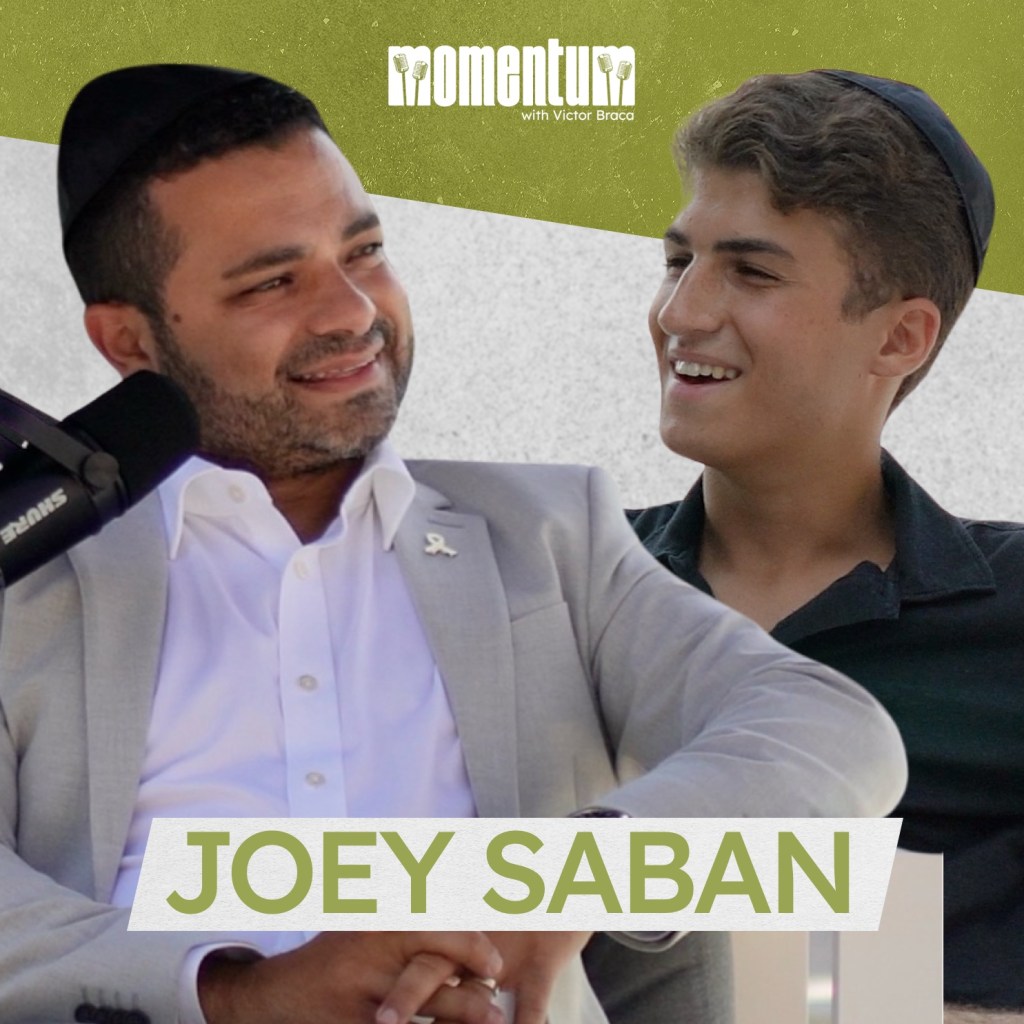




Joey Saban is a community member running for New York State Assembly in the 45th district. Joey shares his journey from growing up in the community to pursuing a career in politics, driven by a deep passion for service.
We discuss his reasons for running, the sacrifices he’s made, and the key issues at the heart of his campaign: crime, education, and community resources.
Tune in to hear Joey’s vision for the future and why he believes winning this race is critical for the community’s future.
Enjoy!
Transcript
Victor M. Braca: Hi guys, welcome back to Momentum, the podcast where we sit down with interesting and successful community members in order to have conversations that will inspire and empower the next generation on their journey to success. I’m your host, Victor Braca, and I have a little bit of a different episode for you today.
I sat down with Joey Saban. Joey is running for State Assembly of the 45th District of New York. We delved into his high school and college days and what got him into politics. We talked about why he values community activism so much, and he shared the advice he has for young adults with that drive for success. I know I say this every time, but this was really a great conversation. You’re really going to enjoy it, and let me know what you think.
Joey Saban, welcome to the podcast.
Joey Saban: It’s good to be here. Thanks for having me.
Victor M. Braca: It’s great to have you. So, you know, you’re not our typical guest, so to speak, in terms of—you know, we try to stick to business-focused episodes. But I want to have you on because I want to hear about your story. I want to hear about why you’re running. You’ve come around to schools and community shuls, but I really want to delve into your early days and some of the action points of your campaign. So I’m excited to have you on; it’s going to be a good conversation.
Joey Saban: Awesome. First, thanks for having me. I heard a lot about what you’re doing and I heard a lot about the podcast. I think this is amazing. We don’t get a lot of chances and opportunities to do this on the campaign trail, so this is fun. I’m looking forward to it.
Victor M. Braca: It’s fun; it’s going to be good. So let’s just take it all the way—before we take it all the way back, actually, what are you running for and why are you running? Give me the rundown.
Joey Saban: I’m running for State Assembly in New York’s 45th Assembly District. Why am I running? This kind of goes into why I love politics and why I’ve gotten involved over the years.
When I was in high school, sophomore year, I didn’t know what I wanted to do, obviously, like most people. I didn’t know what clubs or commissions I wanted to join. And we had this assembly—I remember this gentleman, his name was Jonathan Kessler. He was AIPAC’s Leadership Development Director at the time, and he came to speak at Flatbush. I was blown away. Blown away.
Obviously, he was speaking about the importance of a strong U.S.-Israel relationship. You take something like that and it’s on a really, really large scale, but what he did was he brought it home. He talked about how at 14, 15, 16 years old, you can actually have an effect on U.S. foreign policy. You can actually effectuate change. You can benefit, you can promote the U.S.-Israel relationship.
His speech was extraordinary. After he spoke, I walked up to him and thanked him for coming to Flatbush and said, “Can I have your business card? I’d love to follow up.” All the stuff that they tell you to do always.
Victor M. Braca: Typical. Typical.
Joey Saban: Typical stuff. And so he looks at me and he says, “What would you say if I invited you to join 400 other high school students from around the country in Washington, D.C., next week to learn about how to support a strong U.S.-Israel relationship?”
Victor M. Braca: Wow. Were you the only one that came up to him?
Joey Saban: I was one of the only ones. And so, of course, I was like, “Washington? Free? 400 other high school students? Of course, count me in. I’ll take it. I’ll take it.”
A week later, myself and three other friends, with a chaperone, were in Washington. The program was not only eye-opening, it was transformative. It completely changed everything for me. It really leads me to where I am today.
I remember on the last day of the program, we were on Capitol Hill. We went to meet our local member of Congress. I remember leaving the congressman’s office and walking down the hallway in the House of Representatives, and I see the flags lined up. I’m thinking, like, I’m 15 years old. I’m standing at the epicenter of American democracy. I just left my congressman’s office. I’m 15. This is the greatest place on Earth. This is what I want to do.
Victor M. Braca: 15 years old.
Joey Saban: 15 years old. And that’s what triggered my passion. It’s a passion for really getting things done, for bringing back to your community, to your neighbors, your home, your neighborhood.
Over the course of the years thereafter, you know, going back to Flatbush and creating new organizations and commissions, and going back to Washington and lobbying and getting involved with AIPAC on college campus when I was first at Brooklyn College and then at the George Washington University, where I ended up graduating from. That passion just kept building up. It started from high school, started from when I was 15.
That’s why I find this so fitting. We’re talking about having a passion, having something that you love, right? No matter what it is. Sometime, you know, out of nowhere, that spark’s going to come. The question then becomes what you do with it. You might have an opportunity—what do you do with that opportunity? How do you transform that spark and turn it into effective action, something that will ultimately lead you down a road, down a path that could be transformative?
Victor M. Braca: I love it. So how did you take action following that moment of inspiration? What did you do?
Joey Saban: Came back to school. Again, still 15 at this point. Came back to school and I was like, “All right, so how do we—what do we do? How do we actually make change? How do we help Israel as high schoolers?”
We started the Israel Activism Commission at Flatbush. It used to be Israel Awareness; we turned it into Israel Activism. We turned it into an offshoot, a branch of AIPAC’s high school program at Flatbush. It was, I think, one of the first schools in the community to do it—the first school to do it.
We did the first-ever lobbying mission where we packed 50 students from Flatbush on a bus, took them to Washington for a day to meet their members of Congress and to have that experience. We did symposiums, we invited other schools to get involved, we created a base for support of an issue that we know everyone cares deeply about.
It grew and it grew. I think that even when I graduated, the work kept going. People kept following that foundation, that framework, and kept building on it. I think the organization is still there today. I don’t know what they do now, but I think it’s still within that same framework.
Then when I graduated high school, I went to Brooklyn College for two years and I started doing that at Brooklyn. It was—my first semester in Brooklyn College—
Victor M. Braca: Your first semester in Brooklyn College?
Joey Saban: My first semester in Brooklyn College, and I get a call from a friend of mine at AIPAC. They said, “We have a big race in Brooklyn, a congressional race. We can’t tell you who to support. We want you to look up the two candidates and call us back as soon as you can and let us know what you think, because one of these people we really need to mobilize.”
Okay. So I go online, I look up two people. One of them is Hakeem Jeffries and the other one is Charles Barron. Charles Barron is a known anti-Semite, hates Israel, disaster. And Hakeem Jeffries—moderate candidate, good guy. I call them back and I’m like, “Listen guys, I mean, I don’t know about you guys, but this guy Hakeem needs to win.”
Fast forward to today, and he’s the Minority Leader in Congress.
Victor M. Braca: Very cool.
Joey Saban: Yeah. So we mobilized for him. Over a hundred young people in the community, in the district, mobilized for him in his first race for Congress. That really inspired me even more to get involved.
Two years later, I transferred to the George Washington University because I wanted more. I didn’t feel like I was getting what I wanted in Brooklyn. At GW, that was probably the best two years I ever had, really getting involved in politics, learning about it, focusing on International Affairs, and being able to take my activism to a whole new level.
I got there and I jumped in as a junior. I came in as a junior who didn’t really know much about anything on campus. You go there and you’re meeting your roommates for the first time. I grew up in a bubble, obviously, like most people in our community. Never left home. It’s the first time that I just went away.
I jumped in. You walk into this dorm and you’re meeting your roommates for the first time—and mind you, they’ve been there for two years and you’re a junior and you’re coming in like, what the heck is going on?
Victor M. Braca: It was like a culture shock.
Joey Saban: It was a culture shock, but it was an unbelievable experience. At the end of my first year at GW—so came in as a junior—end of junior year, I talked to a few of my friends and I’m like, “I want to run for the class council, for student government.”
And they’re like, “Are you crazy? You’re the new kid on the block. What are you talking about? People who’ve been here since freshman year, they’re the ones who have the support, they know the people.”
“No, no, no, no, no. I want to do this. I want to run. I think I can win.”
I end up running and I end up winning. I did the same thing with the Jewish Student Association. “What are you doing? You’ve been here for less than a year.” I ran and I won.
When I did that, I developed this love for public service and also for involvement in things that can make change, right? Whether it’s on a small level, whether it’s wherever you are in life—whether you’re in high school, whether you’re in college, whether you’re in post-college community level, whatever it is. It inspired and invigorated a love, a passion for community service, for being able to give back and for being able to solve problems that unfortunately people might be going through.
At Flatbush, the issue was how do we support Israel on a high school level. In college, it was how do we fight BDS and how do we make sure that the Jewish students are well represented, and how do we make sure that we have funding for the institutions that we need.
When we came back to Brooklyn, when we came back home, it was on a community level. How do we make sure that our institutions are well served? How do we make sure that we are well represented?
Then two years ago, a longtime friend of our community, Steven Cymbrowitz, was unseated by the guy that I’m running against now. Steven Cymbrowitz, for many, many years—he was in office for 21 years—has given our community a lot and has supported us and helped us in everything that we’ve needed and everything that we’ve wanted.
He gets unseated by the guy who’s there now, Michael Novakhov, who has provided us with nothing, who hasn’t walked into a shul, hasn’t stepped foot in a single institution. To me, that turned into a call to action similar to what I experienced in high school, similar to what I experienced in college, and then after in community activism.
It was a call to action that said that we have to make sure that one of us steps up in order to ensure that our institutions are well served. We as a community built everything that we know in South Brooklyn: our schools, our shuls, our community centers, our institutions from SBH to SAFE to the Cancer Center—I mean, the list goes on.
We’ve built those institutions, we’ve built everything we know in South Brooklyn. We became in large part the fabric of South Brooklyn. The success and the future of those institutions are predicated on our ability to make sure that they are well served. If we don’t, then they deteriorate. If they don’t have the funding that they need, they can’t operate. If they’re not getting the resources they need, then families in our community that depend on them get affected and get hurt. We can’t afford that.
So to me, it was a call to action. I decided at that point in time, one of us needs to run. One of our community needs to jump in. We have to make sure that our community, our institutions, and our schools, shuls, etc., are well served. That was the thought process that led to me ultimately deciding that I’m going to jump into this race and beat this guy, so our community has what it needs.
Victor M. Braca: Love it. So going back to your college days at GW, how’d you win?
Joey Saban: It was a lot of retail engagement, one-on-one conversations. That’s what it is. You know, one person, micro-level, that’s what it is. Politics is on a micro-level. When they say all politics is local, it’s true. It’s all local and it’s hyper-local. People want to know that you care. People want to know that you’re genuine about what you want to provide and bring to them.
And people want good ideas. Let’s think about it. You hear about promises a lot, right? “I’m going to do this for you and I can get you that and I can bring you this.” You hear it all the time. Every couple of years there’s an election and everyone talks about what I can do. But rarely it actually matriculates into anything.
The funniest thing to me—I always say this, the thing that really I think is laughable—is when you have elected officials who have been in office for like 30 years and they run and they tell you, “If you elect me, if you vote for me, I will do ABC.” I mean, come on, man. You’ve been in office for 30 years. If you haven’t done it yet, you’re probably not going to do it. Chances are.
So I feel like people want to know that they have an ally, they have a friend, someone who’s personable, somebody who’s approachable, and someone who cares. That’s why running for office—back in college, now, whatever it is—it’s on a hyper-local level because you want people to feel like they can approach you. You want people to feel like you care. You want people to feel like you’re the real deal, that you’re actually the person who’s going to get stuff done. That’s how I won in college. That’s how I intend to win now.
It goes also further than politics, right? It goes into business.
Victor M. Braca: I was going to say—but even into everyday life where you’re selling a product, a business, your company, yourself, right? You’re trying to form relationships with people and they need to know that you actually care about them.
Joey Saban: Relationships are everything. Someone once told me a quote: “It’s not who you know, it’s who knows you.”
Victor M. Braca: Ah, interesting.
Joey Saban: And the more you work on who you are—if you are the go-to for anything… you want to do a podcast, who’s the go-to? If you are the go-to, you want people to know that you’re the person that they can reach out to if they need to handle A, B, or C.
That’s across the board. It’s in business, in real estate, in politics, in sales. No matter what you’re inclined to do in your life, the relationships that you have and the relationships that you develop, those are the things that are going to guide you and take you.
It doesn’t matter as much where you go to school, where you graduate. A lot of people are so preoccupied—and I remember this from high school—you’re so preoccupied with “Where am I going to go to college? What am I going to do?” All that’s important, it is. But what’s more important is what people know you for. What’s more important is what people remember you as and the relationships that you build over the course of time. If there’s anything that you get out of this, it’s build those relationships. Relationships matter.
Victor M. Braca: I love it. And on that point of relationships and interacting with people—like you said, everything is individual, all politics are local—how have you over the years honed your public speaking skills, your ability to communicate? Because I’ve heard you speak, not just here but also in a public setting, and you’re a good speaker. I’m interested in that part of it because that also carries over into all other aspects of your life. Public speaking is people’s number one fear generally, and it’s very important. So what are some tips you have for that?
Joey Saban: Over the years, always consider everything a conversation.
Victor M. Braca: Interesting.
Joey Saban: Always consider everything a conversation. It doesn’t matter how many people are in the room, you’re having a conversation with them as though you were having a conversation with one. If you look at it like that, it changes the approach.
If you’re giving a speech, you have a message, you have something that you want to get across or something you want to get through. That message would be the same whether you spoke to a hundred people or one person. If you look at it like that—my goal is to send the message, my goal is to relay the message that I’m trying to relay to connect with the person or the people that I’m trying to connect with—then it flows naturally.
A lot of people think that public speaking is about preparing a speech in advance, and sometimes it is depending on what your crowd is, but always remember that at the end of the day, you’re having a conversation. If you use that as your metric, if you use that as your compass, so to speak, then you’ll get through the fear of public speaking almost immediately.
Victor M. Braca: Hi guys, sorry to interrupt in the middle of the episode. I’m going to make this really quick. I just want to tell you, please share the podcast, like, subscribe, comment on Spotify, Instagram, YouTube, Apple Podcast—we’re everywhere. We’re trying to get the podcast to the entire community. I’m talking as fast as I can so we can get back to the episode. Please let me know what you think of this episode; I need your feedback. Okay, back to the episode.
Between the end of college—post-college—and where you are today, take me through that timeline.
Joey Saban: Post-college, came back to Brooklyn and joined the family business. We do real estate, so I was an investor and developer since I graduated college—2015, 16, something like that. Really focused on real estate. Expanded a portfolio, invested in different places.
A few years ago, I want to say five or six years ago at this point in time, is when I started to get back into politics. I did leave the political, so to speak, for a little bit. It’s not that I wasn’t happy with what I was doing, but I wanted more. I felt like I had that itch.
Victor M. Braca: Passion. You look for your passion.
Joey Saban: And that itch kept bringing me back to politics and community service more than politics, really. It’s not really politics; it comes out in politics a lot. I think politics is an avenue by which you can serve the community. So really the goal was: how do I help my community? What does my community need and how do I better it? That brought me back to politics.
About six years ago, I helped out a few congressional campaigns locally, and that led me to being introduced to a few incredible people like Joe Shami—
Victor M. Braca: Joe Shami is awesome.
Joey Saban: Joe Shami is unbelievable. Lee Jerome, Sam Sutton, and Ronnie Tawil. Great people. Amazing, amazing people. That’s kind of where the politics came back into my life a few years ago.
What happened was I was working on a local congressional campaign for Max Rose, and that’s how I met Joe Shami. After the campaign ended, Joe and I were having conversations, and Joe Shami introduced me to Sam Sutton and Ronnie Tawil, who brought me under their wing for the last three years or so and taught me everything that I know today about local politics.
Sam and Ronnie are the chair people of the Sephardic Community Federation, the umbrella organization that does everything for this community, makes sure that all the institutions are well served, and of course deals with elected officials on a regular basis. So they taught me everything and introduced me to everyone.
Victor M. Braca: That’s great.
Joey Saban: And that’s been the last three years. The last three years has really been like community service. It’s been getting involved in the community, learning about how we can support the community, learning about what our institutions need. Based on that, we’ve kind of built on it, developed more relationships, met more people, and now have the first member of our community running for office.
Victor M. Braca: Very cool. So what was—I don’t know if there was one thing—but what pushed you over the edge? What made you say, “I’m running”?
Joey Saban: Part of it was a slow progression, the passion that we talked about before. When you know you want to do this, you know it’s going to happen, you know you’re going to do it eventually—just a matter of time, “not if but when” kind of thing.
But what really did it was after this guy got elected, I was looking at graphs and charts about what our institutions got before and what they’re getting now. That really is what did it for me. I realized that we were really being underserved by this guy, that he just didn’t care. Doesn’t care.
When you look at these graphs, these charts, these lists, you realize that these institutions really depend on government funding. And if we don’t give them the funding that they need, they can’t operate and help communities.
Think about it like this. To the average elected official, to the average candidate, you go and you talk about an organization like SAFE, and SAFE comes to these elected officials or to these candidates and they give them a list of talking points—”This is who we are, this is what we do.”
SAFE doesn’t need to come to Joey Saban and give him a list of bullet points. SAFE to me isn’t a list of bullet points. SAFE to me is Morty Cameo listening to the experience that he had and how the organization helped him get through some of the most difficult and challenging parts of his life. You can’t talk about that in talking points or bullet points. You can’t relay that to somebody. It’s either a part of them—it either runs in their blood or it doesn’t.
The Special Children’s Center—Special Children’s Center isn’t a list of talking points that you might give to elected officials or candidates because you want to get their support. To me, the Special Children’s Center is Ruthy Tawil and her son Ronnie, and what the Special Children’s Center was able to do for their family. It’s either a part of your DNA or it’s no part of you at all.
And that to me is why it’s so important for one of our community members who understands these institutions, who gets what they do. SBH—when I was 17 years old, I remember I was a part of this Big Brother Little Brother program where they would assign you a younger child and you would be responsible for taking them out on a Sunday and taking them to the movies, going out for pizza, doing some events and activities that their families, their parents, unfortunately weren’t able to provide for them.
I remember picking that kid up and I remember the look in his mom’s eyes. I remember that look because it was a look of like, “You’re doing what I can’t. You’re giving my kid what I can’t, even though I wish that I could.” That’s what these organizations are.
So how can we ever put ourselves in a position or a situation where these institutions that our community depends on so much would be underserved? We can never allow it to happen. Which is why it’s so important that one of us runs. Which is why it’s so important that one of us has a seat at the table as an elected official to get resources and to bring them back directly to these institutions and make sure that they’re well served. That’s what this is about.
Victor M. Braca: I want to shift gears a little bit towards the race itself. So give me a couple of your main points—what you’re running on, specific things you plan to do in office.
Joey Saban: Crime—we got to fight the anti-Semitism, we got to fight the hate crimes that are plaguing our communities. Education—everyone has a right to pick where to send their kids to school, period. The state cannot tell us, “Put them in public school if you can’t afford it.” That’s unacceptable. And number three, quality of life—we need to make sure that our institutions are well served, that we have whatever we need to live everyday life in Brooklyn the way that we expect it, given the high cost of living and the taxes that we pay.
Victor M. Braca: For sure. I love it. I think that every community member hearing this is, you know—yes, they’re pointing at the screens, “We need this.”
Joey Saban: I hope so too.
Victor M. Braca: So what can young people do to make sure that—again, you’re going to be in Albany fighting for us. So we need all the help that we can get on the field level.
Joey Saban: What we’re going to be doing over the course of the next few weeks and next couple of months is building a GOTV effort that is actually going to be heavily predicated on help and support from young people.
Victor M. Braca: GOTV is “Get Out The Vote”?
Joey Saban: “Get Out The Vote,” nice. So a Get Out The Vote effort that basically gets folks around the district out making sure that they vote for me.
You look around the country, you look around the state, and the races that are won are won because of young people. I believe in that because I was that young person one time and I got that call one day and I was told, “We need your help. We got to get that guy elected because we can’t afford the anti-Semite.” And I was the one who went out and mobilized.
I know how important it is and I’m here today making that same ask that was asked of me 12 years ago. We need to win this race. We need to win it for our community and we need to win it for our community’s future. If our community’s young people get involved, if they join, if we make this “the thing to do,” there’s no shot we lose.
Victor M. Braca: Love it. When is the election?
Joey Saban: November 5th.
Victor M. Braca: Yeah, we need as many of our community members as possible to vote if they’re in the district. If not, then how can they help out?
Joey Saban: Volunteer. Join the campaign. Help us make calls, help us with the Get Out The Vote efforts, tell your friends. We want to create a buzz; we want everyone to talk about this. This is the first time in our community’s history that a homegrown member of our community, a graduate of our schools, is going to run for office to represent our community. It’s the first time.
The way we win is with the community. That’s the way we win. So we have to get the community together—young, old, doesn’t matter where you live, where you are, where you’re from—come join us, let’s do it together and let’s win.
Victor M. Braca: Let’s do it. Okay, Joey, thank you for coming on.
Joey Saban: Thanks for having me.
Victor M. Braca: Best of luck to you. This was great.
Joey Saban: Thank you. Awesome.
Victor M. Braca: You’re at the end of the video, which means you’ve made it through the entire episode. Thank you so much for watching. If you enjoyed this episode, you’re going to enjoy all of our other episodes. We’ve done a bunch of episodes so far interviewing people who have started their own small businesses in the community, who have run their family’s businesses for a while, who have started their own companies in industries like food, real estate, wholesale, consulting, finance—we have it all.
Please check out our other episodes; I’m sure you’re going to love them. Let me know what you thought about this episode. Leave a comment, please text me, message me on Instagram. I would love to hear from you. And until next time.

 Momentum
Leave a comment