

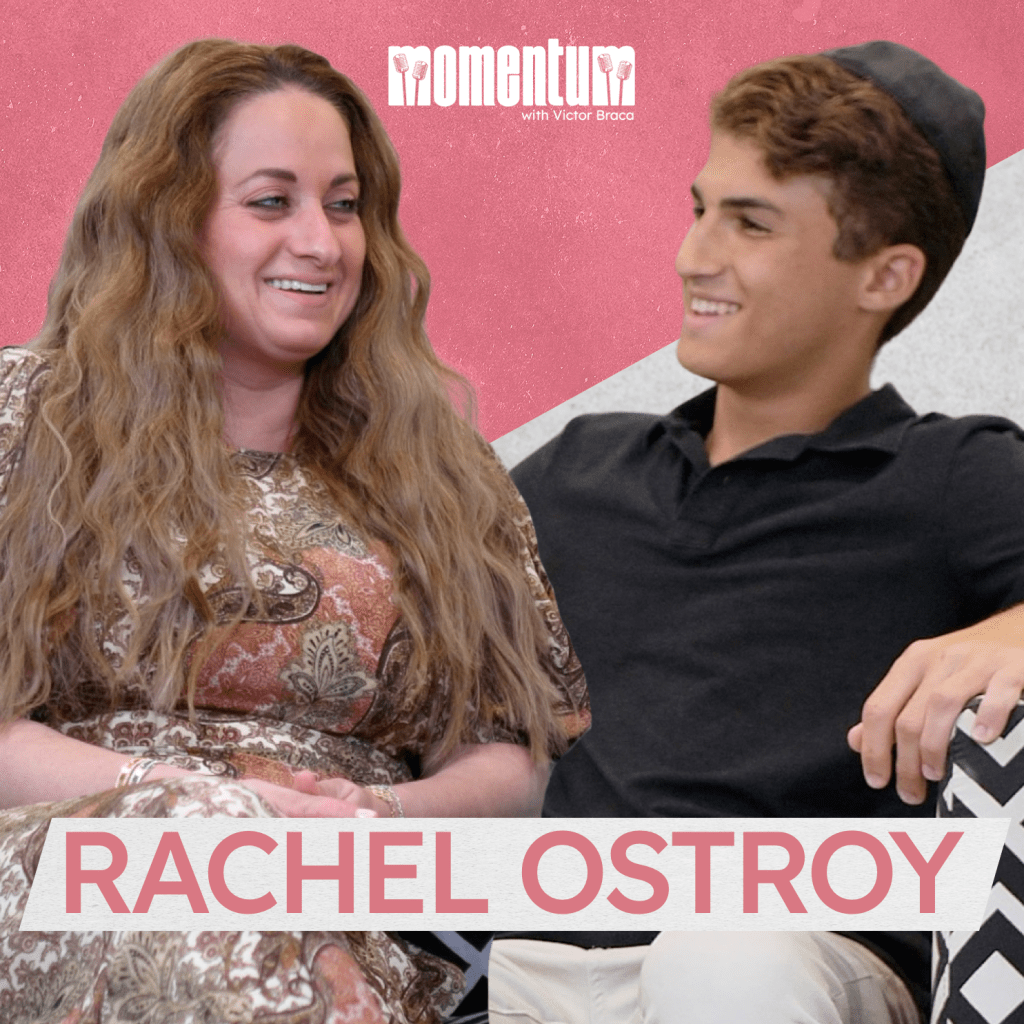




Rachel Ostroy is the founder and owner of Pink Label, a women’s clothing store known for its curated designer pieces. She is also an Instagram activist with nearly 100k followers, blending fashion, lifestyle, and support for Jewish causes.
In this episode, we discuss her journey from launching her store to building a personal brand, how she turned her passion into a thriving business, her advice for aspiring entrepreneurs, and her insights on balancing social media with authenticity.
Enjoy!
Transcript
Victor M. Braca: Hi everybody, welcome back to Momentum, the show where we sit down with interesting and successful community members in order to have conversations that will inspire and empower the next generation on their journey to success. I’m your host, Victor Braca, and today I sit down with Rachel Ostroy, the powerhouse founder of Pink Label and Instagram influencer with almost 100,000 followers.
Rachel—or as you’ll notice, I like to call her Auntie Rachel, even though while she’s not my real aunt, she pretty much grew up with my mom—she’s built an incredible business in fashion combining everything from wedding gowns to lifestyle branding to standing up for important causes on social media. We talk about her journey of opening Pink Label in 2006 to then getting into the influencing space, working with nonprofits, doing brand deals, and standing up for important causes.
Stick around to hear the key lessons she’s learned along her journey of building a successful business, a community with almost 100,000 people, and working with several impactful organizations. I know I say this every time, but you guys are really going to enjoy this episode. Please let me know what you think and enjoy.
Rachel Ostroy, or as I call you when we’re eating Shabbat together, Rachel—Aunt Rachel—welcome to Momentum.
Rachel Ostroy: This is so exciting!
Victor M. Braca: This is an exciting episode, a very special episode. And there’s a lot to unpack with you and your brand, your personal brand, and your store. So we’re going to get through it all, even though, you know, I’ve known you for my whole life, but I don’t know—even this is new to me. You know, I’m going to be learning a lot about you in the next hour, so I’m excited.
So first of all, tell everyone, you know, if they don’t know what you do, how do you explain it to them?
Rachel Ostroy: Okay, so it’s a very good question and I feel like it’s a loaded question. People always ask me, “Tell me about yourself. What do you do? Tell me about Pink Label, tell me about your advocacy, tell me about your Instagram.”
For sure. So it’s very interesting. I opened Pink Label in 2006.
Victor M. Braca: That’s when I was born.
Rachel Ostroy: Yes, I know! And one of the first people I actually dressed was the mother—your mother was one of my, like, first customers.
Victor M. Braca: Nice.
Rachel Ostroy: Yeah. And so I opened Pink Label, single at the time, and really able to, like, focus. Because, you know, I want to say this even to the followers and the listeners: as a single, when you don’t have the responsibility and obligation of being a spouse, parent, finances… take advantage of following your dream because you’re really able to, like, dive into it.
So I’m single at the time I open Pink Label, and it was one of the best experiences of my life because I was able to just, like, focus on that. So we started in 2006, as I told you, and slowly I learned so much from my clients, having the store, doing the buying, doing the selling, a little bit of everything.
And I always say the first year in business is always the best experience. You’re going to learn your ups, you’re going to learn your downs, you’re going to learn your mistakes. And I want to just, like, really highlight this: look at the mistakes as the best tool possible. Best tool possible, because there is no mistakes; it’s just a learning experience to grow from it. There are no mistakes; everything is meant to be. I believe that as a religious person. I believe that from experience we could learn so much from that.
Victor M. Braca: But tell me this: when you make a—let’s say you have a really tough time in business, you know, and the numbers are not looking great and the future doesn’t look so great for you. Are you really thinking at that moment, “You know, this is going to be good for me, I’m going to grow from this,” or how do you have that mindset in the moment?
Rachel Ostroy: So in the moment, I always say, “It’s not happening to me, it’s happening for me.” And what does that mean exactly? You know, like even when I first opened Pink Label, we had made a lot of mistakes—buying mistakes—and you know, the anxiety factor falls in. You have employees that are relying on you for their salary, their paychecks.
And I take—I always tell people—don’t think six months in advance. When you’re dealing with that financial pinch and that crunch time, take it day by day. Make sure what you’re doing makes sense; make sure what you’re doing is best for your business. It’s the same thing like a family, right? You’re going through a financial struggle. People are—you know, we live in a community where people are worried about the holidays and winter break and weddings—and you need to stay in your zone, stay in your lane.
What does that mean? If you’re going through a certain crunch in your business, it’s not a freak-out. There’s a banana peel effect. Take on what you need to do first. If it’s the electric, make sure on Monday the electric is paid. If it’s your salaries on Tuesday, see what you can do.
Also importantly, build a good relationship and network with your employees. Make it a family. I always say: you’re a boss or you’re a leader? Who are you in your business? It’s very easy to be a boss: put this away, pay this bill, answer this email. That’s just a title. And then this relationship of when your employees look at you is leadership. They’re leading this business; they’re leading me through this way of the struggle. So when you’re going through a struggle, they’re not going to feel like they’re looking for another job. They’re going to say, “You were there for me, I want to be there for you.”
Victor M. Braca: I’m assuming that when you’re a leader and not a boss, it carries over into the employees’ relationships with the customers.
Rachel Ostroy: Absolutely. It’s—I always say it’s like the whole theme of the store. You know, I have times where, like, clients walk in the store and I don’t introduce my employees as “this is my employee.” I always say, “Meet Civya, meet Judy, meet Olga.” I work with them. We work alongside people.
You know, if you ever see, like, these really big businesses like Costco, you walk in, you see the employees, they’re always happy and they’re always smiling. They’re there for, like, the long haul. And it’s because who’s running the business? It’s basically the message that you want to call it—the founder or the leader or the boss. It’s the integrity of their business, and they believe in it, they trust in it, and they respect it.
And if you have that respect with your employees—vice versa, they respect you. Like people always tell me, “Rachel, wow, your business like really runs itself and your employees are great.” And I really believe that because when I meet them, like from day one, I tell them what I need, I hear what they need, and we work together.
I always say it’s like a togetherness. It’s like, literally like a sandwich, right? You have the bread, you smear on the peanut butter, and you sandwich it together. And if you run your life like that—your family, your business, your employees, your extended business relationships—you’ll only see positive growth because they want to connect with you and then it’s a continuance. That’s the takeaway from leadership. What do you take away from looking at your employees and seeing what they need? For sure, be a leader, not following the boss title.
Victor M. Braca: For sure. So for those who don’t know, Pink Label is a store you sell mainly wedding gowns, everything…
Rachel Ostroy: We opened, as I said, in 2006. We are a woman’s clothing store that caters to someone’s wardrobe from parties that break down to Brit Milah, Bar Mitzvah, wedding, engagement, holiday, Shabbat—into all those categories. So we cater to basically everybody.
Victor M. Braca: Got it. The grandma to the daughter to the young girls.
Rachel Ostroy: The age categories, I would say, from like 18 up to grandma, grandma.
Victor M. Braca: My mother was telling me before we started filming that when you guys were little, you would always wear these dresses. You were very big into fashion.
Rachel Ostroy: Yeah, way before you were born, Victor. Way before you were born.
Victor M. Braca: Way before. How did that come about for you, number one, that passion? And how did you turn that into a business? Most people don’t succeed at turning their passion, their love, into a business. So tell me about that.
Rachel Ostroy: Good question, because your father once asked me to speak about this. You remember a while ago?
Victor M. Braca: And I’m going to interrupt you for one second. One of the inspirations for the podcast: we were sitting together, Shabbat meal, and my dad was like—listen, you turned what you love into a business, you know? And people should learn how to do that, right? And then that was actually one of the original inspirations to the podcast.
Rachel Ostroy: So when he was saying that I did what I loved, yep. So businesses and hobbies don’t always marinate. We don’t always do what we love, right? Sometimes what we know best or things fall into our lap. So I want to just say it’s important to follow your dreams, but your dream is not always going to turn into a business.
For sure. So for me, from a young girl, like when your mother and I were growing up, I always loved clothing. I was always dressing your mother and I was doing her hair. For those of you that don’t know, Victor’s mother is like my little sister. I planned her wedding; I was the maid of honor in her wedding. Your mother’s like my—my kids are your cousins, sure.
From a little girl, I always had that flare. And I used to tell my mother when I was little—sorry—too many accessories clutter an outfit. I always had that knack for fashion. From when I was 12 years old, I was hopping on the train. I always had a summer job. I worked in a jewelry store called Golden Nugget. I used to go on Sundays to the city, to the fabric store in the Garment District, buy fabric, I would make my own clothing.
Victor M. Braca: Oh wow. How old were you?
Rachel Ostroy: 15, 16, 17. Yeah. So I always had like a passion and a drive for fabric, and I had that flare. And that manifested into getting a job at Elegance. It’s a store in Brooklyn.
It’s actually really interesting. My first day, now that I’m thinking about it, was on Labor Day. Okay, I had an interview. And this is very interesting, and I want to talk to people watching this: if you see something in somebody even at a young age, always keep it at the back of your mind.
I get a phone call one day from this girl, Kay Shore, and she’s like, “I don’t know if you remember me, but you came shopping in my store.” I said, “I did when?” She goes, “You might not remember. It was about 10 years ago.” I must have been 12 or 13, and I guess the way I carried myself or the way I was in the store, she looked at me and she goes, “That girl is going to work in my store one day.”
And she called me up and she asked me if I would like to come work in her store. She was having a baby. And I said I would love to. I was supposed to start, like, maybe two weeks later. She called me up, she said, “I had a baby, can you start?” And I started, and I worked on my own that day. No one showed me what to do. I just took control and I just knew how to work retail a little bit.
Victor M. Braca: Oh wow. You learned the ropes on the job.
Rachel Ostroy: I learned the ropes on the spot. Great. So that was your first real job, so to speak. Literally Labor Day. This is the day before Labor Day and we’re having this podcast, for sure.
Victor M. Braca: So how did that, from there until you starting your store, tell me a little bit about that. What did you learn at that first job that built up the foundations for you to start your company? And also, what gave you the courage to start your own thing? Right? Like, that’s something that most people are scared of.
Rachel Ostroy: This is a great, great question. So I learned a lot from the job that I had. I was like her main sales girl. It was clothing just like Pink Label is, and I was there for quite many years. Kay, who I work for, is one of the most dedicated business owners that I’ve really ever met. She’s a lot like me—she has a family, a husband, and runs her own business. She’s there from morning till night.
And I learned so much from her. I learned sales. I learned alterations because in the fashion business, a lot of times we have to alter clothing. I learned how to actually pin somebody to alter their clothing. I learned customer service, taking care of customers, making sure that they’re happy.
I learned a lot of sales. Sales, I always feel like, is in your blood, but like that fine-tuning of how to sell somebody not to be too pushy. You know, you’ve interviewed many people—I don’t know if you interviewed a lot of people in the retail scope and business—when you’re dealing especially with your own community, a lot of people that walk into your store, you know them. And you have to make them feel comfortable. And you see them on Entebbe and you see them at weddings, and you need to make it feel like a family but also keep that line of being super professional. Helping out, not being too pushy, making them feel comfortable that they want to buy from you, they want to come back, and they’re happy with their product.
Victor M. Braca: Very important. So you learned a ton at this first job. Amazing. And so from then till when you started your store, tell me about the early days of opening up the store. A lot of people when they think of starting a company or a business think of sleepless nights and working weekends. So I want to hear: was that what it was for you? And was it difficult in the beginning to set yourself apart?
Rachel Ostroy: Towards the end of my time in Elegance, you know, people would come over to me all the time and they would tell me, like, “You’re really great at this. Don’t you want your own one day?” And I had really such a beautiful connection and relationship with the woman that I worked with. It was really, really hard.
And sometimes—and I really want this to echo through—you have to really see if there is a future in the job that you’re in and you should stay there, or you could really build a future and having your own. You have to really know that fine line: can I really grow where I am, or can I really grow and build something much bigger if I leave?
Obviously, with that thought process, you need to make sure that you have money behind you. You can’t just say that you want to open a business with no plan. So I put that plan together. And before I left, always know that when you’re leaving something, don’t ever burn a bridge. Always leave a door of that opportunity of goodwill, no hard feelings. Very important.
If you can—I always say this—we can’t control everything; we could only control ourselves. Whatever you could control, especially when it comes to a business, by maintaining and establishing a relationship with somebody that you’re about to leave, do it. Even if you have to lower yourself a little bit, because you never know when things come full circle and when you’ll need each other and when you’ll want to maintain that relationship.
So before I left, I actually asked my former boss if she would want to share partnership. And I knew that that wasn’t possible, but at least I left that door open to tell her, “Listen, I don’t just want to leave you, but I want to grow something like you grew, and I want my own. And I’m, God willing, going to have a family, and I want to get married, and I have this dream of having my own.” So, being—you know, if it’s not in the cards for us to be partners, I want your blessing to be able to go on my own.
And that’s exactly what happened. So this is a really important piece: being honest and not being deceitful and being straight with somebody that you owe a lot to, that taught you everything you know. It might be hard, but it’s much harder in the long run when you see them and it’s uncomfortable, and then you wish and you regret saying, “I wish that I had that conversation with them before.”
Before you jump into something, think about it. Have true appreciation for somebody and know that it is so important to lead by example, because I want my children to do the same thing if they’re in a school and they want to switch schools—you know, if they’re in college or in yeshiva, let’s say, or you know, they have friends. Any situation that they’re in, honesty is so important. And it’s the way that you’re honest—people walk away from each other learning from each other and we maintain relationships, and that’s exactly what happened.
So at that moment I decided, you know, I told her I’m looking to open my own store. My two brothers were my partners and my mom, and we slowly started to establish Pink Label. And now I had a lot of the knowledge. You know, I learned about the vendors, I looked for new brands. I also wanted a little bit of a different kind of store. The store that I worked in was more of like bridge brands. I wanted to open more of like a designer store.
So I did my homework. You know, at that time there was no social media there. Now it’s much easier—you want to look for a brand, you go on social media. I had to do a lot of homework. I had to do a lot of research on certain brands that, you know, it’s not so easy to just contact them. You know, they—there wasn’t like buying offices like the way that you have it now. Now we live in a generation: when you want to open a business, you go on Google or YouTube. “How do I open up my business? How do I establish a name? How do I establish where to open my business?” It’s a whole different animal these days.
Victor M. Braca: You search for Momentum podcast to find all this!
Rachel Ostroy: That too! So I decided to open my own store and I made a list: name, kind of store, what kind of employees I want to have. Going back to what I told you before, I always wanted it to be a family. So when people walk into the store, they don’t have a department store feel. I always like the concept of mom-and-pop. People walk in, they feel comfortable, they have a coffee, and then it’s always like a revolving door. They know it’s like someone’s getting engaged, they know they could call me, “Hi Rachel, I need a dress for my daughter.” It’s a very close-knit relationship with the clientele. It’s a family.
I have so many friends now through Pink Label.
Victor M. Braca: Hi guys, so sorry to interrupt in the middle of the episode. I just want to ask you really quickly to please like, share, subscribe, comment. We’re really trying to get the podcast to the entire community. I know I say this in every episode, but please: if you know of a friend, a family member who would be interested, who would like this episode, send it to them please. Thank you so much. Okay, back to the episode.
You mentioned how you wanted to sell designer brands and you did your homework about that. Tell me about the early days of the store. Was it hard to keep it alive? Were the numbers good? Tell me about how you set yourself apart. I want to hear about that.
Rachel Ostroy: Okay, so there are different kinds of businesses. Certain businesses people run, they’re a one-man show. Then there are a lot of businesses that are not a one-man show. Pink Label is not a one-man show. There are so many divisions in Pink Label. For me, I take care of buying all the clothing, going to the showroom, making the orders, and selling.
I know my strong points. Very, very important when you’re running a business: do not multitask if you’re not a “one” at that task. If you are not computer savvy, don’t write emails. If you don’t know how to do QuickBooks and you don’t know how to do the business end of it, don’t be that person.
Victor M. Braca: But to interrupt you for a second—that, you know, it’s conflicting for me. Because say I want to start a business, right? And I’m good at the creative, a little bit of the back-end work, but I’m not so good at selling. Should I not start the business? Should I learn sales? What if I can’t partner up with somebody? What if I can’t hire someone? What do you think about that?
Rachel Ostroy: That you have to do it slow and steady. Okay, don’t take on too much. Right, like for me in the beginning, I made a lot of mistakes. I bought things that weren’t exactly my clientele because I came from a store expecting that exact ABC kind of clientele. And it wasn’t. I was on Avenue P, I wasn’t on Coney Island. I had a little bit more of a Syrian clientele, then it shifted into more of an Ashkenazi clientele.
When you’re first opening your business, slow and steady wins the race because you need to learn who your clientele is. So for example, you said if you’re not great at sales and you’re better at computers, go slow. Do you understand what I mean? Buy less. Try to do sales. If you see it’s not good for you, then slowly maybe bring someone in two days a week and learn from them and balance ideas off of each other and watch them and learn from them.
Sales is definitely something that comes from inside. It’s like in your blood, but everything needs to be fine-tuned. Everything. Even like, I’m in the sales business since I’m 14 years old, but I could still learn so much from everybody. Sometimes I’m on the phone and a client is leaving the store and I give her, like, my hand but my head is down on my phone. That’s not nice, and that’s not professional. You need to stop what you’re doing, put the phone down, greet the customer outside.
That’s part of sales—making clients feel important. Sometimes I have two customers in front of me and they both need the same thing at the same time and someone’s in a hurry. Very important to tell them, “I know you need to leave, this girl was here first. Do you have a moment?” The sensitivity—I always say it—it’s like running a house, running a household. And every single day is an opportunity to learn from your clients and vice versa.
You want to run a store, you want to run it the right way. You want people to feel comfortable to come back, you want it to be professional—you have to lead by example. That’s why I keep saying it: be the example that your employees learn from you.
Victor M. Braca: So we got into the store and obviously we’re going to continue speaking about Pink Label, but I want to get into your social media influencing side of things. Because you have almost 100,000 followers, I think, on Instagram.
Rachel Ostroy: Yes, amazing. Thank you.
Victor M. Braca: Congratulations, first of all. So how did that come to be? Was that an offshoot of the clothing store? Tell me, you know, how that started.
Rachel Ostroy: So I have had my social media account, I would say, for about 12 or 13 years now. Okay, since, like, Instagram really started. So in the beginning, it was always like, I think, just like everybody else—getting familiar with Instagram, posting fun photos. It was basically like a place where I was painting my art.
Instagram in the beginning was all about a curated account, a lifestyle for me. Creating beautiful photos. I would do a lot of photo shoots, and then slowly I got married and that was great content. People loved it. They see the single girl who’s 35 years old and now she posts a picture that she’s engaged.
And I think personal accounts and business accounts kind of, like, tapped into that. And I would slowly get messages: “Would you like to collaborate?” And I was like, “What is a collaboration?” To me, a collaboration is like two people doing something together, working together. I’m like, “Sure.”
And they’re like, “We want to send you jewelry.” And I guess everything’s catchy. The part about collaborating is how I started, like, the business aspect of it. Brands started sending me product. So if it was, like, things for my engagement, for my wedding… I got married in Israel and I think no one ever saw a wedding on Instagram yet—like, such a public display of beautiful photos and brands. Karen Sabag was the designer who made my gown, and that was a big deal.
And that was, like, put on Instagram. The whole, you know, designers and brands putting things on Instagram—it was just starting. It was like just at the cusp of designers and brands and product going on Instagram. So the “influencer” wasn’t, like, established yet, but I was like already a household name on Instagram. So my wedding in Israel and coming home and working with certain designers became, I would say, the beginning of who Rachel Ostroy became.
Victor M. Braca: I never knew it started when you got married.
Rachel Ostroy: When I got married. So my name on Instagram was Raie Poo—many of you remember me as Raie Poo. And so I get married, I move into my apartment, and now I have so many DMs of brands reaching out: “We would love to send you dishes, we would love to send you napkins.”
And slowly I started doing tablescapes, and my page became a lifestyle of inspiration. But I always wanted to share on Instagram that this beautiful picture that you see, it’s not just like—poof!—it came. Because a lot of what people see on Instagram is not real. You know, it’s like you’re reading a book but there are scenes behind… it’s like a play, right? But behind the scenes there’s wardrobe and pain and mistakes and things.
What you see on Instagram that looks beautiful, behind that is regular people with challenges and real-life problems and crisis and bad days and good days and financial issues and everything that you could think about. And I wanted to bring awareness to that. I didn’t want people to just see a beautiful picture; I wanted people to know what you see was work. I didn’t just get here one day.
So I started sharing about how I married Shully and that I didn’t get married at 21. People just see a wedding; they don’t know that I got married at 35 and I wanted to get married for years. And you know, I would be working in Pink Label and a girl would walk in with her beautiful ring and be like, at 21, “Hi, can I find a dress?” And I’m looking at them and I’m like, “I’m 30. When is it going to be my time?”
And I wanted to amplify the awareness that what you see is a dream that is something I wanted for a very long time. And don’t be fooled by this beautiful photo that I’m here with my husband—that it just happened. It didn’t. It was time and it was a journey and it was a life.
So I infused both sides—the physical aspect and the spiritual—and slowly I built my page that way. You know, I built up my brand in a very special way. I started, you know, collaborating with brands and coming out with Rachel Ostroy brands. So I went from Raie Poo slowly into Rachel Ostroy. I basically transitioned my page not only into fashion and tablescapes and lifestyle and clothing, but into things that felt more meaningful, like inspiration and talking about infertility and organizations and people that need us.
If I have this—I always say—if I have this platform, I would do a very big injustice to everybody watching by not sharing what’s important. Because there could be that one girl or one guy watching behind the screen that could tell me, “You helped me for whatever it is: raising my awareness about not getting married at 21 and being 35 and waiting and walking into shul every holiday and every birthday that goes by and people going away on holidays and you’re not married year after year.”
It’s a big struggle when you live in a very tight-knit community. How do you give people hope? How do you give people strength to put one foot in front of the other? How do you give people hope to get out of bed in the morning? How do you give people hope to once again walk into their friend’s wedding and once again be the bridesmaid and not the bride?
And I knew I had this platform and I said I need to make a difference. Because I have this motto: “If not me, who?” I don’t count on people to set an example or send out a very important message. I do it myself.
Victor M. Braca: Like that, you take action.
Rachel Ostroy: I take action.
Victor M. Braca: Tell me how did you build up… you know, it sounded pretty organic from the start, your influencer business. How did you build it up? You have 100,000 followers now and you’re promoting organizations, you’re promoting brands with sponsorship. So how did you build that up?
Rachel Ostroy: So how it really works is: Instagram in the beginning was more of like a place of fun and posting beautiful pictures, as I told you. It wasn’t a business. Instagram was never a business to begin with. It was really just a place of posting beautiful photos, and then it started to evolve into branding.
So slowly I started, as I told you before, collaborating with many brands—lifestyle—and it started to really grow. Many brands were reaching out. Brands wanted—I started to build a Rachel Ostroy brand of tablescapes, lifestyle, fashion. So I’ve done collections already with, like, little children brands.
I always loved fashion and I always loved styling things. So when I saw that there was like this niche business of branding and branding opportunities on Instagram, I just slowly started doing it because I loved it. I loved doing these tasting parties.
So why was it great? New brands found opportunity for exposure and I was able to, you know, create beautiful content and throw a beautiful party by giving these new brands exposure. So we do these parties, I would do tablescapes. I still do. Rachel Ostroy’s brand does a lot of tablescapes for Rosh Hashanah.
So a tablescape is like—now Rosh Hashanah is coming—and I actually build a table. I put out a beautiful spread. I put a table together from tablecloths to napkins. Presenting a beautiful table.
In the beginning, I would just put a table together and then people started asking me questions: “How… where do you buy your tablecloth from? What’s your color palette for the holiday?” I found such enjoyment in it that when I would start working with brands, they would say, “Rachel, do you want to do a collection together?” Because once people started following them, their collections would start to sell out. So they saw good opportunity to do something together.
It builds branding and ambassadorship to work with brands. During COVID, I worked with a Judaic brand called Ben Ari. Now, if you remember, many people were supposed to go away for Passover. Two weeks before that, while I was in the hype—the “oh my god” of COVID—everyone wasn’t going away for Passover. I decided to come out with matzah covers and they sold out. I was literally selling them with a mask through the door.
So a lot of it just is organic. It’s also like when you’re inspired and you have this like feel for things, it comes together. So that’s how I really built my Instagram on the branding part of Rachel Ostroy: working with a lot of brands, loving what I do, styling from fashion to clothing, working with brands and building that up. And when one brand sees that you’re working with somebody and it looks good and it’s put together and they see it’s working, they’re like, “You know what, I want to work with her.” So it just slowly builds up.
Victor M. Braca: Hi guys, sorry to interrupt. Just want to say, if this interview is leaving you inspired in any way, first of all, I’m happy to hear that. Second of all, you should really consider reaching out to the SBH Young Professionals program to be matched with a career mentor. It’s an amazing program. I myself actually did a lot of work with them showcasing what they have to offer for the community. Essentially, in the mentor program, they match you with a professional who can help you achieve success. You can find them on Instagram @sbh_career or you can email them at careers@sbhonline.org. Make sure to tell them that you came from the Momentum podcast. Okay, back to the episode.
For people hearing, you know, listening to this inspired by you being an influencer and your personal brand, do you think people should start? Is it too late to start on Instagram, on social media? What do you think about that?
Rachel Ostroy: Nothing in life ever expires, only at 120. So if you’re looking on Instagram—look at October 7th. Let’s dive into that for a minute. There’s a quote that people always say: “Who were you before October 7th?”
It’s like a really big Instagram question. You had so many accounts that were not political, were not activists, were not pro-anything. And after October 7th, I would say that Saturday night, many people’s lives, many people’s frames of minds changed. I’ve met so many new friends since October 7th that never really even had a platform.
You look at Hillel Fuld or Elon Jacobs—he had a few hundred followers. He started taking his platform into humor and talking about antisemitism, and now look at him; he has a huge following. Tehila Zucker—she was the F-Factor and now she’s become this huge activist. She’s amplifying her voice every single day.
So for people to say is it too late? Nothing is too late. Start, see where it goes. Don’t talk about next week or next month; just take it day by day and let it unfold and see where it goes. I never thought that I would be a full-fledged activist on Instagram and speaking for the Jewish people and doing what I do now, because all I used to do was kids’ clothing and cooking and tablescapes.
But things evolve and things change. My whole page really now is a balance, obviously, because I still love fashion and I do have a store and I have to also create a positive balance on Instagram. But my heart is with Israel and my heart is with all the organizations I work with.
So many people always ask me, and they still ask me, “When is your page going to go back to normal?” And I tell them there’s nothing in this world that is normal. So when the hostages are free and there’s peace, we could talk about that conversation. But there’s no normal. There’s no normal what goes on in—on college campuses. There’s no normal what goes on in Israel. There’s no normal what is going on in this social media crisis and… I mean, it’s really a very tough question.
But if I have this platform, I’m going to be that voice for the Jewish people. I’m going to be—I always say—this is my kingdom and I’m the queen, and there’s nothing that I won’t do for my people. And if it’s to say all day “Bring them home” and interview hostage families and work with organizations that need to be, really, widen in their reach, like ZAKA. Most people don’t know who ZAKA is. You know what, I’m going to let you ask me that question.
Victor M. Braca: I was actually about to get into that. So you do a lot of work with nonprofit organizations, and why is that so important to you? Tell me a little bit about which organizations you work with and why do you value that so much?
Rachel Ostroy: So it’s a really great question. You weren’t born so you don’t know my father. We call him Grandpa Walter. Walter Ostroy was one of the most selfless men that ever walked this world. He was involved in so many organizations, did so much Chesed, and a tremendous amount of acts of kindness.
And when I got to a certain age, I realized who I was. I was a lot like him: sensitive, caring. I used to ask my mother, “Why am I like this? Why am I so sensitive? Why do I care so much?” And she told me—she answered me really well. She said, “God needs to make certain people sensitive because they’re the ones who get the job done.”
And slowly, I did these giveaways on Instagram but I always connected them with charity. And the messages that I would get from people were just outstanding. A girl would win a baby carriage and she was struggling with infertility, and then she found out she was pregnant… the stories that would just follow me.
Slowly organizations would reach out to me, if it was Chai Lifeline or if it was the Special Children’s Center or if it was just Kids of Courage. Small little acts of kindness that I was able to do on my Instagram. And I would work together with them and raise awareness for their campaign, or if they were doing like a Hanukkah toy drive or money for uniforms for school or anything like that. It brought me such joy and brought so much meaning to my life.
And just so many people that need it that I said: my page cannot only be for the superficial part. There’s so much more that needs to be done here. And after October 7th, ZAKA was having a concert in November. And the production company reached out to me and they said, “We would like for you to be a part of this concert. We would like for you to host the concert, you and your husband.”
And I was just blown away because ZAKA—they’re angels. And they could have chosen anybody to be so involved with them, and they chose Shully and I to host the concert. And I answered them. I said, “On one condition: I’m not just hosting this concert. I want to be part of the ZAKA family.” And from that moment on, I became their ambassador, and we literally became like family.
I was sitting here just now. I got a text message from Yossi Land. His daughter’s engaged, and I wrote to him, “Thank you so much for inviting me.” And he’s like, “What do you mean? We’re family.” We became like family.
The organizations I work with… with Amudim, Zvi Gluck—there he’s an incredible organization what they do. He’s the founder. He has helped so many people in crisis, in drug abuse. Without Amudim, we wouldn’t have many people; they would be gone. They wouldn’t have been helped; they would be dead. I’m being very honest.
And social media is a great way to amplify it, to raise awareness for people that need help and for people to donate. These organizations need sponsorship. So when you put your name on it and you believe in it, I can’t think of a more gratifying feeling. So I work with organizations that I connect with, but I want to make this world a better place.
And I want my children to learn that. And a lot of times when I’m on the phone or working with an organization, I make sure that my kids are standing right next to me, because that is how we teach the next generation: by leading by example, letting them see every single thing that we do.
Victor M. Braca: 100%. I love that way of teaching them, carrying that over to your children. So I want to shift gears a little bit in terms of the advice that you might give to young adults, young men and women in the community looking to start their own venture or just set themselves apart. What do you think young adults nowadays, you know, what skills—soft or hard skills—can they build up now, today, that will put them ahead in terms of business, in terms of success for their lives?
Rachel Ostroy: So it’s a really good question. I always tell this to people if it’s for business or if they’re struggling with something in life or they want to become something, right? From when you enter high school, you start to really think about who you want to be, what you want to be. So if it’s you want a profession or you want to become a rabbi or you want to go to college, we all start thinking about who we want to be and what we want to do in this world.
I’m going to put it for you very clear: we don’t know what we will be, but if we don’t focus on one thing, we won’t become anything. And that is this example I always give: tunnel vision. If you’re very busy looking to the right and you are very busy looking to the left, you are never going to stay in your own lane.
I’m not saying that it’s not hard, but stop looking at everybody else and just look at you and focus completely on what you’re doing. I own Pink Label and I learned this by experience: if I will continuously look at what every other store has and every brand that those stores have, I will never grow and my clients will feel it, and the store will feel it, and the employees will feel it. I won’t feel like I’m on top of my game.
Stay in your own lane. Don’t look at anybody else. Look at people for inspiration; anybody that gives you anxiety, tune them out. You will only succeed if you allow yourself to succeed. You will only be the best if you believe that you’re the best. Once that adrenaline of anxiety starts to tap into your spiritual and emotional veins, you’re just setting yourself up for failure.
If something doesn’t feel good, stay away from it. You’re watching—let’s say you want to open a restaurant and you’re following all these incredible chefs, these French chefs, and the way they do these reels and everything looks amazing and you’re like, “There’s no way I could do it.” Mute that account. Those accounts and those restaurants—they have years of experience. Don’t expect to be them. Be you. Start small. Do what you love. Be happy in what you’re doing.
Victor M. Braca: As you know, the show, the podcast, is called Momentum, and we have a signature question. We call it the “Momentum Moment.” We try to pinpoint in the moment in our guests’ lives, in their careers, where the things that they were doing started to pick up steam, started to gain momentum. And we try to replicate those moments to achieve continuous growth, right?
So I want to hear for you, in terms of your story, in terms of your influencing: what was your momentum moment—moments—and how did those affect the rest of your career trajectory?
Rachel Ostroy: This is such a good question. I would say my momentum moment in Pink Label is one day—it was literally right before the holiday—and I’m looking around and I see mothers and daughters shopping in a community store. They could be in any department store in Manhattan, they could be in Florida shopping, and I have this opportunity to help and dress our own community.
It’s small, but it’s really big. Walking into shul—I think it was Rosh Hashanah—it was like six or seven months later after we opened Pink Label and I’m sitting in shul and I’m looking around at the mothers and the daughters and the aunts, and I said, “I was a part of dressing them for the holiday.” It’s not like charity, because it’s not, but it’s being a part of doing something for your community. They could shop outside the community, but you’re there to help them with their needs in your own community.
There’s—it’s such a small thing. I don’t know if you could see the inspiration in it. I’m a part of the journey in this community. It’s really simple, but to be involved in a day-to-day community where someone could call you at 8:00 at night and say, “Rachel, my daughter just had a baby, we’re coming home from the hospital, can you open early? She needs a bris dress.”
That is my aha moment: to be able to be there. They don’t have to run to the city to get a dress. It’s a community; there’s a store in the community where they’re getting great service, they’re being well-dressed, and I could be a part of it. Right?
You could have a doctor in the city—how many people has Dr. Feit helped? He is the aha moment. He is the momentum; every person he helps is a moment. Some moments are more inspiring than others, but it’s the small things. It’s not always the scale for me of the big moment.
Dressing the girl that finally had a baby after eight years, which is unbelievable. We have a girl in our community, many of you know her, Tony Sued. I’m still in Mexico and I get a phone call from her mother-in-law: “Hi Rachel, Tony had a baby. Are you open tomorrow morning?” And no one was open; the holiday was over, Thursday was last year. I was able to open the store and dress her for her bris.
That is a moment in my life that, if I didn’t have a store like that, that wouldn’t happen. Now you get that opportunity? Never. I got a huge big Mitzvah, a story to tell my children. And what a moment to be able to open the door and look at this girl straight in the face that I’ve seen time after time passing Pink Label, not pregnant, wishing that she could come in and buy a dress for a bris. Open the store just for her, go through dresses, find the perfect dress for her. Get to go to her bris and get that text message after Shabbat: “You don’t understand how you made me feel. I cannot believe I had this baby and I got to wear this dress.”
Being in our community and doing that really every single day, because dressing everybody, even for the small things—that’s why I said it’s such a loaded question, because it’s not always on the big scale. Even the small things.
Victor M. Braca: Small moments.
Rachel Ostroy: Small moments.
Victor M. Braca: Building up—building up momentum. I don’t want to bring it back to the name of the show. It’s not like momentum is building up very slowly—I don’t know how to articulate it so well—but it’s a snowball effect, right? So it’s a little bit, a little bit, a little bit, adding on, adding on, and then all of a sudden look what you made. You know, look what you have in front of you.
Even looking back at this, you know, our conversation the past hour and a half—so many bits of inspiration, insight in with your story and how you got started, how you built up your brand. Is there anything else you think young people nowadays with that drive for success, or without the drive and you know waiting to be inspired, should hear?
Rachel Ostroy: Yeah, you know, I want to say something that’s really important. You know, we’re right now coming off of a big summer. Our community is filled with so many incredible things. You know, we have organizations and we have rabbis and speakers, and it’s usually the same people that always control the stage of these big fundraisers that we do.
And I want to bring it back to Instagram. It’s these same accounts that create so much inspiration. I want every single person that’s listening to know: you don’t need to have 100,000 followers to have a platform. You don’t need to be this huge source of inspiration to do good things. It doesn’t—not everything always has to be on a megaphone. It doesn’t have to be on a huge scale.
Being a good person and being kind is right in front of you. You’re walking out of shul, you see somebody—look them in the eye when you say hi. Take out a minute when you say—you ever see like people say, “Hi, how are you? Hi, hi, how are you?” but no one even finished the question you asked them? “How are you?” The other person didn’t even answer. “Great, everything is great. How’s your family? How’s she doing?” You both said the same question to each other—”Hi, how are you? Hi, how are you?”—and everybody walked away. No one even finished making eye contact.
You know there’s someone in your circle of friends that’s being left out? Take out that moment to tell your other friend, “Let’s not leave them out, include them.” It’s small things that make us great. It’s small things that pour on to our business. When you’re a good person, your business will be good because you’re good and everything around you becomes good.
If you believe you’re good, you will be good. If you believe your employees are good and you tell them they’re good, they will feel good. Life is that journey of small things—those little stepping stones. You don’t just get from zero to 100 because you snap your finger. It’s work, effort, and a lot of time.
You know, I see now that I’m raising my children, I look around and I see these beautiful children that are raised, but they didn’t just become like that. Like you, how much do you do on a daily basis? You have a lot that you do in school and how many things that you’re a part of. You know, it’s like: be the person, be the voice, be that one, like I told you before, that doesn’t count on the torch. Light the torch, hold the torch for someone else to see, for you to see. Be your own example.
Victor M. Braca: Love it. Love it. Auntie Rachel, thank you so much for coming on. This was really a treat. I didn’t even realize how enjoyable it would be.
Rachel Ostroy: And it’s amazing we finally got the schedule—we’ve been trying to schedule for probably a very long time. And anybody that’s watching that thinks that they have a business or that kind of person that could be on the podcast: take out the time, be here. Because there could be somebody that’s watching that you could change their life.
And one day they’ll walk up to you—this happens to me all the time. People come up to me and they say, “If I didn’t hear that piece of advice that you said, I wouldn’t have known it. And I want you to know it changed my life. It changed my marriage, it changed my relationship with my mother, it changed my choice career, it changed my way of thinking every single day.”
Victor M. Braca: That’s awesome. That’s—to hear that from somebody, it’s got to be so meaningful.
Rachel Ostroy: Yeah, it does, for sure. I’m so excited that we did this. It’s going to be great.
Victor M. Braca: Awesome. And it should be a good year. We’re in Elul now, starting the next… this is a big month, and you should just see a lot of joy, happiness, and success.
Rachel Ostroy: Okay, thank you so much.
Victor M. Braca: If you enjoyed this episode, I really think you would love my conversation with Sophia Cohen. Sophia founded Urban Pops from her tiny apartment kitchen, and as you know, today it’s a thriving business both inside and outside of the community. If you’re interested in that, you can find that on our profile or click somewhere on the screen. Again, thank you so much for watching, and until next time.
Would you like me to look up any specific details about Rachel Ostroy’s recent campaigns or Pink Label’s new collections to help you refine the transcript?



 Momentum
Leave a comment