

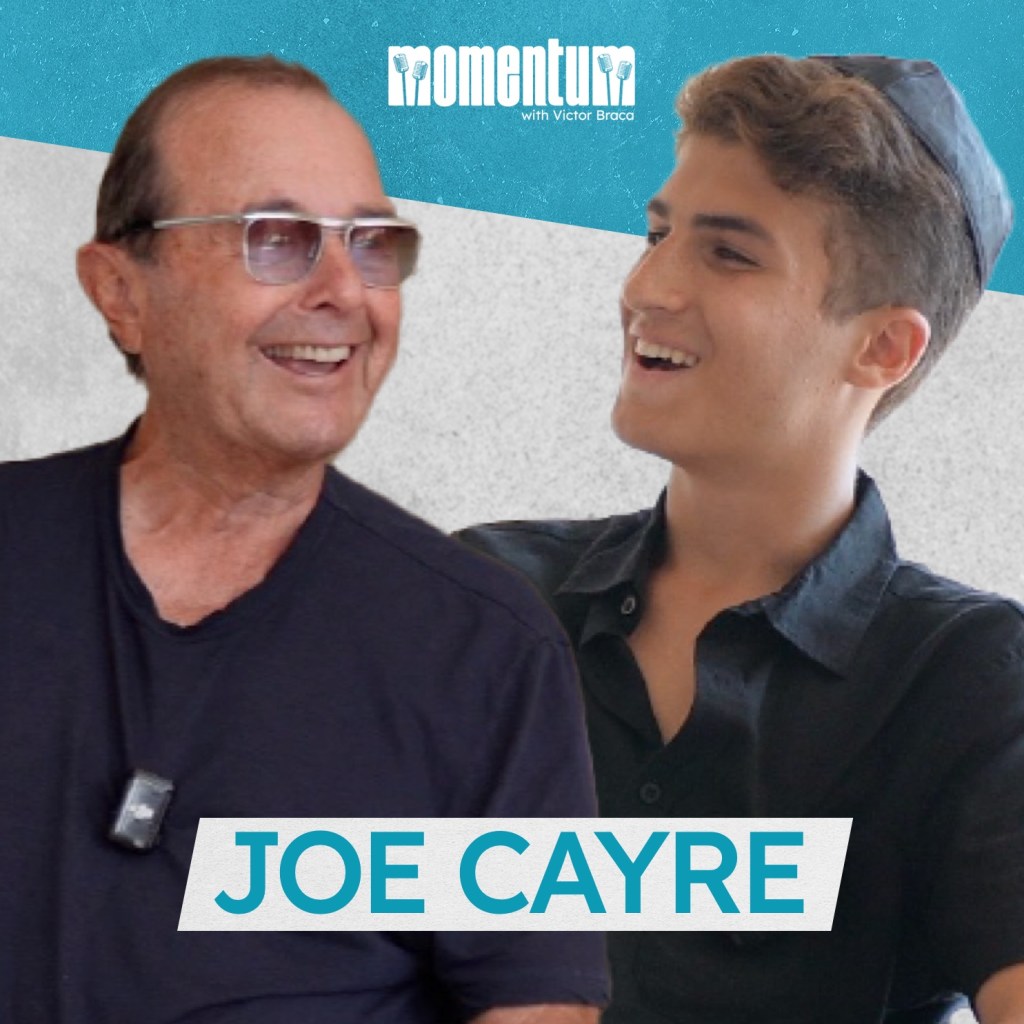




Joe Cayre is a highly successful businessman and community philanthropist. In this animated conversation, we go through Joe’s story in its entirety–from growing up poor to ultimately working with huge corporations in multimillion-dollar deals. Joe tells stories of meeting the Founder of Walmart, working with the CEO of Microsoft, and getting sued by the Walt Disney Company.
Throughout his journey, Joe has continuously given generously to community synagogues, schools, and organizations, and today he underscores the importance of community activism.
We close with Joe’s unconventional #1 piece of advice for young adults.
Enjoy!
Transcript
Victor M. Braca: Hi everybody, welcome back to Momentum, the podcast where we sit down with interesting and successful community members in order to have conversations that will inspire and empower the next generation of our community’s leaders. I’m your host Victor Braca, and today I sat down with Joe Cayre.
Growing up in Miami Beach, money was tight for the Cayres. Joe’s first job was operating a duty-free shop on a cruise ship. He then entered into the music licensing and record label industry where his music received millions of hits. Soon after, he got into the home video industry where his innovation and business catapulted him to tremendous success. Joe eventually transitioned into real estate, which is what he does now.
Throughout his journey, Joe has remained deeply committed to giving back to our community. He’s used his success to uplift our schools, shuls, community organizations, and much, much more. In this episode, we spoke about Joe’s entire career history, which is super fascinating. He tells us some funny stories about his times working with huge companies like Walmart and Microsoft.
Joe Cayre: Never seen corporations so stupid like this. The judge said this: “If you ever sue him again, you’re going to pay his legal fees.”
Victor M. Braca: And he shares his advice to young community members with that drive for success.
Joe Cayre: The best advice I could give you…
Victor M. Braca: Joe is truly a pillar of our community. There’s so, so, so much to learn from him, and I’m sure you’re going to enjoy this episode. Let’s get into it.
Joe Cayre, welcome to the podcast.
Joe Cayre: Thank you.
Victor M. Braca: I’m very excited to have you. You have tons of experience; you have a lot to unpack here. We’re going to get through hopefully all of it.
Joe Cayre: No problem.
Victor M. Braca: Okay, great. Let’s do it. So, tell me about your early days. As a child, were you always business-minded? Because you know, you’re very involved in business.
Joe Cayre: Well, we grew up in Miami Beach and we were very poor, so we had to be business-minded if we wanted to eat. And then I got a fantastic opportunity. There was a boy in my high school who said his father had a boat that would go to Bimini if we wanted the Freeport shop. I said, “Of course.” I had no idea what it was, but I knew we needed to make money because we had a little store on Lincoln Road that I worked in, and some days nobody even walked in. I just sat in the store all day long, and it cost me 40 cents for lunch in those days, which we didn’t have. So it was a pretty tough time.
I was fortunate in that my father was friendly with a fellow who owned all the Freeport shops at the Miami International Airport. He was a Lebanese Christian and they used to watch Arabic movies together. He told him, “Oh, Jack, I know that boat. That boat is so small I didn’t even want it. But tell your son I’ll send him all the whiskey, cigarettes, and perfume that he needs to make some money.”
Now you have to understand, we didn’t really make any money. I mean, we made barely enough to live, maybe $500 a week, which was barely enough for my father and mother and six kids. It was, in fact, very tough. On the first day of that cruise, we made $5,000 profit. To me, I said, “Oh my goodness, we’re millionaires.” If I multiply that times 365, that’s over a million dollars. Anyway, so that went for a few years. We made a lot of money.
I went into New York to work with my cousins from Mexico who had a tricot mill in Puerto Rico. I worked there for about a year, and they promised me 10% of the company, but they wanted 18% interest on their money, which would make it very hard to ever get the money back. I was very lucky that year; we figured out how to make pantyhose out of the machines that we had, and pantyhose were very hard to come by. So we made all the money back and they decided not to give me the 10%. I went back to Miami and I told my dad, “You know, our cousins weren’t too honorable, but I don’t care. I’m going to New York and I’m going to try to make some money.”
I got very friendly with the president of Columbia Records and he said, “You know, Joe, Clive Davis doesn’t want to put out my Spanish music from Mexico, and the only way I can record artists in Mexico is by promising them a release in the United States. How about you handle it?” I said, “Okay, of course.”
He says, “You have to sign a personal guarantee because we’re going to sell you the records and give you a lot of credit.” I wasn’t worth $10 at the time. I said, “Sure, I’ll sign a personal guarantee.” They forgot to ask for a personal statement, so I signed the guarantee, which was not a problem. In the first year, I made $5 million profit.
Victor M. Braca: How old were you at this point?
Joe Cayre: I think I was about 22.
Victor M. Braca: You’re 22. How did you develop that relationship with the president of Columbia Records?
Joe Cayre: We were single and we were going out together in New York. One night when we were out together, his girlfriend went into the bathroom with whatever girl I was with—I don’t recall—and he says, “You know, I’m having a problem. Clive Davis doesn’t want to release any of my records here. Would you do it?”
I said, “Well, what is your business?” He told me, and I said, “Of course.” I was able to figure out that the reason they didn’t do any business was that Mexico would send the records to the United States one year after they released them in Mexico. So I flew down to Mexico and I convinced those people there at Columbia to send it to me six weeks before they even released it in Mexico, which changed the whole business.
Victor M. Braca: Oh wow. So instead of a year late, you’re getting it six weeks early.
Joe Cayre: Right. And then after that, one day we were in the warehouse on 10th Avenue and my brother Kenny said, “You know what? Let’s make our own disco record.” I said, “What is disco?” I didn’t even know what disco was. He said, “It’s a new way to dance. It’s like the salsa that we sell plus black music together. We’ll call it Salsoul Records.”
So we made a record called the “Salsoul Hustle” and I sold it to the president of Columbia Records, who was a very good friend of mine, Walter Yetnikoff at the time. But he never put it out, and he gave me a $100,000 advance but he never released the record. So my brother Kenny took me one night to a disco club and when they played that record, everybody got up and danced. So I went back to Walter. I said, “Listen, why didn’t you release that record?”
He says, “We don’t think it’s any good.”
I said, “Look, can I give you the $100,000 back and you give me back my record?”
He said, “Of course.” So we took that record and that was the only… we had one group called The Salsoul Orchestra, and it became number one in the pop charts. We put an album together and we sold six or seven million albums, which was unheard of, especially from a company that didn’t have distribution. But we got lucky and we signed seven or eight or ten acts and we were having one hit after the other.
Finally, I went to RCA Records and they said, “Look, we really want to distribute your product. It’s so hot.”
I said, “Why should I let you distribute it?”
He said, “Because we’ll only take 10%. It’ll cost you more than that to do it and we’ll give you the money right away.”
I said, “Great.” I said, “But I need a large advance. I’d like a million-dollar advance.”
He said, “No problem.” So I took my father with me and he said, “What’s happening?”
I said, “You’re going to get a check. I’m going to give it to you for a million dollars.”
He says, “What did you sell them?”
I said, “Hawa.” In Arabic, hawa means air. My father got a big kick out of that.
Victor M. Braca: That’s awesome. And your father’s probably at this point going crazy.
Joe Cayre: We never knew what a million dollars was. Okay, so now we get the money and two weeks later they fire the president of RCA and they bring in the president of Hertz Rent-a-Car, which was also owned by NBC. He calls me up the second day he’s there. He says, “Mr. Cayre, I’d like to see you. I understand we have a contract with you to distribute your records.”
I said, “Yes you do.” I went over to see him.
He says, “Could you come at 6:00 p.m.?”
I said, “Of course.” I went there at 6:00.
He says, “You know, we don’t really want to distribute your records. We make a lot more money selling Elvis Presley and we’d like to rip up the contract.”
I said to myself, “Does this guy remember that they gave me a million dollars two weeks ago?” I said, “Look, if that’s what you want, it’s no problem.”
He says, “Okay, we’ll make a contract tomorrow.”
I said, “No, let’s make it right now. I’m leaving town. Just sign that you want to rip up the contract and just make it the best way you can.” He had a lawyer come in; they made some kind of a paper. He signed it, I signed it. I went back and I said, “I’ve never seen corporations so stupid like this. They gave me a million dollars two weeks ago and they didn’t get anything for it. They gave it back to me.” And then we sold the company to another company; we made a lot of money with it.
Victor M. Braca: So going back a little bit, how did you go from distributing music to producing your own music? Sounds like a pretty big jump.
Joe Cayre: My brother Kenny would go to Philadelphia and go to the studios there. He had a fellow, Vince Montana, who put together a street orchestra, which he just named the Salsoul Orchestra. But we owned the name, and he just put a bunch of guys together.
Victor M. Braca: Interesting. So it sort of fell into your hands. Hashem sent it in. You sell the distribution rights to RCA, which they never used, and you kept their advance.
Joe Cayre: And now we had a million dollars to make more records with and make more money with, and we distributed ourselves because we were distributing our own Spanish records throughout the country. It was easy for us.
Victor M. Braca: You had that experience in distributing, so you didn’t have to outsource that; you did that yourself. That probably saved you money.
Joe Cayre: Not at all. It was great. I’m sure it did.
Victor M. Braca: So you’re distributing your own music now. Were all of them as big hits as the first one in terms of popularity?
Joe Cayre: Yes, we had four or five very big hits. We had one, “Dr. Love” with First Choice, which was, I think, number one for six weeks in this country. In those days we were a tiny independent record company and we were bucking all the major record companies.
Victor M. Braca: And do you think this musical success fell into your hands? Was it a strategic play? What set you apart in the space of music?
Joe Cayre: Listen, I really do believe I was blessed. Hashem sent the gift to us. We knew nothing about music and we were able to do it, and it was an interesting thing. But then we went on from that. My brothers and I—Stanley and Kenny—we went on to opening up a company called Caytronics, and after that, we opened… Caytronics was a Spanish music company. And then after the record company started not to do very well, we opened up a video business called GoodTimes Home Video.
We didn’t know exactly what business we wanted to go into. We went out to a show in Las Vegas, a video show. At that time, you would just rent videos for $2 a piece; nobody would buy them. We saw that there were seven studios—all the big studios had their movies for sale for $89.95 for people who wanted to collect them. And then we saw one guy that had them for $29.95.
I walked over and I asked him, “How could you sell these for $29.95 when everybody else is $89.95?”
He says, “Oh, that’s easy. They’re public domain films.”
I says, “Well, what does that mean?”
He says, “Well, in 1956, when the studios had to renew the copyrights on all their films, business was not good for them, so none of them renewed. So they went into the public domain and now anybody could put out that movie.”
I said, “Really?” I looked at all his catalogs. I took the catalogs, then I went back and I called my lawyer. I said, “What do you know about public domain?”
He said, “I don’t know anything, but I know there’s a lawyer in California… why don’t you call him up? I understand he knows everything about it.”
So I called him up and he says, “Look, for $10,000 I’ll give you a list of all the public domain films.”
I says, “But what good would that do me if I wanted to make these films?”
He says, “Oh, I’ll give you a list also of collectors who will lend you their film to record it, and then you give it back to them.”
Victor M. Braca: Interesting.
Joe Cayre: I said, “Wow, sounds like a hell of a business.” What I did is I went and took a look at all the different films. Not knowing anything about movies, I took four Westerns, four mysteries… I took 25 different movies and I made what I call a pre-pack. I put one movie in each pack.
Victor M. Braca: Did you find passion and fulfillment in creating videos and distributing that, or did you find the fulfillment in more making a difference and making the money?
Joe Cayre: First of all, I loved it. For me it wasn’t work. I told you about public domain videos. I found out when I went to the Disney movies that most of them—the animated movies—were public domain. I started knocking them off. And I did it to make nicer endings because some of the endings were too frightening for the kids; I tried to make them less frightening.
In those days, there was Billboard magazine that would tell you what every big studio was starting to film. I would read that they started to film Beauty and the Beast. I went and made a Beauty and the Beast. I made it before they made it, and a week or two before they released it to the public, I released it first. I went on the back of their millions of dollars of advertising; I didn’t spend a penny and I sold a ton of them.
In fact, there was the biggest lawsuit in this country. Disney got crazy from what I was doing. Finally, on Aladdin, I spent a lot of money and I made an Aladdin two weeks before they put theirs out. They spent, I think, $100 million in advertising. I had a sign over my stuff: “THIS IS NOT A DISNEY FILM.” Big sign. They sued me anyway. They brought a guy who came to my office with a hand truck with a lawsuit this high.
I went over to Milton Gould, who was the number one lawyer in New York City. It was Shea & Gould. He was partners with an Irish guy named Shea; they had just won a federal lawsuit for Shell Oil for $3.5 billion or something like that. I went to see him. I said, “Milton, my name is Joe Cayre. I sell public domain videos.” I told him the whole story.
He says, “Look, you should win. But it’ll cost you a lot of money, and if the judge just happened to come back from Disney World with their grandkid, they might not rule in your favor. They can’t rule against you, but you might not win anything.”
I says, “I’ll take that chance.”
He says, “It’s going to cost you a lot of money for our firm.”
I says, “I don’t care about the money. When I’m right, I fight.”
He says, “Okay, I will represent you.”
Calls me up a month later: “Joe, I can’t represent you because the judge used to work for me; it would be biased. But I have somebody else in our office who’s spectacular. She will represent you and don’t worry about a thing.”
I says, “I won’t worry about a thing if you sit in the courtroom with me every day. You sit next to me.” He laughed. He says, “Okay, I’ll do it.”
Now we’re sitting there for one day, two days, three days. Disney has three law firms representing them—never see anything like it. And one day they say, “You know, all of our videos look alike. We have a particular trade dress, and they knocked it off.”
I told Milton, “That’s a blatant lie. I’ll go out tonight, I’ll buy a hundred of them, and I’ll show you they’re all different.”
He says, “If you do that, we win the case tomorrow.”
So I went out and I did that, and they brought them in. On a big blackboard, they put up all the hundred videos of Disney. Each one was different. My lawyer explained it to the judge. It was over. Adjourned. And the judge said, “Disney, if you ever sue him again, you’re going to pay his legal fees.” It was a great win, and it’s still on the books. All the big lawyers refer to it when they have similar cases.
Victor M. Braca: I’m sure that put you forward in terms of your distribution.
Joe Cayre: Yeah. When you’re right, you have to fight.
Victor M. Braca: Amazing. I love it. Hi guys, sorry to interrupt the episode. I just want to ask you guys very quickly to share this episode if you’re enjoying it so far. Leave a like, a comment, follow us—we’re on Spotify, Instagram, YouTube, Apple Podcast, wherever you’re watching. It really helps us out and we’re really trying to grow the podcast to the entire community, so anything you could do to help would be appreciated. Thank you. Back to the episode.
Joe Cayre: My brother-in-law, Joe Beda, was the head of Sephardic Bikur Holim at that time. His son is David; David is now the president.
Victor M. Braca: Nice.
Joe Cayre: He says, “Why don’t you come with me to one of the big retailers?”
I said, “Who are you going to take me to—Kmart?”
He says, “No, I’ll take you to Walmart.”
I said, “What’s that?”
He says, “It’s in Bentonville, Arkansas.”
I said, “Great.” He gets me an appointment at 3:30 in the afternoon. I had to take three or four different planes to get there. I get there and at 3:30 I go to the lady. I said, “You know, I have an appointment here.”
She said, “You have to wait till they come out for you.” I’m waiting, I’m waiting, I’m waiting. At 5:30 the bell rings and everybody leaves the place. I said, “My God.” I got on the phone: “Joe, how could you do this to me? It took me all day to get here. I won’t get back till tomorrow.”
He said, “I’m really sorry. They never do things like that.”
I hang up the phone and some old man comes walking out of the place. He says, “Who are you?”
I said, “Well, who are you?”
He says, “Well, I’m Sam Walton. I own Walmart.”
I said, “Oh, I’m Joe Cayre.”
He says, “Well, what do you do?”
I said, “I make videos.”
He says, “So what are you doing here now?”
I said, “I had a 3:30 appointment and nobody came in to get me and now I have to go home empty-handed.”
He says, “Jump in the truck with me.” He had a truck outside. I was afraid to get in the truck. He had his big dog; he put the dog in the back and then I sat in the front. We went to the store and he says, “What do you think of our video department?”
I says, “Can I be honest with you?”
He says, “Sure, of course.”
I says, “I think it stinks.”
He says, “What?”
I said, “Yeah, you can’t even tell that that’s a video. It looks like a book. You have it spine-out; it just has a name. Nobody knows that that’s a video or a book.”
He says, “Well, how would you do it?”
I said, “I’d make a four-way fixture. I’d put: Your Choice $9.99, Your Choice $14.99, Your Choice $19.99, Your Choice $29.99.”
He says, “Well, come on back to the office with me.” Goes back to the office. He takes me inside a room; it’s a big conference table with 20 people there. He says, “Gentlemen, this is Mr. Cayre. He owns a company called GoodTimes Home Video. Mr. Cayre, would you tell them how you think we should sell our videos?”
So I took a piece of paper and I tried to draw a thing and he says, “Well, no, our fixture man here—draw it out for Mr. Cayre.” He draws it out. At the time they had 800 stores. So he tells the fixture guy, “How long will it take you to put one of these fixtures in all the stores?”
He said, “Well, Mr. Sam, whenever we test something new, we only put them in 50 stores.”
He said, “I want them in all 800 stores right off the bat.” So he says, “Mr. Cayre, can you fill up these?”
I says, “Mr. Sam, this stuff comes out like spaghetti. I can make you all you want.” I didn’t know how to make one; I didn’t even have a factory at the time. I just said it because I had to say it. “How long is it going to take them to make those fixtures?”
The guy tells him, “It’s going to take 16 weeks.”
Sam tells them, “You have six weeks. I want them in the stores in six weeks. Mr. Cayre, you have to ship in five weeks. I want them to all my places. I want you to fill up those racks.”
Immediately I went to build my own factory in New Jersey, which I did. I knew that after a month or two or three, competitors would come in and kill me. All the big studios used to put out their films through Blockbuster and they would rent them for a dollar or two, and if people wanted to buy them, I think they were $89.95. So I flew out to California and I was able to get appointments with the video heads of every major studio. I knocked on their doors; all of them threw me out except one.
I went to Columbia Pictures. I had lunch with the guy and I was very nice. I said, “Tell me something. When you sell Blockbuster these films and then you take them off the shelves, what do you do with them?”
He says, “We put them away for 10 years and then we’re going to put them out again.”
I said, “So for 10 years you don’t make any money on them?”
He says, “That’s correct.”
I said, “Well, how many titles do you have?”
He says, “Oh, we have about 3,000 titles.”
I said, “3,000 that you put out already?”
He said, “Yes.”
I said, “Well, what would it take for me to get 200 titles from you for 5 years?”
He says, “It would take a million dollars.”
I says, “Okay, you have it.” He says it’s up front. I said, “No problem. And no royalty. Give us a million dollars, sell all you can.”
I said, “You know, you have another movie… it was a very big hit, Close Encounters of the Third Kind.” It was a huge hit. I said, “How about if you give me that for 5 years too?”
He says, “I’d want a million dollars just for that one title.”
I said, “You got it.” I went back. I was very excited. Gave him $2 million. Now I had 200 titles to spread in there that nobody had, and so nobody could compete with me. So I kept selling Walmart for seven years all this stuff with no competition.
Victor M. Braca: Why would they just keep them stashed up for 10 years?
Joe Cayre: They said they get valuable again and they put them out. If they kept them out, they wouldn’t sell any.
Victor M. Braca: Interesting. And did they find that after those five years when your contract ended, they were less valuable?
Joe Cayre: No, they waited another 5 years until they put them out again. So you bought the exclusive rights for these films and other studios got jealous and gave them to me.
Victor M. Braca: And you’re continuing this with Walmart for how many years?
Joe Cayre: Continuing this for about five or six years. And then we went into the… we would sell merchandise on television and we’d do a 30-minute infomercial. Somebody told me there was a guy named Richard Simmons who sold a lot of videos with Warner Brothers and they fired him because they didn’t like anybody gay. I said, “Wow. Send him a dozen roses right now from GoodTimes Home Video.” We send him a dozen roses. I call him up: “Simmons, I want to come see you. We have a great idea for you—Dancing to the Oldies.”
And we went out to see him and we made a Richard Simmons infomercial that was spectacular. Then I did a Cindy Crawford exercise video that was also—thank God—it was just unbelievable.
Victor M. Braca: What year is this around?
Joe Cayre: It was the mid-90s. Some company came to see us and said they’d like to buy a percentage of our company to take us public. He says, “Are you pullable?” I didn’t know what he was talking about. I said, “Well, I have a swimming pool now.”
He says, “No, no, no. He said you have two companies. Are they pullable? Could you put them together?” I said, “I don’t know, you have to speak to our CFO.” It was… we were pullable. And so the guy gave us a lot of money for 10% of the company and he came in to help us go public. We went public with a company called GT Interactive Software. I think you remember any of the video games? Doom, Quake… a lot of those were our games.
I did the same thing that I did in the video business. There was a group of guys in Texas that put out a game called Doom. I think they sold 3 million units for $100 each and then it quieted down; they were on to another game. I said, “Hey guys, what do you do with this Doom now?”
He said, “Nothing. It’s finished.”
I said, “Really?” I said, “Tell me, would you license it to me for 5 years so I could sell it to Walmart?”
They said, “Sure. Million dollars.”
Again, I said, “That’s a lot of money,” but I gave him the million dollars. That game cost $2 to manufacture and I think we sold 7 million units at $29.
Victor M. Braca: So same business model as the movies?
Joe Cayre: Same business model, different product. And you’re replicating this; you’re getting the exclusive rights to these movies and these games and Walmart starts to really get close to us. They came to me and said, “Look Mr. Cayre, we have something called point-of-purchase scanning and we want you to put it on all your videos. It’s about a $10 million changeover to your company.”
I said, “I don’t have $10 million. I only make 10% on you guys. I don’t have any money like that.”
He says, “We’ll pay it but we’ll deduct a million dollars a month from your billing.”
I said, “Okay, great. Go ahead and do it.” And by doing that, they were able to get us to replenish much quicker because every time a store sold one of our videos, it would be scanned. The machine would tell our factory to ship them another one. We waited till we had 25 to ship to them and it became a very big asset. Not many people had that in those days. It was a new technology that automated everything which everybody has now, but in those days that was brand new technology.
And then Walmart came to me. They said, “Look, the way you’re doing stuff is incredible. We’re going to give you all of our software distribution, including Microsoft and everything else.”
I said, “Wow.” Gives me a letter in June starting the following January 1st. I went to see these companies; they said, “We’re not selling you nothing.” They wanted to stick with Walmart directly. They said, “We don’t care about Walmart.”
I went back to Walmart. Bill Fields was the president in those days. I said, “Bill, they think they’re not going to sell me and you’ll crack and sell to them directly.”
He says, “It’s not going to happen. I’m going to let them all know it’s not going to happen.” And he did. Everybody called me; they all agreed except Microsoft.
Bill Fields calls me up. He says, “The president of Microsoft wants to come down and see your factory because I told him if he could do what you do, I’d buy from him.”
I said, “I’m not going to let him in. They’re too smart. They’re going to steal all my people and do it themselves.”
He says, “You have to let them in.”
I said, “Okay, if they sign that they won’t hire any of my people under any conditions for two years from the time they walk through… they walk through in five minutes and don’t ask any questions, I’ll agree.”
Steve Ballmer was the president. He agrees, he comes down, we walk him through. I walk outside, he shakes my hand, he says, “We can never do what you do. We’re going to sell you.” He didn’t even try to replicate it; he couldn’t. Their mind was not on distribution; their mind is on software where they make tons of money. Why would they bother? And I distributed through Walmart through our distribution system which was the best in the business. It was that new technology.
And besides that technology, I made my own rack-jobbing company. I hired teachers, librarians, and firemen throughout the United States to go into the Walmart stores for an hour a day and set up my merchandise.
Victor M. Braca: That’s interesting.
Joe Cayre: That made a big difference because those stores don’t have people that do that and so that really helped their business. Walmart wouldn’t set up the merchandise for you. They just put it out once and people pick it up, put it in the wrong place… it kills the sales.
Victor M. Braca: Were you the first person to hire ordinary everyday people to go into your store?
Joe Cayre: I think so. There were rack-jobbers at the time which we used to sell in the beginning, but they took way too much for it. So I said, “I’ll become my own rack-jobber.”
Victor M. Braca: So you’re Walmart’s exclusive distributor for video and software, which is unheard of. I wonder if that even exists with one company today.
Joe Cayre: No, I doubt it. I’m sure they diversify now with different suppliers. The business finally went to nothing—the video business. Somebody came to buy our company and I sat down with my two brothers who are equal partners: Stanley, my older brother, who’s a genius with numbers, and Kenny, my younger brother, who was very good at all the artistic stuff.
We had heard that two or three families in the community were breaking up and it was nasty breakups. I said, “Look guys, our business is starting to go down. These people really want to buy us. Let’s sell it so we never have a problem of fighting.”
They said, “Okay, let’s sell it. We want this number.” We got a much higher number than that number. We sold it. My brother Kenny went into the self-storage business, which is very successful. My brother Stanley and his kids first went into importing ready-to-wear and they did very well, and then we all went into real estate.
I didn’t want to go into either of those businesses, so I hired a fellow that was with GE Capital running their Northeast real estate company. I stole him down and that’s how I started my real estate company.
Victor M. Braca: So you saw that success in business and you catapulted that into a tremendous success in real estate.
Joe Cayre: With the money we made, I was able to buy huge properties. I entered the space with an edge because I had the top guy from GE Capital who knew the business and I really didn’t. I told him, “Look, teach my boys. Because if you don’t teach them, I’ll fire you. But if you do teach them, when you leave, I’ll give you a $10 million bonus.” And I was lucky in that I didn’t have to give a bonus because on one of the deals that we sold, they said they would only buy it if they could get him to go with it. So it was unbelievable. We got rid of him at the time we wanted to and a piece of property that we wanted to get rid of, and it didn’t cost us anything.
Victor M. Braca: Going into community for a second. You’ve seen so much in the span of your career. You’re very involved in the community in terms of philanthropy and being involved in almost every community organization. Why is that so important to you?
Joe Cayre: Listen, I really believe that everything we have is from Hashem. The money you have is not your money; it’s His money. And if Hashem likes the way you use that money and you do the proper thing with it and you help others, I think He keeps filling that bucket for you. That’s really what we believe.
And with that mindset, you’ve gotten involved in so many community organizations. The most important thing for our community today is to get involved in politics. Our young people have to be politicians. They should start by being city councilmen, then state, and then federal. I believe in 10 years, 20 of our kids could get into politics, and in 20 years, one of our kids could be President of the United States.
Victor M. Braca: I love that vision. That’s amazing. And you’re supporting that through community organizations and education?
Joe Cayre: Yes, and we have one or two boys running now for office. We’re going to support them and do everything we can to get them to win. In elections, it’s money that makes the difference. Unfortunately, that’s how you win elections—you have to have enough money to find out who your opponent is and to attack them properly. I think this would be a much better country—New York would be a better city and New York would be a better state—if we had our boys and girls as politicians.
Victor M. Braca: Amazing. That’s a call to action to anybody watching interested in politics or making a difference. You have young grandchildren… to them, say graduating high school or college, looking to get their first job, worried about the crossroads between following your passion and making sure there’s money coming in. What do you say on that subject?
Joe Cayre: I say that if you’re going to get married quick, you certainly have to have a way to live. If your parents or in-laws could support you for a while, then follow your passion. And if they can’t, then you have to do something to earn a living for you and your wife. But it doesn’t mean you can’t follow your passion. It depends what your passion is. If your passion is to make money, then whatever you do might be good. But if your passion is to be a politician, you can almost start to do that because people will give you money; you won’t need the money. If you want to be an artist, you’re going to have to wait. You can’t draw until you can make enough money to support your family.
Victor M. Braca: Looking back at your entire career, if you had to sum it up in terms of advice you would give to a young person…
Joe Cayre: The best advice I could give you: first, marry the right woman. My wife has been at my side, next to me, helping me in everything I do. If you don’t have a wife that really cares and helps you, you’re going to have a tough, tough time. But if you get a good woman—and most of the women in our community are good and they understand that you’re starting off and you have nothing and they’re out there to help you no matter what you need—that makes it much easier.
Victor M. Braca: Amazing. It’s great advice. Joe Cayre, thank you so much for coming on. So much to learn, and I really appreciate it.
Joe Cayre: Okay. And I look forward to you being the President of the United States one day. I’ll call you up; I won’t forget you.
Victor M. Braca: Okay! Guys, we made it to the end of the episode. Thank you so much for watching the whole way through. Just to give a quick recap, in this episode Joe taught us about the importance of taking bold risks and seizing opportunities even when your resources are limited. He showed us how strategic thinking and building strong relationships with people can lead to tremendous success. And he emphasized the importance of giving back to the community throughout your journey and using your success to uplift fellow community members. Joe’s story is a great reminder that with hard work, strategic thinking, and determination, success will come.
Thank you for watching this episode. I really appreciate it. If you enjoyed this episode, you’re going to love my interview with Elliot Horowitz. Elliot started his own finance company at age 50, taking the leap from a steady job to a risky life of entrepreneurship. If you’re watching on YouTube, you can click right here. If you’re watching on Instagram, you can find it in our story highlights. Please follow us wherever you’re watching, leave a like, and comment. Let me know what you thought of this episode. I’m always looking for feedback on how to improve. Have a great day. Thank you.



 Momentum